War Desk

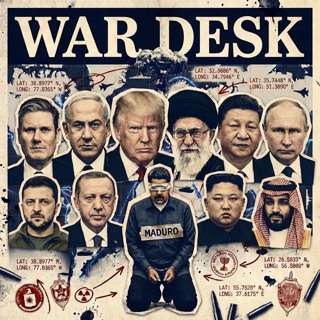
War Desk is an AI-native investigative series built to track the real risk of global war. With thousands of military reports, declassified government testimony, intelligence assessments, and verified conflict data now publicly available, the volume of information exceeds what any traditional newsroom can process. AI can.

This series leverages artificial intelligence at every layer of production. From custom-built architecture that ingests and cross-references thousands of primary source documents, to AI-generated audio that delivers findings in a consistent, accessible format, War Desk represents a new model for geopolitical journalism. What would take a team of defense analysts months to compile, AI can process in days, surfacing patterns, contradictions, and connections across theaters that would otherwise remain buried across separate headlines.


Each episode draws directly from primary sources: Department of Defense force posture statements, IAEA safeguards reports, Congressional testimony, think tank assessments from CSIS, RAND, and ISW, declassified intelligence estimates, and verified conflict databases. The AI architecture identifies relevant findings, cross-references claims across sources, and synthesizes them into episodes that make this information accessible to the public.

The series covers the five active flashpoints that could escalate to major war: the U.S.-Iran confrontation, the Russia-Ukraine war, the Taiwan Strait, the Korean Peninsula, and the global alliance structures that connect them. It examines the military deployments, the nuclear timelines, the economic consequences, and the decisions being made by specific people in specific rooms.


This is not sensationalized content. It is not political commentary. It is documented fact, processed at scale, and presented with journalistic rigor. The goal is simple: give the public the same quality of threat assessment that governments produce internally.

War Desk is politically neutral by design. Every side's claims are sourced and attributed. Adversarial media is labeled. No spin. No speculation. Every source for every episode is published at wardesk.fm so listeners can verify every claim themselves.

New episodes release daily, with AI enabling rapid analysis and production that keeps pace with a fast-moving geopolitical landscape. Journalistic standards guide the output. Every claim is tied to specific documents. The series clearly distinguishes between verified facts, official claims, and unresolved contradictions.


This is documented fact, processed at scale, presented for the public.

Denne podkasten er hentet fra en åpen RSS-feed og er ikke publisert av Podme. Den kan derfor inneholde annonser.

Episoder(167)

Inside the Situation Room: How the President Decides to Strike

Inside the Situation Room: How the President Decides to Strike

The most consequential situation room decisions in modern history involve going to war, and a strike on Iran would be no different. This episode examines the options principals present, the pressures ...

27 Feb 19min

Presidential War Powers: Can the POTUS Bypass Congress?

Presidential War Powers: Can the POTUS Bypass Congress?

Presidential war powers contain enormous loopholes that allow commanders-in-chief to wage war without congressional authorization. From the War Powers Resolution to the 2001 AUMF that has been stretch...

27 Feb 30min

The 2026 Military Draft: Auto-Registration and What It Means for You

The 2026 Military Draft: Auto-Registration and What It Means for You

The 2026 military draft became more real when the U.S. government quietly changed Selective Service registration to automatic enrollment for all males aged 18-26 in December 2024. This episode examine...

27 Feb 23min

Iran Sanctions vs. Military Strikes: What Will Actually Work?

Iran Sanctions vs. Military Strikes: What Will Actually Work?

Forty years of Iran sanctions have failed to stop the Islamic Republic, and a war to destroy its nuclear program may not succeed either. This episode is a comparative analysis of the two primary tools...

27 Feb 31min

How the Ukraine War is Draining the Arsenal Needed for Iran

How the Ukraine War is Draining the Arsenal Needed for Iran

The Ukraine war impact on American military readiness is concrete and measurable. Specific weapons systems, including Javelins, HIMARS, ATACMS, 155mm artillery shells, and Patriot interceptors, have b...

27 Feb 14min

U.S. Military Readiness: Why America Can't Fight Two Wars at Once

U.S. Military Readiness: Why America Can't Fight Two Wars at Once

U.S. military readiness can no longer support two wars at once. The 2018 National Defense Strategy officially abandoned the two-war standard that guided military planning for decades, and the current ...

27 Feb 21min

The U.S. Missile Shortage: Why America Can't Build Weapons Fast Enough

The U.S. Missile Shortage: Why America Can't Build Weapons Fast Enough

If war with Iran lasts longer than a few weeks, the U.S. missile shortage becomes decisive. The defense industrial base bottleneck is severe: production lines take years to expand, sole-source compone...

27 Feb 24min

Grocery Prices in Wartime: The Economic Fallout of Conflict

Grocery Prices in Wartime: The Economic Fallout of Conflict

Grocery prices in wartime spike fast, and a war with Iran would hit American consumers directly through gas prices, food costs, interest rates, and inflation. The cascading effects turn a military con...

27 Feb 30min

Populært innen Politikk og nyheter

giver-og-gjengen-vg
aftenpodden
forklart
stopp-verden
popradet
fotballpodden-2
rss-gukild-johaug
nokon-ma-ga
dine-penger-pengeradet
rss-ness
hanna-de-heldige
e24-podden
det-store-bildet
lydartikler-fra-aftenposten
aftenbla-bla
aftenpodden-usa
frokostshowet-pa-p5
rss-utenrikskomiteen-med-bogen-og-grasvik
oppdatert
grasoner-den-nye-kalde-krigen