War Desk

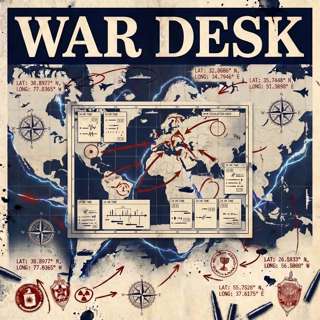
War Desk is an AI-native investigative series built to track the real risk of global war. With thousands of military reports, declassified government testimony, intelligence assessments, and verified conflict data now publicly available, the volume of information exceeds what any traditional newsroom can process. AI can.

This series leverages artificial intelligence at every layer of production. From custom-built architecture that ingests and cross-references thousands of primary source documents, to AI-generated audio that delivers findings in a consistent, accessible format, War Desk represents a new model for geopolitical journalism. What would take a team of defense analysts months to compile, AI can process in days, surfacing patterns, contradictions, and connections across theaters that would otherwise remain buried across separate headlines.


Each episode draws directly from primary sources: Department of Defense force posture statements, IAEA safeguards reports, Congressional testimony, think tank assessments from CSIS, RAND, and ISW, declassified intelligence estimates, and verified conflict databases. The AI architecture identifies relevant findings, cross-references claims across sources, and synthesizes them into episodes that make this information accessible to the public.

The series covers the five active flashpoints that could escalate to major war: the U.S.-Iran confrontation, the Russia-Ukraine war, the Taiwan Strait, the Korean Peninsula, and the global alliance structures that connect them. It examines the military deployments, the nuclear timelines, the economic consequences, and the decisions being made by specific people in specific rooms.


This is not sensationalized content. It is not political commentary. It is documented fact, processed at scale, and presented with journalistic rigor. The goal is simple: give the public the same quality of threat assessment that governments produce internally.

War Desk is politically neutral by design. Every side's claims are sourced and attributed. Adversarial media is labeled. No spin. No speculation. Every source for every episode is published at wardesk.fm so listeners can verify every claim themselves.

New episodes release daily, with AI enabling rapid analysis and production that keeps pace with a fast-moving geopolitical landscape. Journalistic standards guide the output. Every claim is tied to specific documents. The series clearly distinguishes between verified facts, official claims, and unresolved contradictions.


This is documented fact, processed at scale, presented for the public.

Denne podkasten er hentet fra en åpen RSS-feed og er ikke publisert av Podme. Den kan derfor inneholde annonser.

Episoder(167)

Day 55: US Naval Blockade of Iran Continues

Day 55: US Naval Blockade of Iran Continues

The United States maintains a full naval blockade of Iranian ports despite an indefinite ceasefire, a contradiction Iranian leadership has officially categorized as an act of war. This diplomatic para...

23 Apr 29min
Day 54: US Naval Blockade Risks Permanent Iran Oil

Day 54: US Naval Blockade Risks Permanent Iran Oil

The United States maintains a naval blockade of Kharg Island that threatens to permanently damage Iranian oil infrastructure, even as Washington publicly declares an indefinite ceasefire. While diplom...

22 Apr 23min
Day 53: US Blocks Hormuz as Iran Demands Remain Unmet

Day 53: US Blocks Hormuz as Iran Demands Remain Unmet

The United States enforces a 500 million dollar daily naval blockade in the Strait of Hormuz while simultaneously demanding the surrender of nuclear materials the military claims were already destroye...

21 Apr 19min
Day 52: US Navy Seizes MV Tuska and Closes Hormuz

Day 52: US Navy Seizes MV Tuska and Closes Hormuz

The USS Spruance intercepted and boarded the massive container ship MV Tuska in the North Arabian Sea, triggering a total closure of the Strait of Hormuz and sending oil prices surging past 96 dollars...

20 Apr 28min
Day 51: US Navy Blocks Strait of Hormuz

Day 51: US Navy Blocks Strait of Hormuz

The USS Canberra has successfully turned back 23 commercial vessels as the United States enforces a maximum pressure campaign in the Strait of Hormuz. Meanwhile, the regional ceasefire in Lebanon is c...

19 Apr 28min
Day 50: US Navy Blockade and Mines Paralyze Hormuz

Day 50: US Navy Blockade and Mines Paralyze Hormuz

Despite political claims of an open waterway, the Strait of Hormuz remains effectively closed as Iranian sea mines and a US naval blockade interdict commercial shipping. This operational gridlock forc...

18 Apr 28min
Day 49: Iran Controls Strait of Hormuz via Mandatory Corridor

Day 49: Iran Controls Strait of Hormuz via Mandatory Corridor

Financial markets surged after Iran declared the Strait of Hormuz open, but the reality is a strictly managed corridor dictated by the IRGC. While global oil prices plummeted on the news, the diplomat...

17 Apr 28min
Day 48: Iranian Oil Exports Bypass US Naval Blockade

Day 48: Iranian Oil Exports Bypass US Naval Blockade

Windward AI data confirms that Iranian oil exports persist through offshore ship-to-ship transfers, directly contradicting US Central Command claims of a total maritime blockade. Meanwhile, a theologi...

16 Apr 20min

Populært innen Politikk og nyheter

giver-og-gjengen-vg
aftenpodden
forklart
stopp-verden
popradet
fotballpodden-2
rss-gukild-johaug
nokon-ma-ga
dine-penger-pengeradet
rss-ness
hanna-de-heldige
e24-podden
det-store-bildet
lydartikler-fra-aftenposten
aftenbla-bla
aftenpodden-usa
frokostshowet-pa-p5
rss-utenrikskomiteen-med-bogen-og-grasvik
oppdatert
grasoner-den-nye-kalde-krigen