
CHIME’s Cosmic Echo: The First Detection of the 21 cm Auto-Power Spectrum.

CHIME’s Cosmic Echo: The First Detection of the 21 cm Auto-Power Spectrum.

Reference Article: Detection of the Cosmological 21 cm Signal in Auto-correlation at z ∼ 1 with the Canadian Hydrogen Intensity Mapping Experiment, by The CHIME Collaboration.


Summary:

We delve into a groundbreaking astronomical achievement: the **first detection of the cosmological 21 cm intensity mapping signal in auto-correlation at $z \sim 1$** using the Canadian Hydrogen Intensity Mapping Experiment (CHIME). This discovery utilizes 94 nights of observation data, covering a frequency range from 608.2 MHz to 707.8 MHz, corresponding to a mean redshift of approximately $z \sim 1.16$.


The detection was highly significant, measured at **$12.5\sigma$**. This marks a major milestone, as it establishes the 21 cm auto-power spectrum as a direct and potent cosmological probe, eliminating the dependence on external galaxy surveys to study large-scale structure.


Key Discussion Points:

  • The Challenge: Detecting the cosmological 21 cm signal is extremely challenging because astrophysical radio foregrounds are several orders of magnitude brighter.
  • Pipeline Advancements: The success relies on significant improvements to the CHIME data processing pipeline. These advancements include novel RFI (Radio Frequency Interference) detection and masking algorithms, achromatic beamforming techniques, and applying foreground filtering *before* time averaging to minimize spectral leakage. The Hybrid Foreground Residual Subtraction (HyFoReS) algorithm was also deployed to correct residual bandpass errors.
  • Robustness and Validation: The measurement is exceptionally reliable, having been established through a comprehensive suite of validation tests. Key checks demonstrated that the signal is consistent across independent right ascension bins, declination bins, and different baseline configurations, ruling out baseline-dependent, RA-dependent, or declination-dependent systematics. Crucially, the consistency of the signal in Stokes-Q data with noise rules out significant polarized foreground leakage.
  • Consistent Results: The auto-correlation result is statistically consistent with previous cross-correlation measurements performed using the same CHIME data stacked on eBOSS quasars, providing strong evidence against contamination from systematics.
  • Cosmological Implications: The measurement constrains the clustering amplitude of neutral hydrogen (HI). For the full band, the derived amplitude parameter is $A^2_{\text{HI}} = 2.59^{+1.26}_{-0.78}(\text{stat.})^{+2.45}_{-0.47}(\text{sys.})$. Independent detections were also made in two sub-bands (9.2$\sigma$ at $z \sim 1.24$ and 8.7$\sigma$ at $z \sim 1.08$), showing consistency between the different redshift slices.
  • Future Outlook:This detection sets the stage for precision 21 cm cosmology. Future work aims to include the nearly 7 years of archival CHIME data to reduce statistical uncertainties, push measurements to higher redshifts (400–600 MHz band), and develop new techniques to recover linear scales in the power spectrum, potentially enabling measurements of Baryon Acoustic Oscillations (BAOs).


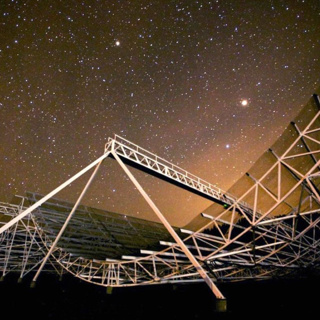
Acknowledements: Podcast prepared with Google/NotebookLM. Illustration credits: CHIME/Andre Recnik

Det här avsnittet är hämtat från ett öppet RSS-flöde och publiceras inte av Podme. Det kan innehålla reklam.

Avsnitt(123)

Supernovae, TDEs, and Scintillation: How ASKAP and Rubin Are Mapping the Variable Universe

Supernovae, TDEs, and Scintillation: How ASKAP and Rubin Are Mapping the Variable Universe

In this episode, we dive into how astronomers are combining the power of the Australian Square Kilometre Array Pathfinder (ASKAP) and the Vera C. Rubin Observatory to capture the dynamic, ever-changin...

16 Okt 20min

JWST and MeerKAT Team Up: Uncovering the Most Distant Fast Radio Burst Yet

JWST and MeerKAT Team Up: Uncovering the Most Distant Fast Radio Burst Yet

Fast Radio Bursts (FRBs) are millisecond-duration radio signals originating from deep space. In this episode, we explore the groundbreaking discovery of FRB 20240304B, detected by the MeerKAT radio te...

12 Okt 20min

GRB 221009A: Measuring Relativistic Jets using Radio Interferometry

GRB 221009A: Measuring Relativistic Jets using Radio Interferometry

In this episode, we explore high-precision Very Long Baseline Interferometry (VLBI) radio observations of GRB 221009A, the brightest gamma-ray burst ever detected. Using the Global-VLBI network at 5 G...

8 Okt 21min

Unveiling GRB 240825A: Cosmic Dust, JWST, and a Supernova in Hiding

Unveiling GRB 240825A: Cosmic Dust, JWST, and a Supernova in Hiding

In this episode, we explore the cosmic mystery of GRB 240825A, a gamma-ray burst detected at redshift z = 0.659. Its short rest-frame duration and hard prompt emission initially pointed toward a compa...

5 Okt 14min

From GeV to EeV: A Data-Driven View of Cosmic Rays

From GeV to EeV: A Data-Driven View of Cosmic Rays

How do high-energy particles traveling across the universe reach Earth, and what are they made of? In this episode, we explore the Global Spline Fit (GSF), a comprehensive framework that unifies cosmi...

2 Okt 24min

From Blazars to Supernovae: Fermi’s Deepest High-Energy Sky Survey

From Blazars to Supernovae: Fermi’s Deepest High-Energy Sky Survey

In this episode, we dive into the release of the Fourth Catalog of Hard Fermi-LAT Sources (4FHL). Utilizing 16 years of continuous data from NASA's Fermi Gamma-ray Space Telescope, this catalog provid...

29 Sep 23min

GRB 220706A: The Longest-Lived Gamma-Ray Burst Engine Ever Seen

GRB 220706A: The Longest-Lived Gamma-Ray Burst Engine Ever Seen

In this episode, we explore the extraordinary discovery of GRB 220706A, a record-shattering cosmic explosion at redshift z = 0.8577. While most gamma-ray burst engines die down within minutes, X-ray f...

24 Sep 19min

Chasing Kilonovae: How LIGO-India Multiplies Multimessenger Discoveries

Chasing Kilonovae: How LIGO-India Multiplies Multimessenger Discoveries

In this episode, we explore the future of multimessenger astronomy as neutron star–black hole (NSBH) mergers take center stage. While binary neutron star collisions have delivered iconic multimessenge...

18 Sep 21min

Populärt inom Vetenskap

p3-dystopia
dumma-manniskor
allt-du-velat-veta
kapitalet-en-podd-om-ekonomi
angestpodden
rss-ai-med-jonas-benjamin
rss-ronden
rss-mottagningen
halsorevolutionen
medicinvetarna
det-morka-psyket
sexet
rss-vetenskapsradion-2
bildningspodden
rss-experimentet
rss-ufobortom-rimligt-tvivel
bildningskomplexet
rss-spraket
ufo-sverige
rss-vetenskapsradion