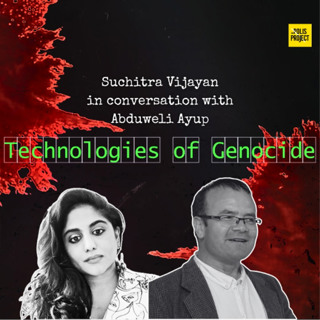

Technologies of Genocide: Suchitra Vijayan in Conversation with Abduweli Ayup

Technologies of Genocide: Suchitra Vijayan in Conversation with Abduweli Ayup

Suchitra Vijayan speaks with Abduweli Ayup, writer, linguist, and one of the most significant chroniclers of the Uyghur genocide. Their conversation traces how China’s “People’s War on Terror” in Xinjiang evolved into an unprecedented system of algorithmic suppression. This model of mass repression uses surveillance, biometric data, and AI-enabled policing function as instruments of erasure. They examine how the technologies of control that dominate Xinjiang today grew out of earlier experiments in Tibet and have since become templates exported around the world. Abduweli situates the Uyghur crisis within a longer history of systematic destruction of community life. He describes how Uyghur language, once the core of identity and imagination, has been deliberately targeted: children forbidden from speaking it at home, parents punished for using it on the phone, and entire generations funnelled into state-run boarding schools designed to sever cultural memory. What distinguishes this genocide, he argues, is not only its scale but its capacity to imprison thought itself. The conversation then turns to the architecture of surveillance that makes this possible. Abduweli explains how the Integrated Joint Operations Platform (a vast data system initially developed using U.S. technologies) links a person’s phone, bank card, ID, health records, and social networks into a single apparatus. This system determines who becomes a suspect. It is this integration, he says, that turns daily life into a site of constant vulnerability. Suchitra and Abduweli also trace how the technologies tested on Tibetans and perfected on Uyghurs now circulate globally. From Zimbabwe to Venezuela to Qatar, Chinese-built “safe city” infrastructures, and facial recognition frameworks have been exported. This creates a supply chain where American microchips, Chinese algorithms, and Gulf capital produce new forms of mass control. The discussion widens into an examination of forced labour transfers and the economic logic that sustains genocide. As visible mass detentions drew international attention, China shifted, under the guise of “poverty alleviation,” to relocating hundreds of thousands of Uyghurs to factories across 18 provinces. This model is more insidious than the camps: it uproots people from their communities, and folds their labour into global supply chains. From seafood processing plants to fashion brands to automobile manufacturing, Uyghur forced labour is the backbone. The episode closes with a meditation on complicity. The Uyghur genocide is made possible by transnational networks of technology firms, investment funds, and consumer markets. Without Silicon Valley’s chips, international capital, and global demand for cheap labour and surveillance tools, the machinery of repression could not function at its current scale. The Uyghur genocide is a final warning. It demands a reckoning with what we buy, what we ignore, and what kind of human future we are willing to defend. — Abduweli Ayup is a Uyghur activist born in Kashgar, China, in 1973. In August 2013, he was detained by Chinese authorities for his efforts to promote Uyghur linguistic rights by opening schools to teach children the Uyghur language. His detention lasted until November 2014. In 2016, Ayup founded the non-profit Uyghur Hjelp to investigate and document the plight of Uyghurs and advocate for their cause. He has continued his efforts to open Uyghur language schools and publish Uyghur language textbooks in the diaspora.

Det här avsnittet är hämtat från ett öppet RSS-flöde och publiceras inte av Podme. Det kan innehålla reklam.

Avsnitt(85)

Technologies Of Genocide X Abdullahi Halakhe

Technologies Of Genocide X Abdullahi Halakhe

Suchitra Vijayan speaks with Abdullahi Boru Halakhe in a conversation that traces the longue durée of exploitation and violence in the Congo from the colonial atrocities of King Leopold II to the reso...

30 Okt 202538min
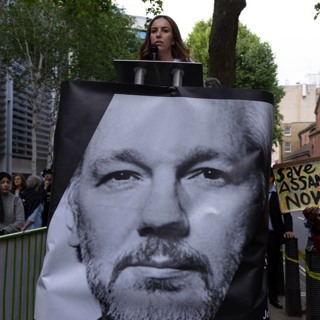
The Trial of Julian Assange: A conversation with Stella Assange

The Trial of Julian Assange: A conversation with Stella Assange

Since 11 April 2019, Julian Assange has been held in the UK’s notorious Belmarsh prison that was once known as Britain’s Guantanamo Bay. This year marks his fourth year inside Belmarsh for revealing t...

18 Sep 20251h 3min
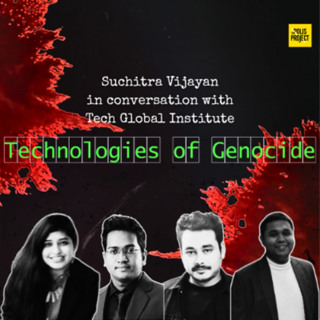
Technologies of Genocide: Suchitra Vijayan in Conversation with Tech Global Institute, Bangladesh

Technologies of Genocide: Suchitra Vijayan in Conversation with Tech Global Institute, Bangladesh

Suchitra Vijayan speaks with Sabhanaz Rashid Diya, Sams Wahid Shahat, Mohammad Arafat and Apon Das of the Tech Global Institute. They unpack the aftermath of Bangladesh’s July 2024 uprising, which end...

16 Sep 202539min

Technologies of Genocide: Suchitra Vijayan in Conversation with 7amleh

Technologies of Genocide: Suchitra Vijayan in Conversation with 7amleh

Suchitra Vijayan speaks with Eric Sype and Jalal Abukhater from 7amleh, The Arab Center for the Advancement of Social Media. They interrogate how Israel’s assault on Palestinians is enabled by global ...

15 Aug 202538min

UK’s racialized immigration policies: Francesca Recchia in conversation with Helidah Ogude Chambert

UK’s racialized immigration policies: Francesca Recchia in conversation with Helidah Ogude Chambert

In this podcast, Francesca Recchia sits down with Helidah Ogude Chambert to discuss the racism and xenophobia inherent in the United Kingdom’s immigration policies, where it stems from and which commu...

15 Sep 202251min

The Genocidal Gaze: A conversation with Elizabeth Baer

The Genocidal Gaze: A conversation with Elizabeth Baer

Suchitra Vijayan in conversation with Elizabeth Baer about her book "The Genocidal Gaze." The first genocide of the twentieth century, though not well known, was committed by Germans between 1904–190...

1 Sep 202229min

Terror Capitalism - A conversation with Darren Byler

Terror Capitalism - A conversation with Darren Byler

Suchitra Vijayan speaks to Darren Byler about his book Terror Capitalism: Uyghur Dispossession and Masculinity in a Chinese City. In Terror Capitalism anthropologist Darren Byler theorizes the conte...

25 Aug 202241min

Populärt inom Samhälle & Kultur

podme-dokumentar
aftonbladet-krim
en-mork-historia
gynning-berg
p3-dokumentar
svenska-fall
creepypodden-med-jack-werner
skaringer-nessvold
hor-har
killradet
kod-katastrof
flashback-forever
aftonbladet-daily
p1-dokumentar
vad-blir-det-for-mord
rss-brottsutredarna
historiska-brott
rss-sanning-konsekvens
mardromsgasten
rysarpodden