Satellite megaconstellations will threaten space-based astronomy

Satellite megaconstellations will threaten space-based astronomy

The rapid expansion of Low Earth Orbit (LEO) satellite megaconstellations is creating a growing threat to space-based astronomy, challenging the long-held perception that space telescopes are immune to light contamination.


If all proposals for new telecommunication satellite launches are fulfilled, projections indicate that Earth could be orbited by **half a million artificial satellites by the end of the 2030s**. Currently, the total number of satellites is only a small fraction (less than 3%) of those planned for the next decade.


This episode delves into a study forecasting the devastating impact of these constellations on vital observatories:


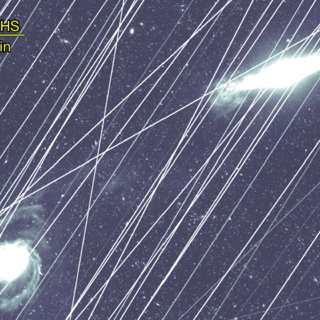
* **Current Impact:** Satellite trails already affect astronomical images across the complete electromagnetic spectrum. A recent study demonstrated that 4.3% of images obtained by the **Hubble Space Telescope** between 2018 and 2021 already contained artificial satellite trails.

* **Future Contamination:** If the planned constellations are completed (approximately 560,000 satellites), light contamination becomes critical for LEO observatories.

* The forecast shows that **more than one-third (39.6% $\pm$ 4.6%) of Hubble Space Telescope images will be contaminated**.

* Newer LEO telescopes, such as the SPHEREx, ARRAKIHS, and Xuntian space telescopes, are predicted to have **more than 96% of their exposures affected**.

* The Xuntian Space Telescope, due to its lower orbit (450 km), will be the most affected, potentially seeing 92 satellite trails per average exposure.

* **Trail Brightness:** Reflections from satellites are extremely bright for professional telescopes. The typical surface brightness of detectable trails is forecasted to range from $\mu = 18$ to $\mu = 23$ mag arcsec⁻². This is orders of magnitude above the detectability limit for these telescopes.


The scientific community is urging action to address this growing threat. Proposed mitigation measures include setting an optimal upper limit for large satellite constellations' orbits, maintaining updated and precise open archives of orbital solutions for active and derelict spacecraft (avoidance), and implementing correction techniques for unwanted light pollution.


***


**Reference to the article discussed:**

Borlaff, A. S., Marcum, P. M. & Howell, S. B. Satellite megaconstellations will threaten space-based astronomy. *Nature*. Published online 3 December 2025.


**DOI:** https://doi.org/10.1038/s41586-025-09759-5


Acknowledements: Podcast prepared with Google/NotebookLM. Illustration credits: Borlaff, A.S., Marcum, P.M. & Howell, S.B., Nature 648, 51–57 (2025)

Det här avsnittet är hämtat från ett öppet RSS-flöde och publiceras inte av Podme. Det kan innehålla reklam.

Avsnitt(112)

Peering Through the Ice: The Milky Way’s High-Energy Neutrino Signal

Peering Through the Ice: The Milky Way’s High-Energy Neutrino Signal

Peering Through the Ice: The Milky Way’s High-Energy Neutrino Signal Episode Summary: In this episode, we explore a major breakthrough in astrophysics: the IceCube Neutrino Observatory has established...

31 Juli 20min

The Schmidt Observatory System unlocking the Transient Universe

The Schmidt Observatory System unlocking the Transient Universe

In this episode, we dive into the Eric and Wendy Schmidt Observatory System, a groundbreaking initiative designed to pioneer a new paradigm for astronomical research through rapid development, modular...

27 Juli 21min

GUANO, NITRATES, and GLIMPSE: The Pipelines Powering Multi-Messenger Astronomy

GUANO, NITRATES, and GLIMPSE: The Pipelines Powering Multi-Messenger Astronomy

In this episode, we dive into the cutting-edge of time-domain and multi-messenger astrophysics with a deep look at BAT-GLIMPSE, a revolutionary new open-source pipeline developed for the Neil Gehrels ...

20 Juli 20min

The Dynamic Radio Sky: Unveiling Transients with the SKAO

The Dynamic Radio Sky: Unveiling Transients with the SKAO

Welcome to a deep dive into the fast-paced, explosive universe of time-domain astronomy! In this episode, we explore how the upcoming Square Kilometre Array Observatory (SKAO) will revolutionize our u...

13 Juli 19min

X-Raying the Earth: Neutrino Tomography at the South Pole

X-Raying the Earth: Neutrino Tomography at the South Pole

Welcome back to the podcast! Today, we are exploring a groundbreaking new way scientists are looking deep inside our planet. For a century, our understanding of the Earth's interior has relied almost ...

8 Juli 23min

SVOM's First Year: From Gamma-Ray Bursts to Blazars

SVOM's First Year: From Gamma-Ray Bursts to Blazars

In this episode, we dive into the exciting early results from the SVOM (Space-based multi-band astronomical Variable Objects Monitor) mission, which launched in June 2024. Originally designed to hunt ...

6 Juli 20min

SN 2024jlc: Bridging the Gap Between Supernova Classes

SN 2024jlc: Bridging the Gap Between Supernova Classes

In this episode, we dive into the fascinating discovery of SN 2024jlc, one of the closest and least luminous super-luminous supernovae (SLSNe) ever found. We explore how this extraordinary event is ch...

3 Juli 20min

Cosmic Accelerators: Unlocking the Secrets of Microquasar GRS 1915+105

Cosmic Accelerators: Unlocking the Secrets of Microquasar GRS 1915+105

In this episode, we dive into the extreme and fascinating world of microquasars—binary systems where a compact object, like a black hole, feeds off a companion star and launches powerful, relativistic...

26 Juni 20min

Populärt inom Vetenskap

p3-dystopia
dumma-manniskor
allt-du-velat-veta
hacka-livet
bildningspodden
rss-vetenskapsradion
medicinvetarna
rss-ufobortom-rimligt-tvivel
sexet
ufo-sverige
rss-vetenskapsradion-2
halsorevolutionen
paranormalt-med-caroline-giertz
svd-nyhetsartiklar
det-morka-psyket
vetenskapsradion
ufo-sverige-2
rss-spraket
dumforklarat
rss-kriminologerna