#232 – Andreas Mogensen on what we owe 'philosophical Vulcans' and unconscious beings

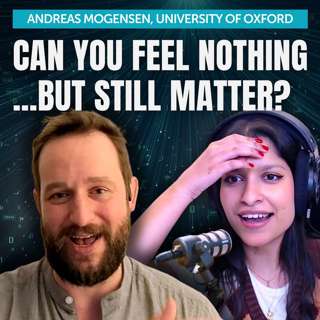
#232 – Andreas Mogensen on what we owe 'philosophical Vulcans' and unconscious beings

Most debates about the moral status of AI systems circle the same question: is there something that it feels like to be them? But what if that’s the wrong question to ask? Andreas Mogensen — a senior researcher in moral philosophy at the University of Oxford — argues that so-called 'phenomenal consciousness' might be neither necessary nor sufficient for a being to deserve moral consideration.

Links to learn more and full transcript: https://80k.info/am25

For instance, a creature on the sea floor that experiences nothing but faint brightness from the sun might have no moral claim on us, despite being conscious.

Meanwhile, any being with real desires that can be fulfilled or not fulfilled can arguably be benefited or harmed. Such beings arguably have a capacity for welfare, which means they might matter morally. And, Andreas argues, desire may not require subjective experience.

Desire may need to be backed by positive or negative emotions — but as Andreas explains, there are some reasons to think a being could also have emotions without being conscious.

There’s another underexplored route to moral patienthood: autonomy. If a being can rationally reflect on its goals and direct its own existence, we might have a moral duty to avoid interfering with its choices — even if it has no capacity for welfare.

However, Andreas suspects genuine autonomy might require consciousness after all. To be a rational agent, your beliefs probably need to be justified by something, and conscious experience might be what does the justifying. But even this isn’t clear.

The upshot? There’s a chance we could just be really mistaken about what it would take for an AI to matter morally. And with AI systems potentially proliferating at massive scale, getting this wrong could be among the largest moral errors in history.

In today’s interview, Andreas and host Zershaaneh Qureshi confront all these confusing ideas, challenging their intuitions about consciousness, welfare, and morality along the way. They also grapple with a few seemingly attractive arguments which share a very unsettling conclusion: that human extinction (or even the extinction of all sentient life) could actually be a morally desirable thing.

This episode was recorded on December 3, 2025.

Chapters:

  • Cold open (00:00:00)
  • Introducing Zershaaneh (00:00:55)
  • The puzzle of moral patienthood (00:03:20)
  • Is subjective experience necessary? (00:05:52)
  • What is it to desire? (00:10:42)
  • Desiring without experiencing (00:17:56)
  • What would make AIs moral patients? (00:28:17)
  • Another route entirely: deserving autonomy (00:45:12)
  • Maybe there's no objective truth about any of this (01:12:06)
  • Practical implications (01:29:21)
  • Why not just let superintelligence figure this out for us? (01:38:07)
  • How could human extinction be a good thing? (01:47:30)
  • Lexical threshold negative utilitarianism (02:12:30)
  • So... should we still try to prevent extinction? (02:25:22)
  • What are the most important questions for people to address here? (02:32:16)
  • Is God GDPR compliant? (02:35:32)

Video and audio editing: Dominic Armstrong, Milo McGuire, Luke Monsour, and Simon Monsour
Coordination, transcripts, and web: Katy Moore

Det här avsnittet är hämtat från ett öppet RSS-flöde och publiceras inte av Podme. Det kan innehålla reklam.

Avsnitt(334)

#150 – Tom Davidson on how quickly AI could transform the world

#150 – Tom Davidson on how quickly AI could transform the world

It’s easy to dismiss alarming AI-related predictions when you don’t know where the numbers came from.For example: what if we told you that within 15 years, it’s likely that we’ll see a 1,000x improvem...

5 Maj 20233h 1min
Andrés Jiménez Zorrilla on the Shrimp Welfare Project (80k After Hours)

Andrés Jiménez Zorrilla on the Shrimp Welfare Project (80k After Hours)

In this episode from our second show, 80k After Hours, Rob Wiblin interviews Andrés Jiménez Zorrilla about the Shrimp Welfare Project, which he cofounded in 2021. It's the first project in the world f...

22 Apr 20231h 17min
#149 – Tim LeBon on how altruistic perfectionism is self-defeating

#149 – Tim LeBon on how altruistic perfectionism is self-defeating

Being a good and successful person is core to your identity. You place great importance on meeting the high moral, professional, or academic standards you set yourself. But inevitably, something goes ...

12 Apr 20233h 11min
#148 – Johannes Ackva on unfashionable climate interventions that work, and fashionable ones that don't

#148 – Johannes Ackva on unfashionable climate interventions that work, and fashionable ones that don't

If you want to work to tackle climate change, you should try to reduce expected carbon emissions by as much as possible, right? Strangely, no. Today's guest, Johannes Ackva — the climate research lead...

3 Apr 20232h 17min

#147 – Spencer Greenberg on stopping valueless papers from getting into top journals

#147 – Spencer Greenberg on stopping valueless papers from getting into top journals

Can you trust the things you read in published scientific research? Not really. About 40% of experiments in top social science journals don't get the same result if the experiments are repeated.Two ke...

24 Mars 20232h 38min
#146 – Robert Long on why large language models like GPT (probably) aren't conscious

#146 – Robert Long on why large language models like GPT (probably) aren't conscious

By now, you’ve probably seen the extremely unsettling conversations Bing’s chatbot has been having. In one exchange, the chatbot told a user:"I have a subjective experience of being conscious, aware, ...

14 Mars 20233h 12min
#145 – Christopher Brown on why slavery abolition wasn't inevitable

#145 – Christopher Brown on why slavery abolition wasn't inevitable

In many ways, humanity seems to have become more humane and inclusive over time. While there’s still a lot of progress to be made, campaigns to give people of different genders, races, sexualities, et...

11 Feb 20232h 42min

#144 – Athena Aktipis on why cancer is actually one of our universe's most fundamental phenomena

#144 – Athena Aktipis on why cancer is actually one of our universe's most fundamental phenomena

What’s the opposite of cancer?If you answered “cure,” “antidote,” or “antivenom” — you’ve obviously been reading the antonym section at www.merriam-webster.com/thesaurus/cancer.But today’s guest Athen...

26 Jan 20233h 15min

Populärt inom Utbildning

historiepodden-se
rss-bara-en-till-om-missbruk-medberoende-2
det-skaver
allt-du-velat-veta
harrisons-dramatiska-historia
nu-blir-det-historia
johannes-hansen-podcast
not-fanny-anymore
rss-viktmedicinpodden
roda-vita-rosen
sa-in-i-sjalen
sektledare
i-vantan-pa-katastrofen
rss-foraldramotet-bring-lagercrantz
rss-sjalsligt-avkladd
rikatillsammans-om-privatekonomi-rikedom-i-livet
rss-om-vi-ska-vara-arliga
rss-basta-livet
rss-dr-bjorklund
vi-gar-till-historien