War and Peace in 2025, with Clarissa Ward and Comfort Ero

War and Peace in 2025, with Clarissa Ward and Comfort Ero

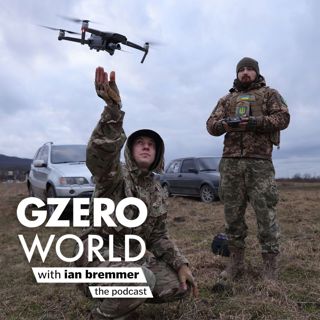
This week, instead of zooming in on a single conflict, the GZERO World Podcast looks back on 2025 and takes stock of a world increasingly defined by conflict. Ian Bremmer sits down with CNN Chief International Correspondent Clarissa Ward and Comfort Ero, President and CEO of the International Crisis Group to look at some of the biggest crises of 2025–-both the headline making wars and the ones the world overlooked.

Gaza and Ukraine captured the world’s attention this year. But at the same time, around 60 other armed conflicts and struggles have been raging around the world. It’s the most active period of conflict since the end of World War II. Some are decades-long battles, like Myanmar’s devastating civil war. Others are more recent, like the surge of terrorist insurgent groups in Africa’s Sahel. But each is a symptom of a broader global order breaking down—driven by weakening institutions, regional rivalries, climate shocks, and failing states. Bremmer sits down first with Clarissa Ward, to discuss her reporting from war zones around the world and then with Comfort Ero, for a global perspective on the conditions that have created so much strife.

Host: Ian Bremmer

Guests: Clarissa Ward, Comfort Ero

Subscribe to the GZERO World with Ian Bremmer Podcast on Apple Podcasts, Spotify, or your preferred podcast platform, to receive new episodes as soon as they're published.


Hosted by Simplecast, an AdsWizz company. See pcm.adswizz.com for information about our collection and use of personal data for advertising.

Avsnitt(415)

Spy games and loyalty tests with Senator Mark Warner

Spy games and loyalty tests with Senator Mark Warner

It’s been a banner stretch for President Trump: a major strike on Iran’s nuclear sites, a sprawling tax-and-spending bill pushed through Congress, and a growing foreign policy resume. But beneath the surface of all the flag-waving and victory laps, Democrats like Senator Mark Warner are warning that the real story is unfolding in the shadows—inside an increasingly politicized US intelligence community.In this episode of the GZERO World podcast, Ian sits down with the senior Senator from Virginia at his Capitol Hill office for a wide-ranging conversation about what’s breaking inside America’s national security institutions—and what that means for foreign policy decisions from Tehran to Gaza. Warner doesn’t hold back: “We’re in uncharted, dangerous territory. [Intelligence] Analysts are being told to change their conclusions—or lose their jobs.”The two also dive into the fallout from the US-Israeli strikes on Iran, the fragile push for a Gaza ceasefire, and why Warner sees a largely ignored civil war in Sudan as one of the world’s worst ongoing humanitarian crises—and a rare opportunity for the US to lead.Host: Ian BremmerGuest: Senator Mark Warner (D-VA) Subscribe to the GZERO World with Ian Bremmer Podcast on Apple Podcasts, Spotify, or your preferred podcast platform, to receive new episodes as soon as they're published. Hosted by Simplecast, an AdsWizz company. See pcm.adswizz.com for information about our collection and use of personal data for advertising.

19 Juli 23min

A new era of space defense

A new era of space defense

For many of us, the idea of a space-based arm of the military calls to mind images from science fiction. But the real-life world of space defense has become increasingly integral to military operations on land, at sea, and in the air. In this episode of Next Giant Leap, hosts Mike Massimino and Mike Greenley explore the world of space military technology. Guests Major General (Ret.) Kim Crider formerly of the United States Space Force, and Brigadier-General Chris Horner of the Canadian Space Division walk us through the many innovations in this fascinating arena, and attempt to answer one crucial question: how do you secure a domain with no borders?Hosts: Mike Massimino, Mike GreenleyGuests: Kim Crider, Chris Horner  Subscribe to the GZERO World with Ian Bremmer Podcast on Apple Podcasts, Spotify, or your preferred podcast platform, to receive new episodes as soon as they're published. Hosted by Simplecast, an AdsWizz company. See pcm.adswizz.com for information about our collection and use of personal data for advertising.

17 Juli 34min

The return of the nuclear threat, with Admiral James Stavridis

The return of the nuclear threat, with Admiral James Stavridis

The world is heading toward a new nuclear arms race—one that’s more chaotic and dangerous than the last. The Cold War built rules of deterrence for a world of dueling superpowers and static arsenals. But in a fragmented, GZERO world of fast-moving technology and unpredictable leadership, the safeguards are fraying. On the GZERO World Podcast, Admiral James Stavridis, former Supreme Allied Commander of NATO, sits down with Ian Bremmer to discuss the growing nuclear threat and what we can do to stop it. The indicators are alarming: China is stockpiling nuclear warheads at record speed. Russia continues to rattle its nuclear saber in Ukraine. Even US allies are privately and publicly questioning whether they need a deterrent of their own. So how serious is the nuclear risk? How do we guarantee security in a world where the weapons (and the rules) are changing? Are we ready for a future where not just missiles, but lines of code, could end civilization? Stavridis and Bremmer assess the current arms race and what it will take to lower the nuclear temperature.“We're already involved in a proxy war with a nuclear power,” Stavridis warns, “We'd be smart to try and continue to have strong alliances to balance China and Russia drawing closer and closer together.”Host: Ian BremmerGuest: Admiral James Stavridis  Subscribe to the GZERO World with Ian Bremmer Podcast on Apple Podcasts, Spotify, or your preferred podcast platform, to receive new episodes as soon as they're published. Hosted by Simplecast, an AdsWizz company. See pcm.adswizz.com for information about our collection and use of personal data for advertising.

12 Juli 27min

The new Sputnik moment

The new Sputnik moment

Over the last decade, the world of space exploration and innovation has exploded. On this episode of Next Giant Leap, season 2 hosts Mike Greenley, CEO of MDA Space, and Mike Massimino, Columbia Engineering professor and former NASA astronaut, take a look at the new space race with former Congresswoman Jane Harman and China expert Dean Cheng. They discuss the role of space in national security, the potential for space-based conflict, and the role of private space companies in this new era.Hosts: Mike Greenley, Mike MassiminoGuests: Jane Harman, Dean Cheng Subscribe to the GZERO World with Ian Bremmer Podcast on Apple Podcasts, Spotify, or your preferred podcast platform, to receive new episodes as soon as they're published. Hosted by Simplecast, an AdsWizz company. See pcm.adswizz.com for information about our collection and use of personal data for advertising.

10 Juli 34min

Season 2 of Next Giant Leap is coming!

Season 2 of Next Giant Leap is coming!

Welcome back to Next Giant Leap! This new podcast series is brought to you by GZERO Media and the Canadian space company MDA Space.Hosted by MDA Space CEO Mike Greenley and former NASA astronaut Mike Massimino, this 4-part series explores how business and innovation are transforming space—and life on Earth. With fascinating conversations on everything from national security to military technology to medical discoveries, we’re talking to leading experts about all of the risks, opportunities, and big questions of the new Space Age. Subscribe to the GZERO World with Ian Bremmer Podcast on Apple Podcasts, Spotify, or your preferred podcast platform, to receive new episodes as soon as they're published. Hosted by Simplecast, an AdsWizz company. See pcm.adswizz.com for information about our collection and use of personal data for advertising.

9 Juli 1min

What's next for Iran, with the New York Times' Thomas L. Friedman

What's next for Iran, with the New York Times' Thomas L. Friedman

Ian Bremmer sits down with New York Times columnist Thomas Friedman to dissect what may go down as the most consequential month in the Middle East in years. Just weeks after Israel launched a war against Iran—and after President Trump authorized US airstrikes—an uneasy ceasefire is in place. But what was actually achieved?Iran, the clear loser of the 12-Day War, entered as the most vulnerable player and emerged weaker still. Tehran stood largely alone, with Hamas degraded, Hezbollah decimated, Syria toppled, and Russia distracted. Yet the Islamic Republic can still claim regime survival, some damage inflicted on Israel, and a murkily intact nuclear program.Netanyahu, meanwhile, avoided a ceasefire until he had secured key gains: he crippled Iran’s infrastructure, leveraged US firepower to hit targets beyond Israel’s reach, and rescued his collapsing political career. As Friedman notes, “The people who won this war for Israel...were, for the most part, the very same people who were in the streets of Israel for nine months against Netanyahu and his judicial coup.” That tension will only grow in the months ahead.For Trump, this marks the biggest foreign policy victory of his second term—at least for now. He struck a blow to Iran’s ambitions, avoided a broader war, and emerged politically unscathed. But what happens next, especially in Gaza, will test the durability of that win.Host: Ian BremmerGuest: Thomas L. Friedman  Subscribe to the GZERO World with Ian Bremmer Podcast on Apple Podcasts, Spotify, or your preferred podcast platform, to receive new episodes as soon as they're published. Hosted by Simplecast, an AdsWizz company. See pcm.adswizz.com for information about our collection and use of personal data for advertising.

3 Juli 25min

Why life sciences are critical to national security

Why life sciences are critical to national security

What if the next virus isn’t natural, but deliberately engineered and used as a weapon? As geopolitical tensions rise and biological threats become more complex, health security and life sciences are emerging as critical pillars of national defense.In the special edition episode from our new series, “The Ripple Effect: Investing in Life Sciences”, host Dan Riskin is joined by two leading voices at the intersection of biotechnology and defense: Dawn Meyerriecks, former CIA Deputy Director for Science and Technology and current member of the National Security Commission on Emerging Biotechnology, and Jason Kelly, co-founder and CEO of Ginkgo Bioworks. Together, they explore the dual-use nature of biotechnology and the urgent need for international oversight, genetic attribution standards, and robust viral surveillance. From pandemic preparedness and fragile supply chains to AI-driven lab automation and airport biosurveillance, their conversation highlights how life science innovation strengthens national resilience and strategic defense.This timely conversation follows the June 25th, 2025 Hague Summit Declaration, where NATO allies pledged to invest 5% of GDP in defense by 2035—including up to 1.5% on resilience and innovation to safeguard critical infrastructure, civil preparedness, networks, and the defense industrial base. This limited series, produced by GZERO’s Blue Circle Studios in partnership with Novartis, examines how life science innovation plays a vital role in fulfilling that commitment. Subscribe to “The Ripple Effect: Investing in Life Sciences” series on your preferred podcast platform.Look for the next episode of the GZERO World with Ian Bremmer podcast when we kick off our eighth season on July 5, 2025.Host: Dan RiskinGuests: Jason Kelly, Dawn Meyerriecks Subscribe to the GZERO World with Ian Bremmer Podcast on Apple Podcasts, Spotify, or your preferred podcast platform, to receive new episodes as soon as they're published. Hosted by Simplecast, an AdsWizz company. See pcm.adswizz.com for information about our collection and use of personal data for advertising.

30 Juni 30min

Where middle class growth and small business meet

Where middle class growth and small business meet

Small businesses are more than just corner shops and local services. They’re a driving force of economic growth, making up 90% of all businesses globally. As the global middle class rapidly expands, new opportunities are emerging for entrepreneurs to launch and grow small businesses. In this special edition podcast episode, the first of GZERO's “Local to global: The power of small business” series, host JJ Ramberg sits down with Shamina Singh, Founder and President of the Mastercard Center for Inclusive Growth, and Homi Kharas, Senior Fellow at Brookings Institution and Co-Founder of the World Data Lab. Together, they explore how the spending power of the global middle class is fueling small business growth from Taipei to Toronto and beyond. The discussion also highlights how digital inclusion, access to finance, and cybersecurity are essential for small business success.For more from this series, subscribe to “Local to global: The power of small business”, a new four-part podcast series from GZERO Media's Blue Circle Studios and Mastercard, where we'll look behind the curtain to explore the world of small businesses and why they’re positioned to play an even bigger role in the future of the global economy. Look for the next episode of the GZERO World with Ian Bremmer podcast when we kick off our eighth season on July 5, 2025.Host: JJ RambergGuests: Homi Kharas, Shamina Singh Subscribe to the GZERO World with Ian Bremmer Podcast on Apple Podcasts, Spotify, or your preferred podcast platform, to receive new episodes as soon as they're published. Hosted by Simplecast, an AdsWizz company. See pcm.adswizz.com for information about our collection and use of personal data for advertising.

27 Juni 27min

Populärt inom Politik & nyheter

aftonbladet-krim
svenska-fall
motiv
p3-krim
flashback-forever
rss-viva-fotboll
fordomspodden
politiken
aftonbladet-daily
rss-sanning-konsekvens
rss-krimstad
rss-vad-fan-hande
spar
olyckan-inifran
rss-krimreportrarna
rss-frandfors-horna
dagens-eko
blenda-2
rss-flodet
rss-expressen-dok