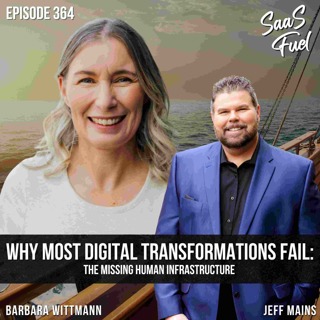
Why Most Digital Transformations Fail: The Missing Human Infrastructure | Barbara Wittmann | 364
SaaS Fuel19 Feb

Why Most Digital Transformations Fail: The Missing Human Infrastructure | Barbara Wittmann | 364

In this episode, Jeff Mains sits down with Barbara Wittmann, a 25-year veteran of IT transformation who has pioneered the concept of "human infrastructure" - the invisible framework of trust, clarity, and collaboration that determines whether technology projects succeed or fail. Barbara shares her journey from mountain biking and logistics to SAP consulting, and how she discovered that most technology failures are actually people problems in disguise.

She introduces her four-pillar model for preventing costly project detours, explains why people development should be a permanent IT budget line item (not a one-time HR initiative), and reveals how AI is raising the bar on what humans need to do best. The conversation explores psychological safety, shared mental models, limiting beliefs, and why wisdom drawn from indigenous cultures can help modern SaaS leaders build more resilient organizations.

Key Takeaways

[4:56] - Technology problems are almost always people problems - software can't fix misalignment, confusion, or teams that weren't brought along for the change

[8:35] - Human infrastructure is the framework where departments work seamlessly together, end-to-end processes are understood, and people have artifacts to help them navigate complexity

[10:14] - Shared mental models are critical - creating a high-level map of systems, data elements, and functions helps everyone align on what changes will impact

[12:20] - People development should be an OPEX line item in IT budgets, not a one-time HR initiative - we upgrade servers continuously but treat people upgrades as "one and done"

[16:15] - Empowering the middle layer of organizations can save about 20% on consulting spend because in-house people already have the knowledge

[20:20] - The four-pillar model: Understand the problem → Condense it → Create a solution → Get people excited about it (most teams skip understanding the problem)

[22:32] - The dual ecosystem approach: Train people in a cross-industry environment where they can practice without fear, then bring learnings back to their organization

[25:53] - Once 25% of your middle layer adopts a new mindset, you see behavioral shifts ripple throughout the entire organization

[29:00] - Indigenous wisdom teaches that everything is connected (ecosystems) and everything works in cycles - nature isn't "on" all the time

[34:27] - Limiting beliefs often sound like "I can't do that, I've never done that before" - when your instant reaction is "no," pause and get curious about why

[37:17] - AI should be seen as a coworker, not a competitor - the key is training our uniquely human aspects: emotional intelligence, sense-making, and asking better questions

[39:38] - First step to building human infrastructure: Create psychological safety where people can voice concerns, and reconnect with your company's core mission and values

Tweetable Quotes

"Most teams learn the hard way: Technology rarely fails because of the tools. It fails because the people aren't aligned to use them." - Barbara Wittmann

"If your company is not really talking to each other as it is, a software is not gonna fix the issue." - Barbara Wittmann

"We are upgrading servers all along, but with people upgrades, we look at it in a very old fashioned way. It's a one and done kind of thing." - Barbara Wittmann

"AI models are evolving at the speed of light, and we are not upgrading our humans. What can go wrong?"- Barbara Wittmann

"Your execution layer cannot delegate complexity anymore because they need to deal with it inevitably." - Barbara Wittmann

"We need to see AI not as a competitor, but as a potential coworker that's being added." - Barbara Wittmann

SaaS Leadership Lessons

1. Invest in Human Infrastructure Like You Invest in Technology Just as you continuously upgrade servers and systems, treat people development as an ongoing operational expense. Make it a permanent line item in your IT budget, not a one-time training event. The human operating system deserves the same attention as your technical infrastructure.

2. Empower Your Middle Layer The middle of your organization holds untapped power. These are the people executing initiatives and making strategy come to life. When you empower them with voice, training, and psychological safety, you can save 20% on consulting costs and get more honest feedback on what's actually possible.

3. Create Shared Mental Models Don't just provide milestone maps - create high-level visual maps that show systems, data elements, and functions. When everyone can point to the same map and understand how changes ripple through the organization, alignment becomes exponential and decision-making accelerates.

4. Understand the Problem Before Jumping to Solutions Most organizations skip the critical first step: truly understanding the problem. Use the four-pillar model - understand, condense, solve, excite. Pause long enough to listen to everyone, synthesize the real issue, then move to solutions. This prevents costly detours.

5. Build Psychological Safety as a Foundation Trust and psychological safety are the bedrock of human infrastructure. Create spaces where people can voice concerns without fear. When your team feels safe to speak truth, you get early warnings about unrealistic timelines, resource gaps, and strategic misalignments.

6. Prepare Humans for the AI Era AI isn't replacing humans - it's raising the bar on what humans need to excel at. Focus on developing uniquely human capabilities: emotional intelligence, complexity sense-making, asking better questions, and connecting dots. Train people to be better "prompt engineers" of both AI tools and human collaboration.

Guest Resources

barbara@digitalwisdom.co

https://www.digitalwisdomcollective.com/

https://www.linkedin.com/in/barbarawittmann/

Episode Sponsor

The Captain's Keys

Small Fish, Big Pond – https://smallfishbigpond.com/ Use the promo code ‘SaaSFuel’

Champion Leadership Group – https://championleadership.com/

SaaS Fuel Resources

Website - https://championleadership.com/

Jeff Mains on LinkedIn - https://www.linkedin.com/in/jeffkmains/

Twitter - https://twitter.com/jeffkmains

Facebook - https://www.facebook.com/thesaasguy/

Instagram - https://instagram.com/jeffkmains

Det här avsnittet är hämtat från ett öppet RSS-flöde och publiceras inte av Podme. Det kan innehålla reklam.

Avsnitt(401)

5 Reasons Your Cold Emails Are Getting Ignored in 2026| Mohan Muthoo | 400

5 Reasons Your Cold Emails Are Getting Ignored in 2026| Mohan Muthoo | 400

This milestone 400th—and final—episode of SaaS Fuel brings clarity to what’s broken with outbound, why most companies blend into the noise, and how founders can actually futureproof their pipeline. Je...

25 Juni 55min

7 Lessons On Scaling A Business Without Burning Out | Robin Sims-Allen | 400

7 Lessons On Scaling A Business Without Burning Out | Robin Sims-Allen | 400

In this episode, Robin Sims Allen—agile consultant, founder of Phoenix Marcus, and creator of Total Her—joins the show for a direct conversation on why speed isn’t always your superpower and how build...

23 Juni 44min

How SaaS Companies Escape the “Messy Middle” of Growth | Corinne Cavanaugh | 398

How SaaS Companies Escape the “Messy Middle” of Growth | Corinne Cavanaugh | 398

Most SaaS founders in the messy middle are making the same expensive mistake — building first and validating never. In this episode, Jeff Mains sits down with Corinne Kavanagh, founder of CAC Media & ...

18 Juni 49min

What Founders Get Wrong About AI, Cybersecurity & Market Shifts | Mike Armistead  | 397

What Founders Get Wrong About AI, Cybersecurity & Market Shifts | Mike Armistead | 397

Mike Armistead has been in the room for almost every major technology wave of the past 30 years — from client-server computing, to the early internet at Lycos, to application security at Fortify Softw...

16 Juni 48min

How Founders Can Use AI Without Creating More Chaos | Jenna Nelson | 396

How Founders Can Use AI Without Creating More Chaos | Jenna Nelson | 396

Most founders are on one of two extremes when it comes to AI: either completely overwhelmed and frozen, or trying to bolt AI onto everything at once. Neither works. In this episode, Jeff Mains sits do...

11 Juni 47min

Why the Best Financial Advisors Focus on Trust, Timing & Data | Rylan Folts | 395

Why the Best Financial Advisors Focus on Trust, Timing & Data | Rylan Folts | 395

Rylan Foltz went from JP Morgan analyst to independent wealth advisor to co-founding WealthFeed — a marketing and prospecting platform helping financial advisors find better clients faster using predi...

9 Juni 47min

How Modern Companies Scale Through Operational Automation | Garrett Fritz | 394

How Modern Companies Scale Through Operational Automation | Garrett Fritz | 394

Most growing companies are held together by spreadsheets that nobody fully understands — built by someone who left three jobs ago, maintained by someone who doesn't know why it exists, and quietly cri...

4 Juni 46min

The Hyperscaler Playbook: Co-Selling, AI & Ecosystem Growth | Chaitra Vedullapalli | 393

The Hyperscaler Playbook: Co-Selling, AI & Ecosystem Growth | Chaitra Vedullapalli | 393

What does it actually take to partner with Microsoft, Google, or Amazon — and turn that relationship into real revenue? In this episode, Jeff Mains sits down with Chaitra Vedullapalli, co-founder of W...

2 Juni 46min

Populärt inom Business & ekonomi

badfluence
framgangspodden
varvet
uppgang-och-fall
rss-borsens-finest
svd-tech-brief
avanzapodden
bathina-en-podcast
rss-dagen-med-di
24fragor
lastbilspodden
fill-or-kill
kapitalet-en-podd-om-ekonomi
borsmorgon
rss-den-nya-ekonomin
rss-inga-dumma-fragor-om-pengar
tabberaset
rikatillsammans-om-privatekonomi-rikedom-i-livet
dynastin
affarsvarlden