Catastrophe Apathy: Why understanding the climate crisis isn’t enough

Catastrophe Apathy: Why understanding the climate crisis isn’t enough

Climate concern is not the problem. Most people have it. What's missing is everything that turns concern into action - and understanding that gap turns out to be a lot more complicated than it looks.

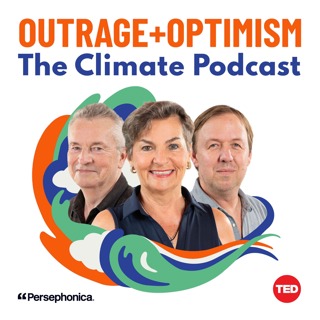
This week, Christiana Figueres, Tom Rivett-Carnac and Paul Dickinson sit down with Lorraine Whitmarsh, Professor of Environmental Psychology and Director of the Centre for Climate Change and Social Transformations at the University of Bath.

Together they dig into the psychology behind catastrophe apathy: why understanding an existential threat doesn't always lead to action, and what the research says actually moves people.

Lorraine shares real-world evidence - including renewable energy tariffs that shifted 90% of customers onto green power simply by making it the default - and explains why trusted everyday messengers, from hairdressers to taxi drivers, employers to community figures, often have more influence than expert voices in reshaping what feels normal.

The conversation also revisits an uncomfortable history: how the personal carbon footprint, popularised by BP in the early 2000s, reframed climate responsibility around individual choices rather than systemic change. A framing so powerful that even environmental organisations adopted it. Who benefited most from that shift is a question the movement is still grappling with.


If systemic change requires public consent, and public consent requires political will, and political will requires behaviour change - how do you break the climate Catch-22?


With thanks to the University of Bath.


Learn More:

🧠 Explore Lorraine Whitmarsh's research at the Centre for Climate Change and Social Transformations, University of Bath

🔌 Read about the Swiss renewable energy default study — the experiment that moved 90% of customers to green energy by changing a default setting

🗳️ Learn more about citizens' assemblies on climate and deliberative democracy in practice

🌍 Read the IPCC's work on demand-side solutions and behavioural change in its Sixth Assessment Report


🎤 Leave us your voice notes and questions for upcoming episodes on SpeakPipe


Join the conversation:

Instagram @outrageoptimism LinkedIn @outrageoptimism

Or get in touch with us via this form.


Producer: Ben Weaver-Hincks

Edited by Miles Martignoni

Planning: Caitlin Hanrahan

Exec Producer: Ellie Clifford


This is a Persephonica production for Global Optimism and is part of the Acast Creator Network.


Hosted on Acast. See acast.com/privacy for more information.

Det här avsnittet är hämtat från ett öppet RSS-flöde och publiceras inte av Podme. Det kan innehålla reklam.

Avsnitt(394)

Can the rules keep up?: Lawsuits, LLMs and the looming oil recession

Can the rules keep up?: Lawsuits, LLMs and the looming oil recession

An unprecedented government move to outrun the courts. A country racing to write AI into its constitution. And a global energy crisis that's already moved faster than any possible fix. Are our institu...

21 Maj 46min

The Jet Fuel Crisis: What’s next for aviation?

The Jet Fuel Crisis: What’s next for aviation?

Are flights across the world about to be grounded? Is a terrible war about to create an unlikely good news story for the climate? As conflict in the Middle East threatens the Strait of Hormuz, jet fue...

14 Maj 50min

David Attenborough at 100

David Attenborough at 100

Monarch butterflies crossing a continent. Peregrine falcons above Manhattan. A giant lemur most of the world had never heard of, until one man pointed a camera at it. For seventy years, Sir David Atte...

7 Maj 40min

“This is civilisation changing stuff”: Is AMOC the hardest climate story to tell?

“This is civilisation changing stuff”: Is AMOC the hardest climate story to tell?

Europe plunged into a deep freeze. Life as we know it upended. The 2004 film ‘The Day After Tomorrow’ gave a generation of terrified journalists an impossible task: how do you communicate the counter ...

30 Apr 45min

Beyond the Oil Crisis: What’s actually blocking the transition?

Beyond the Oil Crisis: What’s actually blocking the transition?

The Iran crisis continues to prove how dangerously dependent the global economy is on fossil fuels. But what will it actually take to move beyond them?In this episode, Christiana Figueres, Tom Rivett-...

23 Apr 43min

It’s In Our Blood: Communities vs Forever Chemicals

It’s In Our Blood: Communities vs Forever Chemicals

There are chemicals in your blood that weren't there fifty years ago. They are in the products you use, the water you drink, the food you eat - and for years, almost nobody was told the full truth abo...

16 Apr 42min

The Health Emergency Hiding in Rising Seas

The Health Emergency Hiding in Rising Seas

Sea-level rise is often spoken about in centimetres, forecasts and future scenarios. But what if we understood it as a health emergency that is already reshaping lives, harming bodies and minds, and d...

9 Apr 42min

Forecasting Disaster: A ‘super’ El Niño? And the case for early action

Forecasting Disaster: A ‘super’ El Niño? And the case for early action

As headlines warn of a possible ‘super El Niño’ later this year, we ask: how do we respond to a warning before it becomes a catastrophe? The last major El Niño brought record heat, crop failures, floo...

2 Apr 36min

Populärt inom Politik & nyheter

svenska-fall
motiv
aftonbladet-krim
p3-krim
aftonbladet-daily
politiken
flashback-forever
rss-sanning-konsekvens
rss-krimreportrarna
rss-krimstad
rss-flodet
spar
rss-frandfors-horna
rss-vad-fan-hande
krimmagasinet
blenda-2
spotlight
rss-expressen-dok
sydsvenskan-dok
olyckan-inifran