378E-414-Enormous Visitor

378E-414-Enormous Visitor

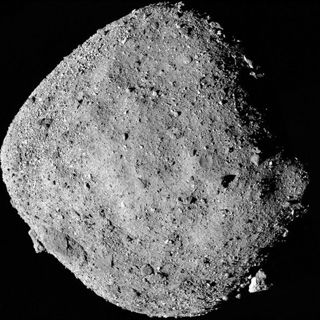
Without additional data, the true nature of the rapidly northward moving point of light my Catalina Sky Survey teammate Carson Fuls had just discovered would have remained a mystery. Fortunately, this new object was tracked by telescopes in both Arizona and New Mexico. These data were used to calculate it's orbit around the Sun, estimate it's size, and give it the name 2017 UX5. When Carson first spotted this enormous 1,200 foot diameter space rock it was more than 30 million miles away traveling in our direction at 10.7 mi/s. It's orbit and that of the Earth's nearly intersect and at the closest point they are about two and one half times the Moon's distance from us apart. An asteroid the size of 2017 UX5 impacts the Earth every 76,000 years or so. According to the impact calculator developed at Purdue University and the Imperial College of London if 2017 UK5 is made of porous rock and came in at an angle of 45 degrees, it would start to break into pieces at an altitude of 41 miles and upon reaching the surface would create a crater 2.2 miles in diameter and 5/8 of a mile deep in sedimentary rock. The results 20 miles away from impact would be that of a 6.4 Richter Scale magnitude Earth quake followed by 176 mph air wind blast which would blow down 90% of the trees and collapse wood frame buildings. Fortunately asteroid hunters have not discovered any object like Carson's discovery with our number on it.

Det här avsnittet är hämtat från ett öppet RSS-flöde och publiceras inte av Podme. Det kan innehålla reklam.

Avsnitt(1000)

912-Boston Bolide

912-Boston Bolide

Recently on a Saturday afternoon a loud double booming sound startled residents of Massachusetts and Rhode Island as a large bolide meteor exploded high above.  This type of space rock is a message fr...

14 Aug 2min
401E-442-Brian's Debut

401E-442-Brian's Debut

During the only 3 clears hours of his first night solo as an asteroid hunter, my new Catalina Sky Survey teammate Brian Africano discovered two new Earth approaching asteroids with our Schmidt Telesco...

11 Aug 2min
911-Comet Brightness Explosion

911-Comet Brightness Explosion

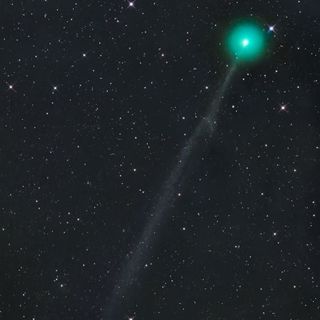
Comet 220P/McNaught orbits the Sun once every 5.5 years on a path which is between Mars and Jupiter. At that extreme distance, more than 1.5 times the Earth’s distance from the Sun, it still receives ...

7 Aug 2min
400E-441-Carson's Pair

400E-441-Carson's Pair

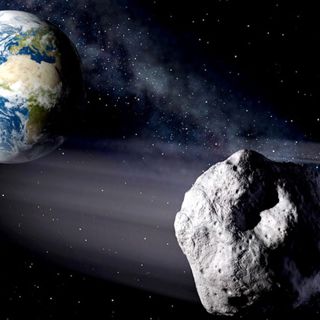
My Catalina Sky Survey teammate Carson Fuls was observing, in the constellation Lynx, with our Schmidt telescope on Mt. Bigelow, Arizona , when within the space of only 35 minutes, he discovered two s...

4 Aug 2min
910-Mega Constellations

910-Mega Constellations

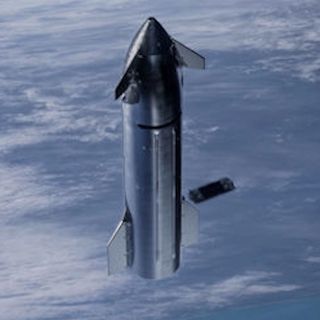
In an experiment that will involve all of the residents of planet Earth SpaceX has asked the FCC for permission to launch 1 million satellites into low Earth orbit to create a solar powered data cente...

31 Juli 2min
399E-440-Tracking Elon's Car

399E-440-Tracking Elon's Car

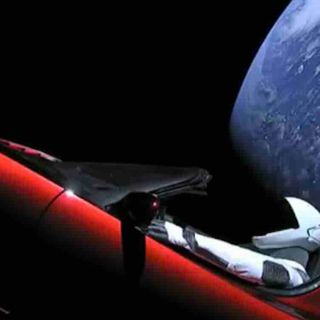
Elon Musk decided not to use a traditional mundane concrete block dummy payload for the first launch of the SpaceX Falcon Heavy launch vehicle to test his rockets lifting capabilities. After orbiting ...

28 Juli 2min
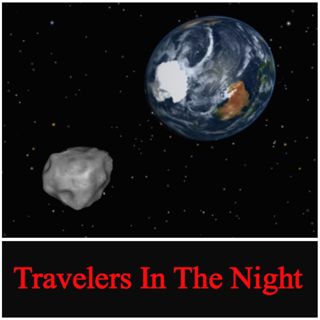
909- 2026 JH2

909- 2026 JH2

My Catalina Sky Survey teammates  Josh Hogan and Alessandra Serrano were asteroid hunting in the constellation of Ursa Major when they discovered a fast moving point of light in the night sky. My team...

24 Juli 2min
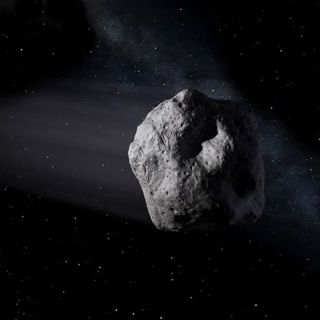
398E-439-Big and Close

398E-439-Big and Close

Using our Schmidt telescope on Mt. Bigelow, Arizona, my Catalina Sky Survey teammate Richard Kowalski was searching for Earth approaching asteroids in the constellation of Virgo when he discovered a m...

21 Juli 2min

Populärt inom Vetenskap

p3-dystopia
dumma-manniskor
allt-du-velat-veta
hacka-livet
ufo-sverige
bildningspodden
rss-vetenskapsradion
medicinvetarna
rss-ufobortom-rimligt-tvivel
det-morka-psyket
sexet
halsorevolutionen
rss-kriminologerna
rss-vetenskapsradion-2
ufo-sverige-2
svd-nyhetsartiklar
dumforklarat
paranormalt-med-caroline-giertz
doden-hjarnan-kemisten
vetenskapsradion