How Scales and Sympathetic Strings Teach the Ear to Play | The Continuum Approach to Music

 How Scales and Sympathetic Strings Teach the Ear to Play | The Continuum Approach to Music

How Scales and Sympathetic Strings Teach the Ear to Play.

Before we talk about scales, we should talk about listening. Most people are introduced to scales as ladders — up, down, repeat — something to conquer with the fingers. But the original purpose of a scale was never speed or accuracy. It was orientation. A way of placing the body inside a sound world and letting the ear learn where it belongs. When you play slowly inside a scale — especially one built around open strings — something subtle happens. The instrument begins to answer you. Certain notes bloom. Others resist. Some feel inevitable, while others feel like questions. This isn’t theory. It’s acoustics teaching the ear. Sympathetic strings make this process impossible to ignore. Unlike stopped strings, sympathetic strings do not respond to effort or intention. They only respond to truth. When a pitch aligns clearly enough with the harmonic field of the instrument, the sympathetic strings vibrate. When it doesn’t, they remain still. In this way, they act like a mirror for the ear — not judging, not correcting, simply responding. This is why sympathetic systems are so powerful for ear-led playing. They remove the idea of “right notes” and replace it with felt resonance. You don’t choose the pitch because it’s correct; you choose it because the instrument opens. Scales, in this context, are no longer exercises. They become listening paths. A scale like D major works so well on bowed instruments not because of tradition, but because of physics. Open strings align. Overtones reinforce one another. The body of the instrument resonates freely. When sympathetic strings are tuned to the same tonal centre, they amplify this effect, turning even a single bowed note into a small harmonic environment. This teaches the ear in three ways at once:
  • You hear the note you are playing
  • You hear the instrument responding
  • You feel the vibration in the body
That triangulation is ear training of the deepest kind. Why “Beating” Happens — and Why It’s Useful When two strings are close in pitch but not aligned, you hear a gentle pulsing or wavering in the sound. This is called beating. It happens because the sound waves from each string are slightly out of sync, interfering with one another. Beating isn’t a mistake — it’s information. When the pulses are slow and wide, the notes are far apart.
When the pulses speed up, the notes are getting closer.
When the beating disappears, the pitches have aligned. This is one of the most reliable ways the ear learns intonation. You’re not measuring; you’re listening for calm. The ear recognises alignment as a kind of settling — a moment when the sound stops arguing with itself. Sympathetic strings make beating especially obvious. If a note is slightly off, the sympathetic strings will shimmer unevenly or fall silent altogether. As you adjust the pitch, you’ll hear the beating slow, soften, and finally dissolve into a stable ring. That moment of stillness is the instrument saying: yes. Over time, the ear begins to anticipate this. You start to aim for resonance rather than correction. Intonation becomes something you arrive at, not something you fix. Guided Listening Practice (5–7 minutes) You can do this on any instrument with open strings. Instruments with sympathetic strings make it clearer, but the principle is universal.
  1. Choose a tonal centre
    Pick one open string — D works beautifully — and let it ring. Bow or play it slowly. Don’t add anything yet.
  2. Listen for the room
    Notice how the sound fills the space. Don’t analyse. Just let the note exist until it feels complete.
  3. Introduce a second pitch slowly
    Add another note from the scale — perhaps A or F♯ — very gently. Hold it. Do not adjust immediately.
  4. Notice the beating
    Listen for pulsing, wobbling, or shimmer. Don’t judge it. This is the sound giving you information.
  5. Micro-adjust until the sound settles
    Without looking, adjust the pitch slowly. As the beating slows and disappears, notice the moment the instrument opens and the sound becomes calm.
  6. Return to the tonic
    Go back to the open string. Notice how it now feels more familiar, more anchored.
  7. End in stillness
    Stop playing and let the sound fade completely before moving on.
This practice isn’t about perfection. It’s about trusting the ear to recognise belonging. Beyond a Single Instrument At this point, the specific instrument matters less than the behaviour it encourages. Any instrument that offers:
  • a stable tonal centre
  • ringing or open strings
  • and sympathetic response
can support ear-led learning. Some musicians encounter this through historical bowed instruments with sympathetic strings. Others through drone instruments, altered tunings, or hybrid setups. Across cultures and centuries, different traditions have arrived at the same understanding: resonance teaches faster than instruction. In the Continuum approach, we don’t chase accuracy. We cultivate sensitivity. Scales are not drills; they are environments. Sympathetic strings are not decorations; they are teachers. Scales show us the landscape.
Beating shows us when we’re lost.
Resonance tells us when we’ve arrived. And in that listening, the ear learns not how to perform — but how to belong.

iServalan™
Music, listening, and the Continuum Approach: Exploring sound across genres, eras, and performance cultures — from Baroque to punk, hip-hop to minimalism — without hierarchy or haste.

🎧 Podcast & essays: 🎻 Music School
https://iservalan.gumroad.com/l/concervatoire?
https://iservalan.gumroad.com📚 Books & long-form work by Sarnia de la Maré FRSA:
https://www.amazon.co.uk/stores/author/B0CWGX2DJ6🎨 Professional profile:
https://www.a-n.co.uk/person/sarnia-de-la-mare-frsa-2/

#iServalan #ContinuumApproach #MusicPodcast #RadicalListening #MusicAcrossGenres
#PerformanceCulture #SarniaDeLaMaré

Avsnitt(252)

Oh Me Oh Life by Walt Whitman Lyrics Songs Live Readings in the Public Domain | Continuum Approach

Oh Me Oh Life by Walt Whitman Lyrics Songs Live Readings in the Public Domain | Continuum Approach

https://iservalan.gumroad.com/l/concervatoire?iServalan™Music, listening, and the Continuum Approach: Exploring sound across genres, eras, and performance cultures — from Baroque to punk, hip-hop to m...

5 Jan 1min

Acquainted With the Night by R Frost Live Reading Open Mic Songs and Lyrics in the Public Domain

Acquainted With the Night by R Frost Live Reading Open Mic Songs and Lyrics in the Public Domain

https://iservalan.gumroad.com/l/concervatoireiServalan™Music, listening, and the Continuum Approach: Exploring sound across genres, eras, and performance cultures — from Baroque to punk, hip-hop to mi...

5 Jan 1min

 Image Scores: Where Improvisation Meets Composition | iServalan | Continuum Approach

 Image Scores: Where Improvisation Meets Composition | iServalan | Continuum Approach

Image Scores: Where Improvisation Meets CompositionImage scores occupy a rare and valuable space in music-making. They sit between improvisation and composition, allowing each to inform the other with...

5 Jan 5min
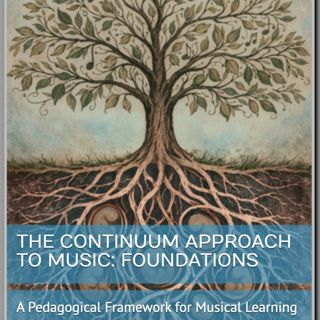
Why Visual Music Scores Might Be a Good Fit For Autistic Music Students | Continuum Approach

Why Visual Music Scores Might Be a Good Fit For Autistic Music Students | Continuum Approach

From the new Book The Continuum Approach to Music: Building: A Pedagogical Framework for Musical Learning (The Continuum Music Framework™ Part 2) Playing the Line, without reading  note.When we remove...

5 Jan 7min

A Certain Lady D. Parker Public Domain Lyrics Poetry Song Writing | Continuum Approach | iServalan

A Certain Lady D. Parker Public Domain Lyrics Poetry Song Writing | Continuum Approach | iServalan

Words add a new dimension to music, but for some musicians, the words are difficult to render. I want to talk for a moment about writing songs before we know what they are. Not demos or tracks.Not fin...

4 Jan 1min

Writing Songs Spoken Word Poetry and Prose Continuum Approach Pedagogy with iServalan™

Writing Songs Spoken Word Poetry and Prose Continuum Approach Pedagogy with iServalan™

Today iServalan begins the Continuum lyrical sketchbook of 2026iServalan™Music, listening, and the Continuum Approach: Exploring sound across genres, eras, and performance cultures — from Baroque to p...

4 Jan 4min

Copyright Tips for Scores and Live Performances and creating the Bach Cello Suites for Viola Bass and Piano with iServalan™

Copyright Tips for Scores and Live Performances and creating the Bach Cello Suites for Viola Bass and Piano with iServalan™

iServalan™Music, listening, and the Continuum Approach: Exploring sound across genres, eras, and performance cultures — from Baroque to punk, hip-hop to minimalism — without hierarchy or haste.🎧 Podc...

3 Jan 12min

Fold Up Glarry Piano Review by iServalan™ What is the music school verdict?

Fold Up Glarry Piano Review by iServalan™ What is the music school verdict?

Join the school on Patreon or GumroadiServalan™Music, listening, and the Continuum Approach: Exploring sound across genres, eras, and performance cultures — from Baroque to punk, hip-hop to minimalism...

1 Jan 14min

Populärt inom Utbildning

historiepodden-se
rss-bara-en-till-om-missbruk-medberoende-2
det-skaver
alska-oss
harrisons-dramatiska-historia
nu-blir-det-historia
not-fanny-anymore
johannes-hansen-podcast
rss-viktmedicinpodden
sektledare
allt-du-velat-veta
rss-foraldramotet-bring-lagercrantz
roda-vita-rosen
sa-in-i-sjalen
i-vantan-pa-katastrofen
rss-sjalsligt-avkladd
rss-max-tant-med-max-villman
rss-pa-insidan-med-bjorn-rudman
rss-basta-livet
sex-pa-riktigt-med-marika-smith