
TROVE: Decoding the Subsolar Gravitational Wave Event S251112cm

TROVE: Decoding the Subsolar Gravitational Wave Event S251112cm

In this episode, we dive into a cosmic mystery that has astronomers buzzing: the detection of the gravitational wave event S251112cm. Detected in November 2025, this event is groundbreaking because it has a 100% probability of containing a compact object with a subsolar mass—an object lighter than our own Sun. Standard stellar evolution models tell us that neutron stars and black holes shouldn't be this light, as modern supernova simulations do not yield remnant objects lighter than roughly 1.17 solar masses. So, what exactly collided out there in the dark?


We explore the massive, multi-telescope campaign launched by the astronomical community to find the electromagnetic "flash" of this merger. Along the way, we discuss the wild theoretical phenomena that might produce such a signal, such as primordial black holes merging within the accretion disks of active galactic nuclei (AGN), massive "super-kilonovae," or "kilonovae-within-supernovae" born from the fragmented disks of collapsing massive stars. Finally, we learn how scientists are using a new framework called TROVE (Multimessenger Tool for Rapid Object Vetting and Examination) to sift through hundreds of transient candidates to separate the true cosmic counterparts from the false alarms.


Key Takeaways:

  • The Anomaly of S251112cm: Why a subsolar mass (SSM) merger challenges our current understanding of physics, and how it opens the door to theories involving primordial black holes.
  • The Electromagnetic Zoo: A breakdown of the exotic, theorized transients that could accompany an SSM merger, including standard kilonovae, kilonovae embedded within stripped-envelope supernovae, super-kilonovae, and bright flares in AGN disks.
  • The Search Effort: How a global network of telescopes (including the Vera C. Rubin Observatory, Swift-XRT, and others) vetted 248 optical and X-ray candidates, and why ultimately none of them were confidently linked to S251112cm.
  • Introducing TROVE: How the Multimessenger Tool for Rapid Object Vetting and Examination ranks candidates using location, distance, and photometry to help astronomers efficiently allocate their limited telescope time during future gravitational wave events.


Episode Reference:

Vieira, N., Franz, N., Subrayan, B., Kilpatrick, C. D., Sand, D. J., Fong, W., et al. (2026). Search For a Counterpart to the Subsolar Mass Gravitational Wave Candidate S251112cm. Draft version March 19, 2026.


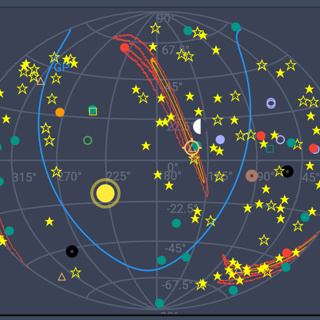
Acknowledements: Podcast prepared with Google/NotebookLM. Illustration credits: Astro-COLIBRI

Det här avsnittet är hämtat från ett öppet RSS-flöde och publiceras inte av Podme. Det kan innehålla reklam.

Avsnitt(123)

Supernovae, TDEs, and Scintillation: How ASKAP and Rubin Are Mapping the Variable Universe

Supernovae, TDEs, and Scintillation: How ASKAP and Rubin Are Mapping the Variable Universe

In this episode, we dive into how astronomers are combining the power of the Australian Square Kilometre Array Pathfinder (ASKAP) and the Vera C. Rubin Observatory to capture the dynamic, ever-changin...

16 Okt 20min

JWST and MeerKAT Team Up: Uncovering the Most Distant Fast Radio Burst Yet

JWST and MeerKAT Team Up: Uncovering the Most Distant Fast Radio Burst Yet

Fast Radio Bursts (FRBs) are millisecond-duration radio signals originating from deep space. In this episode, we explore the groundbreaking discovery of FRB 20240304B, detected by the MeerKAT radio te...

12 Okt 20min

GRB 221009A: Measuring Relativistic Jets using Radio Interferometry

GRB 221009A: Measuring Relativistic Jets using Radio Interferometry

In this episode, we explore high-precision Very Long Baseline Interferometry (VLBI) radio observations of GRB 221009A, the brightest gamma-ray burst ever detected. Using the Global-VLBI network at 5 G...

8 Okt 21min

Unveiling GRB 240825A: Cosmic Dust, JWST, and a Supernova in Hiding

Unveiling GRB 240825A: Cosmic Dust, JWST, and a Supernova in Hiding

In this episode, we explore the cosmic mystery of GRB 240825A, a gamma-ray burst detected at redshift z = 0.659. Its short rest-frame duration and hard prompt emission initially pointed toward a compa...

5 Okt 14min

From GeV to EeV: A Data-Driven View of Cosmic Rays

From GeV to EeV: A Data-Driven View of Cosmic Rays

How do high-energy particles traveling across the universe reach Earth, and what are they made of? In this episode, we explore the Global Spline Fit (GSF), a comprehensive framework that unifies cosmi...

2 Okt 24min

From Blazars to Supernovae: Fermi’s Deepest High-Energy Sky Survey

From Blazars to Supernovae: Fermi’s Deepest High-Energy Sky Survey

In this episode, we dive into the release of the Fourth Catalog of Hard Fermi-LAT Sources (4FHL). Utilizing 16 years of continuous data from NASA's Fermi Gamma-ray Space Telescope, this catalog provid...

29 Sep 23min

GRB 220706A: The Longest-Lived Gamma-Ray Burst Engine Ever Seen

GRB 220706A: The Longest-Lived Gamma-Ray Burst Engine Ever Seen

In this episode, we explore the extraordinary discovery of GRB 220706A, a record-shattering cosmic explosion at redshift z = 0.8577. While most gamma-ray burst engines die down within minutes, X-ray f...

24 Sep 19min

Chasing Kilonovae: How LIGO-India Multiplies Multimessenger Discoveries

Chasing Kilonovae: How LIGO-India Multiplies Multimessenger Discoveries

In this episode, we explore the future of multimessenger astronomy as neutron star–black hole (NSBH) mergers take center stage. While binary neutron star collisions have delivered iconic multimessenge...

18 Sep 21min
Populärt inom Vetenskap

p3-dystopia
dumma-manniskor
allt-du-velat-veta
kapitalet-en-podd-om-ekonomi
angestpodden
rss-ai-med-jonas-benjamin
rss-ronden
rss-mottagningen
halsorevolutionen
medicinvetarna
det-morka-psyket
sexet
rss-vetenskapsradion-2
bildningspodden
rss-experimentet
rss-ufobortom-rimligt-tvivel
bildningskomplexet
rss-spraket
ufo-sverige
rss-vetenskapsradion