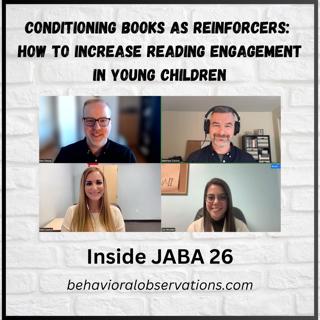
Conditioning Books as Reinforcers: How to Increase Reading Engagement in Young Children: Inside JABA 26

Conditioning Books as Reinforcers: How to Increase Reading Engagement in Young Children: Inside JABA 26

Episode Summary

In this episode, I'm joined by Dr. Daniel Fienup, Dr. Kate Loomis, and Lilian Morales to discuss their recent paper in JABA, Turning the Page: Increasing children's preference for looking at and engaging with books.

In this episode, we explore how books can function as powerful reinforcers for young children, especially in early learning and ABA contexts. We discuss how to identify when books are actually reinforcing, how to condition books as reinforcers if they're not already, and practical strategies for incorporating them into teaching and behavior support.

Key Topics Covered 1. What Makes Something a Reinforcer?
  • Reinforcers are defined by their effect on behavior—not by intention

  • A book is only a reinforcer if it increases the likelihood of a behavior

  • Preference ≠ reinforcement (must test it)

2. Are Books Naturally Reinforcing?
  • For some children: yes (especially those with strong interest in stories, visuals, or routines)

  • For others: books may be neutral or even aversive

  • Depends on learning history and prior pairing

3. Conditioning Books as Reinforcers
  • Pair books with already-established reinforcers (e.g., attention, snacks, praise)

  • Make reading interactive and engaging (voices, movement, pointing, questions)

  • Start with short durations and build up tolerance/enjoyment

  • Follow the child's lead (let them turn pages, choose books, etc.)

4. Embedding Books into Teaching
  • Use books as part of discrete trial or natural environment teaching

  • Reinforce responses with brief access to a favorite book

  • Incorporate targets into reading (labeling, WH questions, listener responding)

  • Use repeated readings to build fluency and predictability

5. Expanding Reinforcer Repertoires
  • Why it matters: reduces reliance on edibles or screens

  • Books are portable, social, and developmentally beneficial

  • Helps build early literacy and joint attention skills

6. Common Mistakes
  • Assuming all kids like books

  • Using books too long as a reinforcer (loses value)

  • Not rotating or updating book options

  • Ignoring signs of disengagement

7. Practical Tips
  • Keep a small "high-value" book rotation

  • Use novelty strategically

  • Observe what aspects the child enjoys (pictures, repetition, sensory elements)

  • Track what actually increases responding

Takeaways
  • Books can absolutely function as reinforcers—but only if conditioned or preferred

  • Pairing and engagement are key to building their value

  • Using books as reinforcers supports both behavior change and language development

Resources

Det här avsnittet är hämtat från ett öppet RSS-flöde och publiceras inte av Podme. Det kan innehålla reklam.

Avsnitt(340)

Safety, Dignity, and Clinical Judgement in Skills Based Treatment: Session 338 with Cory Whelan

Safety, Dignity, and Clinical Judgement in Skills Based Treatment: Session 338 with Cory Whelan

What does it look like to assess and treat severe problem behavior when safety concerns have become so significant that a student can no longer participate successfully in their typical school environ...

27 Aug 1h 25min
What is Gestalt Language Processing? Session 337 with Kathleen Oppenheimer

What is Gestalt Language Processing? Session 337 with Kathleen Oppenheimer

Gestalt Language Processing (GLP) and Natural Language Acquisition (NLA) have become extraordinarily popular in speech-language pathology, particularly in conversations about autistic children who use...

12 Aug 1h 14min
What is Facilitated Communication? BOP Rewind | Session 199/336 | Jason Travers

What is Facilitated Communication? BOP Rewind | Session 199/336 | Jason Travers

Welcome to Session 336 The Behavioral Observations Podcast. Well technically, this is actually Session 199, and I wanted to take a minute to explain why you're hearing a rebroadcast. This conversation...

24 Juli 1h 13min
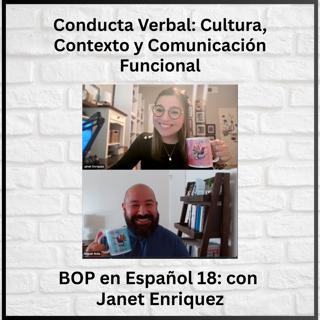
Conducta Verbal: Cultura, Contexto y Comunicación Funcional | BOP en ESP 18 con Janet Enriquez

Conducta Verbal: Cultura, Contexto y Comunicación Funcional | BOP en ESP 18 con Janet Enriquez

En este episodio, Miguel conversa con Janet sobre la conducta verbal desde una perspectiva práctica y cultural. A lo largo de la conversación, exploran por qué la conducta verbal sigue siendo una de l...

14 Juli 1h 23min
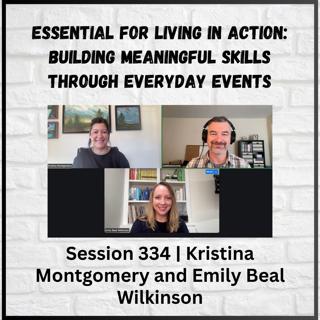
Essential for Living in Action: Building Meaningful Skills Through Everyday Events | Session 334 with Kristina Montgomery and Emily Beal Wilkinson

Essential for Living in Action: Building Meaningful Skills Through Everyday Events | Session 334 with Kristina Montgomery and Emily Beal Wilkinson

Many behavior analysts have experienced the frustration of teaching a skill successfully in one setting only to discover that it doesn't transfer to the situations where it actually matters. In this e...

30 Juni 1h 24min
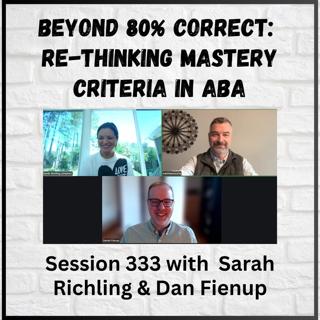
Beyond 80% Correct: Rethinking Mastery Criteria in ABA: Session 333 with Sarah Richling & Dan Fienup

Beyond 80% Correct: Rethinking Mastery Criteria in ABA: Session 333 with Sarah Richling & Dan Fienup

How do we determine when a learner has truly mastered a skill? In behavior analysis, performance criteria such as "80% correct across two sessions" have become nearly ubiquitous. Yet despite their wid...

12 Juni 1h 12min
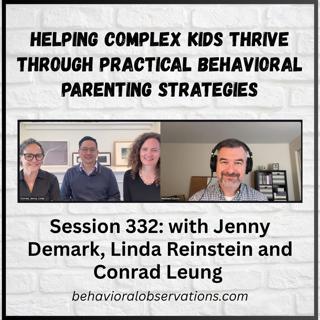
Helping Complex Kids Thrive Through Practical Behavioral Parenting Strategies: Jenny Demark, Linda Reinstein and Conrad Leung | Session 332

Helping Complex Kids Thrive Through Practical Behavioral Parenting Strategies: Jenny Demark, Linda Reinstein and Conrad Leung | Session 332

In this episode, I'm joined by Dr. Jenny Demark, Conrad Leung, and Dr. Linda Reinstein to talk about their new book, Complex Kids, Simple Solutions: How to Raise Resilient, Confident, Likable Kids. Th...

27 Maj 1h 9min
Supporting Individuals With Severe Problem Behavior Through Collaboration: Session 331 with Ben Seifert

Supporting Individuals With Severe Problem Behavior Through Collaboration: Session 331 with Ben Seifert

In Session 331, I sat down with Dr. Ben Seifert to talk about some of the most challenging — and important — work happening in applied behavior analysis today: supporting individuals with severe probl...

14 Maj 1h 3min

Populärt inom Vetenskap

p3-dystopia
dumma-manniskor
allt-du-velat-veta
rss-mottagningen
kapitalet-en-podd-om-ekonomi
halsorevolutionen
det-morka-psyket
medicinvetarna
sexet
ufo-sverige
bildningspodden
rss-spraket
rss-vetenskapsradion
rss-vetenskapsradion-2
paranormalt-med-caroline-giertz
vetenskapsradion
dumforklarat
rss-geopodden-2
ufo-sverige-2
rss-ufobortom-rimligt-tvivel