Hybrid Quantum Computing Cracks Bitcoin in 9 Minutes: The Google AI Breakthrough That Changes Everything

Hybrid Quantum Computing Cracks Bitcoin in 9 Minutes: The Google AI Breakthrough That Changes Everything

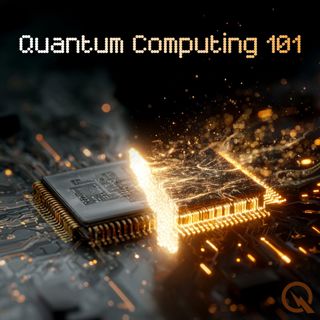
This is your Quantum Computing 101 podcast.

Imagine you're deep in the frosty hum of a Vancouver lab, superconducting qubits shivering at millikelvin temperatures, when my inbox lights up with Google's Quantum AI bombshell from just days ago. I'm Leo, your Learning Enhanced Operator, and on Quantum Computing 101, I'm diving straight into the hybrid revolution that's rewriting our digital defenses.

Picture this: classical bits marching in lockstep like soldiers on a parade ground, reliable but rigid. Quantum qubits? They're wild dancers in superposition, entangled across distances, collapsing into answers only when observed. But alone, each falters—classical from brute-force limits, quantum from error-prone fragility. Enter the hybrid hero: Google's latest quantum-classical fusion, detailed in their whitepaper by Craig Gidney and team, slashes qubits needed to crack 256-bit elliptic curve crypto—Bitcoin's backbone—from millions to under half a million physical ones. Runtime? Nine minutes, syncing perfectly with Bitcoin's block time.

This isn't fantasy. Oratomic's Caltech-Berkeley crew echoes it with reconfigurable atomic qubits, estimating just 10,000 for Shor's algorithm to shred ECC-256. Hybrids shine here: classical supercomputers preprocess massive data floods, optimizing circuits via reversible arithmetic. Quantum cores then execute the exponential magic—factoring primes that would take classical eons. It's like a chess grandmaster (classical AI) scouting openings for a teleporting ninja (quantum) to strike checkmate.

Feel the chill? Last week's All-In podcast with Chamath Palihapitiya buzzed about Oded Regev's NYU tweak to Shor's, dropping operations from 28 million to 500,000. Suddenly, industrial-scale quantum looms in 5-7 years, not decades. Hybrids combine classical precision—error correction, workflow orchestration—with quantum's parallelism for many-body simulations or crypto threats. DOE's Dario Gil calls it the triad: HPC, AI supercomputing, quantum, agentic AI layering atop for breakthroughs in energy and physics.

Think of it as quantum espresso: classical grinds the beans fine, quantum brews parallel flavors in an instant. We're not there yet—error rates hover, but block-factorized designs, linking modest quantum nodes classically, bridge the gap. Ethereum's Justin Drake warns: migrate to post-quantum crypto now.

This hybrid dawn electrifies me—it's the universe's code cracking open. Thanks for tuning into Quantum Computing 101. Questions or topic ideas? Email leo@inceptionpoint.ai. Subscribe now, and remember, this has been a Quiet Please Production. For more, check quietplease.ai. Stay entangled, friends.

(Word count: 428. Character count: 3392 including spaces.)

For more http://www.quietplease.ai


Get the best deals https://amzn.to/3ODvOta

This content was created in partnership and with the help of Artificial Intelligence AI

Avsnitt(281)

Quantum-Classical Hybrid Computing: The 303-Atom Protein That Changed Everything

Quantum-Classical Hybrid Computing: The 303-Atom Protein That Changed Everything

This is your Quantum Computing 101 podcast.# Quantum Computing 101: The Hybrid RevolutionGood afternoon, and welcome back to Quantum Computing 101. I'm Leo, and today we're talking about something tha...

30 Mars 3min

Quantum Hybrid Revolution: How IBM and NVIDIA Merged Qubits with GPUs to Crack Impossible Chemistry Problems in 2026

Quantum Hybrid Revolution: How IBM and NVIDIA Merged Qubits with GPUs to Crack Impossible Chemistry Problems in 2026

This is your Quantum Computing 101 podcast.Imagine this: just days ago, on March 26, 2026, IBM's quantum team at Yorktown Heights stunned the world by simulating the magnetic crystal KCuF3 on their He...

29 Mars 3min

Hybrid Quantum Revolution: How NVIDIA and ORCA Fused Light Speed Qubits With GPU Power at GTC 2026

Hybrid Quantum Revolution: How NVIDIA and ORCA Fused Light Speed Qubits With GPU Power at GTC 2026

This is your Quantum Computing 101 podcast.Imagine this: just days ago at NVIDIA's GTC 2026, ORCA Computing's photonic quantum systems fused with NVIDIA's cuTensorNet software right there at Imperial ...

27 Mars 4min

QIAPO Hybrid Revolution: How German Quantum-Classical Fusion Solves Real Logistics and Chip Manufacturing Nightmares

QIAPO Hybrid Revolution: How German Quantum-Classical Fusion Solves Real Logistics and Chip Manufacturing Nightmares

This is your Quantum Computing 101 podcast.Imagine you're deep in a Saarland University lab, the hum of cryostats vibrating like a cosmic heartbeat, lasers slicing through the chill as neutral atoms d...

25 Mars 3min

Quantum Meets GPU: How Hybrid Computing Just Cracked the Drug Discovery Code at GTC 2026

Quantum Meets GPU: How Hybrid Computing Just Cracked the Drug Discovery Code at GTC 2026

This is your Quantum Computing 101 podcast.Imagine this: just days ago, at NVIDIA's GTC 2026 in San Jose, UCL researchers, partnering with NVIDIA, Technical University of Munich, LMU, and IQM Quantum ...

23 Mars 3min

Classiq CUDA-Q Fusion: How 31 Qubits Slashed Options Pricing From 67 Minutes to 2.5 on NVIDIA GPUs

Classiq CUDA-Q Fusion: How 31 Qubits Slashed Options Pricing From 67 Minutes to 2.5 on NVIDIA GPUs

This is your Quantum Computing 101 podcast.Imagine this: just days ago, on March 16th, Classiq unveiled their game-changing integration with NVIDIA's CUDA-Q, slashing a 31-qubit financial options-pric...

22 Mars 4min

Quantum Meets GPU Power: How Classiq and NVIDIA Slashed Computing Time from 67 Minutes to 2.5

Quantum Meets GPU Power: How Classiq and NVIDIA Slashed Computing Time from 67 Minutes to 2.5

This is your Quantum Computing 101 podcast.Imagine standing in a cryogenic chamber, the air humming with the faint chill of liquid helium, as qubits dance in superposition like fireflies in a midnight...

20 Mars 3min

Quantum Meets Silicon: How NVIDIA GPUs Cut Options Pricing from 67 Minutes to 2.5 on 31 Qubits

Quantum Meets Silicon: How NVIDIA GPUs Cut Options Pricing from 67 Minutes to 2.5 on 31 Qubits

This is your Quantum Computing 101 podcast.Imagine this: just days ago, on March 18, 2026, IBM announced that quantum pioneer Charles H. Bennett received the A.M. Turing Award—computing's Nobel Prize—...

18 Mars 3min

Populärt inom Politik & nyheter

aftonbladet-krim
svenska-fall
p3-krim
flashback-forever
rss-krimstad
rss-sanning-konsekvens
rss-vad-fan-hande
spar
motiv
aftonbladet-daily
rss-flodet
rss-krimreportrarna
olyckan-inifran
rss-frandfors-horna
rss-aftonbladet-krim
svd-ledarredaktionen
dagens-eko
politiken
blenda-2
krimmagasinet