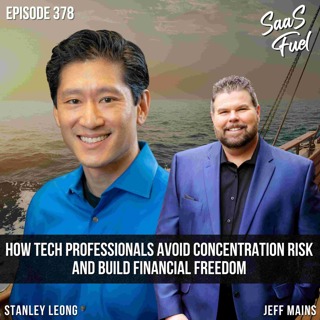
How Tech Professionals Can Avoid Concentration Risk and Build Financial Freedom | Stanley Leong | 378

How Tech Professionals Can Avoid Concentration Risk and Build Financial Freedom | Stanley Leong | 378

In this episode, Jeff Mains sits down with Stanley Leong — former IBM/Agilent engineer turned bestselling author and private wealth advisor — to explore what it truly means to engineer your finances. Stanley brings his analytical, systems-driven engineering background to personal wealth building, and the result is a refreshingly practical framework for tech founders and high-income professionals who are great at running businesses but often treat their personal finances as an afterthought.

Stanley shares how getting laid off the day after buying his first house sent him on an unexpected 20-year journey into financial planning. He explains why concentration risk (too much wealth in one stock or one company) is the #1 mistake he sees among tech professionals, why investment management is really risk management, and how the key question every investor should ask first is "What if I'm wrong?" The conversation also dives deep into underutilized tax strategies — including the Mega Backdoor Roth and the HSA as a stealth retirement account — and wraps with a powerful discussion on aligning money with purpose and preparing emotionally for life after a liquidity event.

Key Takeaways

4:10 — From Chips to Cashflow: Stanley's Origin Story Stanley was laid off the day after buying his first house. Frustrated by conflicting advice and no clear answers, he pivoted from engineering to financial planning — and discovered he could serve others facing the same confusion.

7:24 — What "Engineering Your Finances" Actually Means Stanley applies the same systematic, process-oriented thinking he used as an engineer to personal finance. His "Wealth Focus Model" structures client meetings around specific, scheduled topics — goal tracking, protection planning, taxes, and investment strategy.

9:02 — Concentration Risk: The #1 Mistake Tech Founders Make Too much net worth tied up in a single stock, employer equity, or your own company is the most common and dangerous financial mistake. Tech founders are especially vulnerable — success can quietly become massive exposure.

15:19 — How to Think About When to Diversify Start with your goal (e.g., retire at 60), work backward to determine how much you need to set aside in diversified investments, and then let the rest work harder in higher-risk/higher-reward vehicles. This keeps you on track even if the concentrated bet doesn't pay off.

17:10 — Investment Management Is Really Risk Management Most people think investing is about making money. Stanley reframes it: the job is to manage risk first, then optimize returns. That mindset shift is what separates investors from gamblers.

18:10 — The Investor's First Question: "What If I'm Wrong?" Before committing capital to anything, ask what happens if the investment doesn't go your way — and whether you can live with that outcome. Gamblers ask "How much can I make?" Investors ask "What's the downside?"

20:34 — Tax Diversification: Build Three Buckets Prepare for an uncertain tax future by spreading wealth across three types of accounts: pre-tax (traditional 401k), after-tax Roth (tax-free growth and withdrawals), and taxable brokerage. Having optionality across tax buckets is just as important as investment diversification.

22:44 — The Mega Backdoor Roth: A Largely Unknown Strategy High earners who can't contribute directly to a Roth IRA can use a little-known third 401k contribution type — after-tax contributions — to funnel an additional $20–40K/year into a Roth position. The key: don't forget to actually convert the after-tax contributions to Roth.

27:45 — The HSA: The Most Tax-Efficient Account Nobody Maxes Out The Health Savings Account beats every other tax-advantaged vehicle: pre-tax contributions, tax-deferred growth, and tax-free withdrawals. The strategy: don't use it for current healthcare costs — let it grow, save your receipts, and reimburse yourself decades later tax-free.

32:44 — The Retirement Tax Window Many Miss Many high earners experience a brief "tax valley" in early retirement — income drops before RMDs and Social Security kick in. Use that window to convert pre-tax retirement accounts to Roth at a very low (sometimes 0%) rate before required minimum distributions force higher taxes.

36:19 — Money Without Purpose Has No Value Stanley's first question to every new client: "What is the purpose of this money?" Clear goals — not just "retire someday," but where, with whom, doing what — make risk evaluation real and decisions intentional.

39:10 — Life After a Liquidity Event: The Emotional Preparation The financial transition is only part of the story. Founders who retire or exit without a clear vision for what comes next often struggle. Start forming that post-exit identity before the event — read, talk to others, explore — so you're moving toward something, not just away from work.

42:17 — Financial Independence ≠ Retirement The better framing is "financial independence" — the freedom to work on your own terms. One of Stanley's clients realized he loved his job the moment he knew he didn't have to be there anymore. The ability to walk away is sometimes more valuable than walking away.

Tweetable Quotes"You should want to pay more capital gains tax than anyone you know — because that means you've made more money than anyone you know." — Stanley Leong"Investment management sounds cooler, but we're really risk managers. The focus on risk is what defines an investor versus a gambler." — Stanley Leong"A gambler's first question is 'How much money am I going to make?' A good investor's first question is always 'What if I'm wrong?'" — Stanley Leong"Money without purpose has no value." — Stanley Leong"Success can quietly turn into massive exposure. Diversification isn't about fear — it's about freedom." — Stanley Leong"Don't be afraid to pay capital gains tax. It means you made money. The more you pay, the more you made." — Stanley Leong"Financial independence doesn't mean you stop. It means you're still living your life — just maybe in a different way." — Stanley Leong"Start forming your post-retirement vision while you're still working — it's a lot easier to dream when you're not already in it." — Stanley LeongSaaS Leadership Lessons

1. Engineer Your Systems, Not Just Your Product The same discipline you apply to software architecture belongs in your financial life. Build repeatable, scheduled processes around your wealth — don't wing it. A systematic approach to finances compounds over time just like good code.

2. Concentration Is a Silent Risk As founders, your identity and your net worth are often tied to one thing: your company. That's a risk management problem, not a success story. The most dangerous financial position isn't losing — it's winning so much in one place that you forget you're exposed.

3. Reframe Risk Before You Reach for Returns Before you invest in anything — a new product line, a strategic hire, a side bet — ask "What if I'm wrong?" Not just "What's the upside?" Embedding this question into your leadership culture protects the company as much as the balance sheet.

4. Build Optionality Into Everything — Including Taxes High-growth founders often optimize for today's tax savings and ignore tomorrow's flexibility. Diversifying across tax buckets (pre-tax, Roth, taxable) gives you options in an unpredictable future. The same principle applies to your cap table, your customer base, and your revenue streams.

5. Purpose Drives Better Decisions at Every Stage Vague goals produce vague results. Whether you're managing a P&L or a portfolio, specificity creates accountability. "Retire at 60 to travel Europe with my family" is a strategy. "Someday retire" is a wish. Build toward something concrete.

6. Financial Independence Is a Better Goal Than Exit The most underrated outcome of building a great company isn't the exit — it's the freedom to choose. Many founders discover they love the work once they no longer have to do it. Design your financial life so you work because you want to, not because you have to.

Guest Resources

Stan@engineeringyourfinancesbook.com

www.engineeringyourfinancesbook.com

Episode Sponsor

The Futureproof Series - https://www.youtube.com/playlist?list=PLfkXKUPZ5xuOqMPR7_gzGybncTtavyR1N

The Captain's Keys

Small Fish, Big Pond – https://smallfishbigpond.com/ Use the promo code ‘SaaSFuel’

Champion Leadership Group – https://championleadership.com/

SaaS Fuel Resources

Website - https://championleadership.com/

Jeff Mains on LinkedIn -

Det här avsnittet är hämtat från ett öppet RSS-flöde och publiceras inte av Podme. Det kan innehålla reklam.

Avsnitt(415)

414 | How to Sell in the Age of AI: A Founder's Guide | Bob Kocis

414 | How to Sell in the Age of AI: A Founder's Guide | Bob Kocis

Jeff Mains sits down with Bob Kocis, former President & COO of Aptean and former CRO of Continuum Managed Services, and author of The President's Club Mindset: Inside the Winning Strategies of Tech's ...

13 Aug 48min

413 | How to Enter Flow State for Peak Performance | Steven Puri

413 | How to Enter Flow State for Peak Performance | Steven Puri

Steven Puri has produced Academy Award-winning visual effects on films like Independence Day, Braveheart, and Se7en, climbed the executive ladder at DreamWorks and 20th Century Fox, and built three te...

11 Aug 52min

412 | Are AI Agents Ruining Customer Experience? | Vanitha Swaminathan

412 | Are AI Agents Ruining Customer Experience? | Vanitha Swaminathan

Vanitha is a marketing professor at the University of Pittsburgh, Director of their Center for Branding, and author of Hyper Digital Marketing: Six Pillars of Strategic Brand Marketing in an AI-Powere...

6 Aug 44min

411 | Physical Mail: Your Best Sales Weapon in 2026 | Neal Goyal

411 | Physical Mail: Your Best Sales Weapon in 2026 | Neal Goyal

In a world where 21,883 software companies are all chasing the same narrow pool of buyers, automation isn't a competitive edge — it's the noise. Neal Goyal, who has closed $41M in software revenue wit...

5 Aug 45min

410 | 5 SaaS Onboarding Mistakes Killing Your Growth | Claire Heginbotham

410 | 5 SaaS Onboarding Mistakes Killing Your Growth | Claire Heginbotham

Claire has spent nearly a decade writing emails, fixing onboarding flows, and tightening messaging for enterprise AI security, LiDAR tech, and competitive SaaS products — where a bad first impression ...

30 Juli 48min

409 | Can AI Replace Your Accountant? | Sai Dhanak

409 | Can AI Replace Your Accountant? | Sai Dhanak

In this episode, Sai breaks down why he deliberately chose a services business over pure SaaS, how a human-in-the-loop model creates a defensible moat in a world increasingly disrupted by Claude and C...

28 Juli 48min

408 | 95% of AI Projects Fail: Here's the Fix | Ben Tasker

408 | 95% of AI Projects Fail: Here's the Fix | Ben Tasker

Ben Tasker joins Jeff Mains to break down the real reason most AI rollouts fail: it's almost never the technology. From his time as Dean of AI at Southern New Hampshire University to building life-sav...

23 Juli 47min

407 | The SaaSpocalypse: Why Startups Fail in 2026 | Brian Herr

407 | The SaaSpocalypse: Why Startups Fail in 2026 | Brian Herr

The SaaS world is in the middle of a brutal reckoning. Products that looked innovative 18 months ago are quietly becoming redundant — not because markets disappeared, but because the floor rose. In th...

21 Juli 51min

Populärt inom Business & ekonomi

framgangspodden
badfluence
varvet
dynastin
rss-borsens-finest
uppgang-och-fall
avanzapodden
svd-tech-brief
rss-inga-dumma-fragor-om-pengar
borsmorgon
fill-or-kill
tabberaset
lastbilspodden
rss-dagen-med-di
rikatillsammans-om-privatekonomi-rikedom-i-livet
rss-kort-lang-analyspodden-fran-di
borslunch-2
rss-hos-psykologen
rss-veckans-trade
bathina-en-podcast