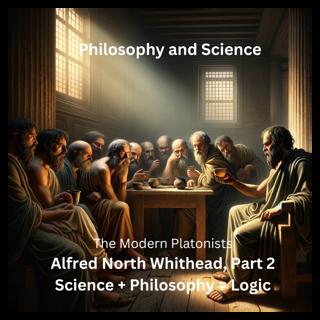
Alfred North Whitehead, Part 2: The Mathematician Who Added Plato to Modern Science

Alfred North Whitehead, Part 2: The Mathematician Who Added Plato to Modern Science

In their second episode featuring the works of modern Platonist Alfred North Whitehead (1861-1947), James Myers and Michael Fitzpatrick brought Plato into the 21st century through Whitehead’s perspectives as a mathematician and philosopher. The discussion relates Whitehead’s perspectives to many of Plato’s dialogues, including The Sophist, The Timaeus, The Republic, The Parmenides, and The Philebus.

Writing his landmark work Process and Reality during the years when quantum mechanics and general relativity were discovered, Whitehead’s philosophy of organism treats the universe as a web of interconnected processes and changes. Whitehead applied the logic of Plato’s writing from 2,400 years ago to identify crucial connections in the web and, by following their paths, he related concepts in general relativity and quantum mechanics to the universe as an organism. From Whitehead’s perspective, there was clear logic for an eternal co-dependency of the infinite universe and the finite connections within its web.

The mathematician had much to say about the nature of time, which was a prominent in the episode’s discussion. To Whitehead, time was not linear but circular, and likewise Plato’s character Timaeus described the universe as spherical. Timaeus also stated that the changes we see everywhere around us are in a “moving image of eternity, moving according to number, of eternity remaining in unity.” The appeal of Timaeus’ perspective to a mathematician becomes even more obvious in the character’s next statement: “This number, of course, is what we now call 'time'.”

Can science and philosophy be reunited? If ever there was a time for such unity, the time is now, and Whitehead paved the way to connecting ancient principles with the discoveries of Albert Einstein and Nils Bohr that have transformed the modern world.

Det här avsnittet är hämtat från ett öppet RSS-flöde och publiceras inte av Podme. Det kan innehålla reklam.

Avsnitt(77)

On Modern Platonist Alfred North Whitehead, Part 1: The Mathematician Philosopher

On Modern Platonist Alfred North Whitehead, Part 1: The Mathematician Philosopher

In this episode, James Myers and Michael Fitzpatrick continue to discuss modern Platonists with an introduction to Alfred North Whitehead (1861-1947), a mathematician who ended up as a professor of ph...

11 Feb 1h 20min
Why Artificial Intelligence is Impossible

Why Artificial Intelligence is Impossible

Plato’s Pod host James Myers brings the logic of the characters in ten of Plato’s dialogues to bear on the question of “what is intelligence?” and concludes that “artificial intelligence” is impossibl...

5 Jan 41min
Justice in Plato’s Time and Our Time: Words that Shape Constitutions, Justice, and Governments

Justice in Plato’s Time and Our Time: Words that Shape Constitutions, Justice, and Governments

Our choice and use of words has a profound effect on the operation of justice, and a particular legal dispute now before the United States Supreme Court hangs on the meaning of three words. In this ep...

15 Nov 202527min
On Modern Platonist Alain Badiou:"Thinking the Event" to Distinguish the Real from Images on the Wall

On Modern Platonist Alain Badiou:"Thinking the Event" to Distinguish the Real from Images on the Wall

“Think the event” is central to the philosophy of Alain Badiou, a modern Platonist who has been writing and lecturing in philosophy for over five decades. Badiou said, “Philosophy is the seizure of th...

22 Sep 20251h 52min
Plato’s Letters VI and VIII: Good Kings are Servants of the Laws and Justice

Plato’s Letters VI and VIII: Good Kings are Servants of the Laws and Justice

We followed our discussion of Plato’s famous Letter VII by looking at his lesser-known Letters VI and VIII. Together, they form a powerful trilogy in which “Love your neighbour” emerges as an overarch...

9 Maj 20251h 30min
Plato's Seventh Letter, Part 2: Can Virtue Be Taught?

Plato's Seventh Letter, Part 2: Can Virtue Be Taught?

The second half of our discussion on Plato’s Seventh Letter begins with a reading of Plato’s famous statement that he never published any statement of his opinions. That’s both the beauty and, for som...

7 Apr 20251h 33min
Plato's Seventh Letter: On Tyrants Who are Blind to Philosophy

Plato's Seventh Letter: On Tyrants Who are Blind to Philosophy

In our first discussion on Plato's letters, we look at his best-known Seventh Letter. In the letter, Plato relates his experience with Dionysius, the tyrannical ruler of Syracuse, and the philosophica...

3 Mars 20251h 17min

Populärt inom Vetenskap

p3-dystopia
dumma-manniskor
rss-mottagningen
allt-du-velat-veta
kapitalet-en-podd-om-ekonomi
ufo-sverige
rss-ronden
det-morka-psyket
halsorevolutionen
rss-spraket
sexet
rss-vetenskapsradion
rss-odla
svd-nyhetsartiklar
ufo-sverige-2
medicinvetarna
paranormalt-med-caroline-giertz
bildningspodden
rss-arkeologi-historia-podden-som-graver-i-vart-kulturlandskap
vetenskapsradion