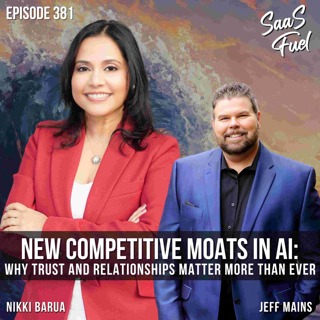
New Competitive Moats in AI: Why Trust and Relationships Matter More Than Ever | Nikki Barua | 381

New Competitive Moats in AI: Why Trust and Relationships Matter More Than Ever | Nikki Barua | 381

Nikki Barua — immigrant, serial entrepreneur, and CEO of Flip Work — joins Jeff Mains for a conversation on what it truly takes to build something outsized in the AI age. Drawing on two decades of experience in M&A, corporate strategy, and scaling tech businesses, Nikki shares why reinvention isn't a one-time event but a survival skill.

The conversation digs into the mindset required to make bold decisions under uncertainty, the triple leverage behind billion-dollar companies (ideas, talent, and operating agility), and why mid-market SaaS companies are facing a binary outcome — perish or thrive — depending on how fast they move. Nikki also unpacks how the new competitive moats are shifting to proprietary data, distribution, and trust, and why the AI era is actually the golden age of entrepreneurship for those willing to step into the arena.

Key Takeaways

3:33 — Nikki's immigration story as a foundational lesson in reinvention: "Adapt or die."

5:45 — What boardroom access in M&A taught her about high-stakes decision making and the courage required.

7:43 — The three types of leverage that separate billion-dollar companies from million-dollar ones: exponential idea, exceptional talent, and operating agility.

8:48 — Why big ideas attract great talent — and why that's a compounding advantage.

10:43 — What Flip Work does: closing the divide between AI technology and human workforce readiness in 90-day sprints.

14:00 — The hiring mistake founders repeat at every stage: hiring for tomorrow without considering whether that person has lived through where you are today.

16:10 — The #1 limiting belief of founders: not dreaming big enough. Your business will never exceed the size of your own vision.

19:06 — Why "family culture" is a trap and "sports team" is a better mental model for scaling.

20:19 — Mid-market's binary moment with AI: too big to do nothing, but not big enough to transform alone.

21:20 — The scary truth: mid-market SaaS companies could be one AI model feature away from being replaced.

22:25 — The binary outcome: perish by inaction or capture massive market share through speed and new AI-resilient moats.

27:19 — The new competitive moats: proprietary data, distribution, and trust — and why public data is no longer an advantage.

30:14 — Why the founder's personal brand is becoming the most important trust signal in the AI age.

32:06 — We're in the golden age of entrepreneurship — AI makes big ideas achievable with minimal capital and headcount.

33:14 — How to build a genuinely high-agency culture: information symmetry, clear guardrails, and fail-safe zones.

40:03 — The one mindset shift for overwhelmed founders: "Don't be a bystander. Step into the arena."

42:16 — The rallying cry for the AI age: go from "people scared" to "people squared."

Tweetable Quotes"Adapt or die. When you show up with nothing, the only thing you can count on is: who do I need to become to thrive in this new environment?" — Nikki Barua"Building a billion-dollar company isn't just harder — it's different. It requires exponentially better ideas, not incrementally better ones." — Nikki Barua"Big ideas attract great talent. People that are phenomenal at what they do like hard problems — they want to prove themselves doing something no one has ever done." — Nikki Barua"You cannot build a business beyond the size of your own dreams. Your lid is the ceiling of what you believe is possible." — Nikki Barua"Mid-market companies could be one AI model feature away from being completely replaced. That's a dangerous place to stand still." — Nikki Barua"Don't look in the rear-view mirror. Let go of sunk costs and step into what's possible instead of focusing on what was." — Nikki Barua"Don't be a bystander. Do it scared — but just do it." — Nikki Barua"Go from people scared to people squared. That's the real shift you have to make." — Nikki Barua"The founder's personal brand is going to be one of the biggest trust signals in the AI age — because software is no longer a moat." — Nikki Barua"Family culture means you just tolerate dysfunction. A sports team? You want the best players in all the right roles — and results decide who stays." — Nikki BaruaSaaS Leadership Lessons

1. Reinvention Is a Survival Skill, Not a Strategy Nikki's immigration story set the tone: the willingness to shed old identities and step into new ones isn't optional — it's what separates those who thrive from those who get left behind. For SaaS leaders, this means actively interrogating who you need to become, not just what you need to build.

2. Hire for the Stage You're In, Not Just the Stage You're Heading To One of the most costly and repeated mistakes founders make is bringing on "tomorrow" talent without considering whether they've survived "today." The person who's scaled a $100M company may be an anchor at the $5M stage. Match talent to the current phase, then plan thoughtful transitions as you grow.

3. The Lid on Your Business Is the Size of Your Dream If you can't see a billion, you'll never build one. Your belief in what's possible is the actual ceiling on your company's growth. This isn't about fantasy — it's about radically expanding what you genuinely believe you can achieve and recruiting your whole organization into that expanded vision.

4. Build AI-Resilient Moats Before You Need Them Proprietary data, deep distribution, and earned trust are the new defensible positions. Software alone is not a moat. Distribution (like Microsoft or Salesforce) and the personal brand trust of the founder are increasingly the differentiators that survive AI commoditization. Evaluate your moat honestly — and rebuild it now, not later.

5. High-Agency Culture Requires Architecture, Not Announcements Saying "we empower our people" means nothing without the structures to support it. Real high-agency cultures are built on: (1) information symmetry — share what's happening at the top, (2) clear decision guardrails — define where authority lies at each level, and (3) fail-safe zones — explicit permission to experiment and fail within defined boundaries.

6. The Cost of Indecision Is Falling Behind Whether in a boardroom M&A decision or an AI transformation moment, the founders and leaders who win are those who make bold calls under uncertainty and trust they can course-correct. Waiting for perfect information isn't a risk management strategy — it's how you become obsolete. Every week of inertia compounds the gap between you and those who are moving.

Guest Resources

nikki@fts-ai.com

https://www.flipwork.ai/

https://www.linkedin.com/in/nikkibarua/

https://www.instagram.com/thenikkibarua

Episode Sponsor

The Futureproof Series - https://www.youtube.com/playlist?list=PLfkXKUPZ5xuOqMPR7_gzGybncTtavyR1N

The Captain's Keys

Small Fish, Big Pond – https://smallfishbigpond.com/ Use the promo code ‘SaaSFuel’

Champion Leadership Group – https://championleadership.com/

SaaS Fuel Resources

Website - https://championleadership.com/

Jeff Mains on LinkedIn - https://www.linkedin.com/in/jeffkmains/

Twitter - https://twitter.com/jeffkmains

Facebook - https://www.facebook.com/thesaasguy/

Instagram - https://instagram.com/jeffkmains

Det här avsnittet är hämtat från ett öppet RSS-flöde och publiceras inte av Podme. Det kan innehålla reklam.

Avsnitt(433)

432 | How Cross-Functional Alignment Prevents Costly Project Failures | Deborah Kaminetzky

432 | How Cross-Functional Alignment Prevents Costly Project Failures | Deborah Kaminetzky

A software implementation can be delivered on time and on budget, then fail the moment people refuse to use it.In this episode, Jeff Mains talks with Deborah Kaminetzky, founder of De Facto Project Ma...

15 Okt 47min

431 | The Hidden Work Behind Cross-Border Supply Chains | Daman Grewal

431 | The Hidden Work Behind Cross-Border Supply Chains | Daman Grewal

Daman Grewal grew a logistics company from $1 million to $24 million in four years, working across dispatch, safety, accounts receivable, and sales before he fully recognized the skills he was buildin...

13 Okt 53min
430 | Revenue Per Employee, Capital Efficiency, and the Future of Startup Growth | Lindsey Mignano

430 | Revenue Per Employee, Capital Efficiency, and the Future of Startup Growth | Lindsey Mignano

Are you raising venture capital because your business needs it—or because getting funded feels like proof you’ve made it?In this episode of Futureproof Founder, Jeff Mains sits down with Lindsey Migna...

8 Okt 54min
429 | AI, Education, and the Decline of Independent Thinking | Jonathan Schaeffer

429 | AI, Education, and the Decline of Independent Thinking | Jonathan Schaeffer

Are you using AI to make better decisions—or letting a confident answer do your thinking for you?In this episode of Futureproof Founder, Jeff Mains sits down with AI researcher and entrepreneur Jonath...

6 Okt 57min
428 | Intellectual Property for Founders: Trademarks, Patents, Copyright, and Trade Secrets | James Gourley

428 | Intellectual Property for Founders: Trademarks, Patents, Copyright, and Trade Secrets | James Gourley

Jeff Mains sits down with James Gourley, a patent attorney and IP litigator who has spent 20 years on both sides of intellectual property disputes — from filing patents and trademarks to defending com...

1 Okt 42min
427 | Customer Outcomes, AI Adoption, and the New Software Economy | Carl Lenocker

427 | Customer Outcomes, AI Adoption, and the New Software Economy | Carl Lenocker

Jeff Mains sits down with Carl Lenocker, a 30-year enterprise software veteran who started in Silicon Valley in the '80s, survived the dot-com bust, and now consults founders on what actually creates ...

29 Sep 45min
426 | How Founders Can Turn AI Whiplash Into Strategic Focus | David Fung

426 | How Founders Can Turn AI Whiplash Into Strategic Focus | David Fung

David Fung spent 15 years at Salesforce as a Senior Director before walking away from unvested RSUs to launch Coachful Coaching. He now coaches CTOs and tech leaders on the pattern he calls "AI whipla...

24 Sep 46min
425 | Product-Market Fit Starts with Understanding the User | Erin Rollenhagen

425 | Product-Market Fit Starts with Understanding the User | Erin Rollenhagen

Erin Rollenhagen learned the most expensive lesson in product development the hard way: she spent years building software without ever talking to a single end user—and people took early retirement to ...

22 Sep 46min

Populärt inom Business & ekonomi

framgangspodden
varvet
rss-jossan-nina
rss-borsens-finest
24fragor
uppgang-och-fall
badfluence
avanzapodden
rss-inga-dumma-fragor-om-pengar
rss-dr-bjorklund
bathina-en-podcast
rss-svart-marknad
lastbilspodden
fill-or-kill
kapitalet-en-podd-om-ekonomi
rss-kort-lang-analyspodden-fran-di
tabberaset
rikatillsammans-om-privatekonomi-rikedom-i-livet
rss-hos-psykologen
rss-dagen-med-di