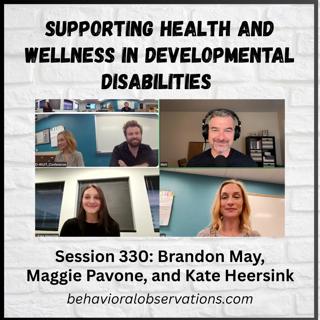
Supporting Health and Wellness in Developmental Disabilities: Session 330: Brandon May, Maggie Pavone, and Kate Heersink

Supporting Health and Wellness in Developmental Disabilities: Session 330: Brandon May, Maggie Pavone, and Kate Heersink

In this episode, I'm joined by Drs. Brandon May and Maggie Pavone, and Kate Heersink to talk about how we can better support healthier lifestyles for individuals with developmental disabilities.

We start by digging into how each of them came to this work. Maggie shares some early experiences working as a direct support professional, where she began to notice patterns between food-related variables and challenging behavior. Brandon talks about coming into behavior analysis through the health and fitness world, and seeing firsthand how difficult it was to support individuals in building healthier routines without a clear behavioral framework. Kate adds her perspective from working with individuals with brain injury, where the connection between physical health and overall functioning is hard to ignore.

We also spend some time acknowledging that this isn't entirely new territory. There's a solid body of work—both within and outside of behavior analysis—focused on physical activity and health for individuals with disabilities. At the same time, there's still a gap when it comes to practical, easy-to-implement tools that can be used by the people doing the day-to-day work.

From there, we get into the early development of the Fit 4 All program and how it's currently being implemented in a day program setting for adults with developmental disabilities. Kate walks through what a typical session looks like, including:

  • Starting the day by ensuring wearable tech (e.g., a Fitbit) is in place
  • Using a token system tied to individualized goals (hydration, movement, functional fitness, and nutrition skills)
  • Embedding physical activity throughout the day (walking, fitness videos, etc.)
  • Teaching basic nutrition concepts using structured learning trials
  • Incorporating functional skills like cooking where appropriate

One of the things I appreciated about this approach is how integrated it is. Rather than treating exercise or nutrition as separate, isolated targets, they're woven into the flow of the day and supported through clear contingencies and reinforcement systems.

We also talk about the importance of working within real-world environments. This isn't about creating tightly controlled, clinic-based interventions—it's about meeting people where they are and building systems that can be implemented by direct support staff, teachers, and caregivers in the settings where individuals actually live and spend their time.

This is very much a "boots on the ground" application of behavior analysis—figuring out how to increase things like step count, heart rate, and water consumption in ways that are practical, sustainable, and individualized. And like a lot of good ABA work, it involves ongoing problem-solving—adjusting activities, testing different approaches, and using data to guide decisions.

If you're a BCBA, or someone working directly with individuals with developmental disabilities, this conversation is a good reminder that health and wellness is an area where our science has a lot to offer—and probably more room to grow.

🔑 Key Takeaways
  • Health behaviors (movement, nutrition, hydration) are behavior—and can be addressed using behavior-analytic principles
  • Many professionals feel underprepared to support these areas without a structured framework
  • Embedding interventions into natural environments (e.g., day programs) increases feasibility and sustainability
  • Simple systems (token boards, wearable data, clear goals) can support meaningful behavior change
  • Effective programming in this area requires flexibility, creativity, and ongoing data-based decision making
🧩 Why This Matters

Individuals with developmental disabilities are often at higher risk for health-related issues tied to sedentary behavior and diet. At the same time, these are areas that don't always receive systematic attention in programming.

This is one place where behavior analysis can have a meaningful impact on long-term quality of life.

📚 Resources Mentioned Sponsors
  • CEUs from Behavioral Observations. Learn from your favorite podcast guests while you're commuting, walking the dog, or whatever else you do while listening to podcasts. New events are being added all the time, so check them out here.
  • The BOP Patreon. Do you want to get the show ad-free and before everyone else? Click here to learn how!
  • The Whoop Strap. If you want to take control of your health and fitness, start by getting the data you need with the Whoop Strap. And by using this link, you'll get your first month free!

Avsnitt(332)

Train Smarter, Not Harder: Heart Rate Zones, VO2 Max, and Better Fitness: Session 329 with Nick Green

Train Smarter, Not Harder: Heart Rate Zones, VO2 Max, and Better Fitness: Session 329 with Nick Green

In Session 329, I'm joined once again by Dr. Nick Green, Ph.D., BCBA-D, who's been doing some really interesting work at the intersection of fitness and behavior science. In this episode, Nick walks u...

8 Apr 1h 1min

Conditioning Books as Reinforcers: How to Increase Reading Engagement in Young Children: Inside JABA 26

Conditioning Books as Reinforcers: How to Increase Reading Engagement in Young Children: Inside JABA 26

Episode Summary In this episode, I'm joined by Dr. Daniel Fienup, Dr. Kate Loomis, and Lilian Morales to discuss their recent paper in JABA, Turning the Page: Increasing children's preference for look...

2 Apr 1h 7min

Comportamiento, espacio y algoritmos: Análisis de la conducta recargado, BOP en Español 17 con Alejandro León

Comportamiento, espacio y algoritmos: Análisis de la conducta recargado, BOP en Español 17 con Alejandro León

Comportamiento, espacio y algoritmos: Análisis de la conducta recargado En este episodio de Espacio y Comportamiento, Miguel Avila conversa con Alejandro León sobre una dimensión del comportamiento qu...

20 Mars 1h 9min

The 2025 Verbal Behavior Conference Panel Discussion: Session 326

The 2025 Verbal Behavior Conference Panel Discussion: Session 326

Thanks for joining me for Session 326 of The Behavioral Observations Podcast. This episode was recorded live at the 2025 Verbal Behavior Conference, where I had the honor of moderating the annual pane...

11 Mars 59min

Developing Rapport and Sustaining Motivation in Autism Treatment: Session 325 with Alice Shillingsburg

Developing Rapport and Sustaining Motivation in Autism Treatment: Session 325 with Alice Shillingsburg

In this episode, I talk with Dr. Alice Shillingsburg about her work on rapport building and pairing procedures in applied behavior analysis for children with autism. We explore how building therapeuti...

23 Feb 1h 5min

Resilience Is a Skill — Raising Capable Kids in a Fragile World: Session 324 with Paulie Gavoni and Steve Ward

Resilience Is a Skill — Raising Capable Kids in a Fragile World: Session 324 with Paulie Gavoni and Steve Ward

In Session 324, Dr. Paulie Gavoni and Steve Ward join me to discuss what resilience actually looks like from a behavior science perspective — and why many well-intentioned adult responses can unintent...

13 Feb 1h 21min

Building Clinical Excellence in Autism Services: How Apollo Trains and Supports RBTs and BCBAs - Session 322

Building Clinical Excellence in Autism Services: How Apollo Trains and Supports RBTs and BCBAs - Session 322

In this episode of the Behavioral Observations Podcast, I'm joined by Kim Dean, founder of Apollo Behavior, and Kristen Vaughn, Vice President of Clinical Operations, to talk about what it really take...

30 Jan 1h 1min

Populärt inom Vetenskap

p3-dystopia
dumma-manniskor
allt-du-velat-veta
kapitalet-en-podd-om-ekonomi
svd-nyhetsartiklar
det-morka-psyket
rss-spraket
rss-vetenskapsradion
rss-ufo-bortom-rimligt-tvivel-2
medicinvetarna
hacka-livet
rss-vetenskapsradion-2
paranormalt-med-caroline-giertz
sexet
dumforklarat
rss-tidslinjen-podcast
bildningspodden
halsorevolutionen
4health-med-anna-sparre
naturmorgon