
The American Gold Rush

The American Gold Rush

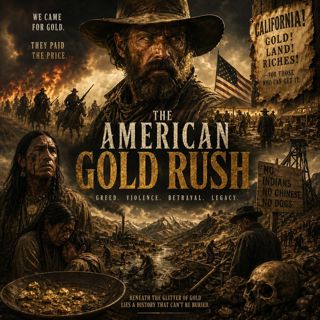
Most of us learned a version of the Gold Rush that was cheerful, portable, and mostly wrong. In this episode we set that version aside and go looking for what actually happened — the history that didn't make it onto the plaques.On 1/24/1848, James Marshall found gold at Sutter's Mill on the American River.

California was still technically Mexican territory at the time; the Treaty of Guadalupe Hidalgo, which formally transferred the region to the United States, wasn't signed until 2/2/1848 — nine days later. What followed was one of the most consequential and destructive episodes in American history, compressed into less than a decade.This episode covers the near-total collapse of California's Native population, from an estimated 150,000 people at the time of the discovery to fewer than 50,000 by 1870. We examine the California legislature's Act for the Government and Protection of Indians, passed in 1850, which functioned as a slavery statute for thirteen years.

We look at Governor Peter Burnett's 1851 declaration that a "war of extermination" between the races was inevitable, and at the state-funded militia campaigns that historian Benjamin Madley has documented in his research on the California genocide.We also cover the Foreign Miners' Tax of 1850, the violent expulsion of Chilean and Mexican miners from the southern diggings, and the legal framework that stripped Chinese miners of any recourse in California courts — including the California Supreme Court's 1854 ruling in People v. Hall, which held that Chinese witnesses could not testify against white men.

The environmental destruction of hydraulic mining, which began around 1853 and wasn't stopped until the Sawyer Decision of 1884, transformed entire river systems and buried farmland under debris. The Malakoff Diggins mine alone carved a canyon nearly 7,000 feet long and nearly 600 feet deep from what had been a Sierra Nevada hillside.The stories of John Sutter and James Marshall — both of whom died broke — are here, along with the story of Sam Brannan, who made $36,000 in nine weeks selling shovels to miners and died penniless in 1889.

So is the story of Mary Ellen Pleasant, a free Black woman who arrived in San Francisco in 1852, built a substantial fortune, and used it to fund abolitionist causes including John Brown's raid on Harpers Ferry. And the story of Bret Harte, the 23-year-old journalist who wrote the only honest account of the 1860 Wiyot Massacre and had to flee the region under death threats.The Gold Rush produced California. It also produced the Chinese Exclusion Act of 1882, eighteen unratified Native treaties buried in Senate archives until 1905, and a pattern of racialized dispossession that shaped the state for generations.

This episode takes all of it seriously.If this episode stayed with you, share it with someone who needs to hear it. You can reach us at brian@paranormalworldproductions.com, and you can find more at paranormalworldproductions.com.

Have a forgotten historical mystery, disturbing event, unsolved crime, or hidden conspiracy you think deserves investigation?

Send your suggestions to brian@paranormalworldproductions.com.

Disturbing History is a dark history podcast exploring unsolved mysteries, secret societies, historical conspiracies, lost civilizations, and the shadowy stories buried beneath the surface of the past.

Follow the show and enable automatic downloads so you never miss a deep dive into history’s most unsettling secrets.

Because sometimes the truth is darker than fiction.

Avsnitt(91)

Diamonds Are Forever

Diamonds Are Forever

For most of human history, diamonds were genuinely rare. Then in 1867, on a sheep farm near the Orange River in South Africa, a fifteen-year-old boy picked up a shiny pebble that turned out to be a 21...

29 Apr 1h 8min

Who Found America First: Columbus or the Vikings?

Who Found America First: Columbus or the Vikings?

A thousand years before Christopher Columbus saw a light on a Bahamian beach, a small band of Norse settlers stood on the northern tip of Newfoundland, swinging iron axes against fir and juniper trees...

26 Apr 1h 3min

The 1857 Mountain Meadows Massacre

The 1857 Mountain Meadows Massacre

In September 1857, a wagon train of roughly one hundred and forty men, women, and children from Arkansas made camp in a remote valley in southwestern Utah Territory. They were headed to California. Th...

22 Apr 1h 19min

The Aurora Texas Alien Crash

The Aurora Texas Alien Crash

In this episode of Disturbing History, we step away from the dark corridors of government experiments and serial killers to explore one of the strangest and most enduring mysteries in American history...

19 Apr 1h 18min

Eugenics in America

Eugenics in America

This episode traces the full history of eugenics in America from its origins in Francis Galton's Victorian-era theories through the establishment of Charles Davenport's Eugenics Record Office at Cold ...

17 Apr 1h 22min

The Battle of Blair Mountain

The Battle of Blair Mountain

The Battle of Blair Mountain stands as the largest armed insurrection on American soil since the Civil War, yet for nearly a century it was virtually absent from the nation's textbooks and public memo...

10 Apr 1h 14min

The Horror of Holmesburg Prison

The Horror of Holmesburg Prison

For more than two decades, incarcerated men inside Philadelphia's Holmesburg Prison were used as human test subjects in experiments that sound like something out of a dystopian novel. Beginning in 195...

8 Apr 1h 18min

Populärt inom Samhälle & Kultur

podme-dokumentar
aftonbladet-krim
en-mork-historia
gynning-berg
p3-dokumentar
svenska-fall
creepypodden-med-jack-werner
skaringer-nessvold
hor-har
spar
killradet
aftonbladet-daily
mardromsgasten
kod-katastrof
rss-brottsutredarna
flashback-forever
historiska-brott
vad-blir-det-for-mord
larm-vi-minns
rysarpodden