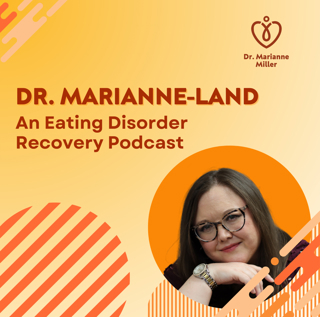
If Everyone Is Getting Smaller, This Might Be Why: GLP-1s, Tradwives, & Eating Disorder Pressure With Anne Richardson @theeatingdisordernutritionist

If Everyone Is Getting Smaller, This Might Be Why: GLP-1s, Tradwives, & Eating Disorder Pressure With Anne Richardson @theeatingdisordernutritionist

It feels like everyone around you is getting smaller. This conversation will change how you understand why.

In this episode of the podcast, Dr. Marianne Miller sits down with eating disorder nutritionist Anne Richardson @theeatingdisordernutritionist to unpack what’s really driving the current push toward thinness. From GLP-1 medications like Ozempic to the rise of tradwife content to the constant noise around food and bodies, this episode goes beyond surface-level trends and into the deeper cultural, political, and psychological forces shaping how we relate to eating, weight, and worth. If your relationship with food or your body has felt more intense, more pressured, or more confusing lately, this conversation will help you make sense of it.

GLP-1s, Ozempic, and the New Era of Diet Culture

GLP-1 medications have rapidly shifted the landscape of weight loss, but this conversation asks a deeper question: are these medications simply tools, or are they reinforcing a much larger cultural push toward shrinking bodies? Anne and Dr. Marianne explore how conversations about Ozempic and similar drugs have taken over social media and everyday life, creating an environment where body size is once again under constant scrutiny. What might look like a health trend on the surface can quietly intensify eating disorder risk, comparison, and pressure to conform.

The “Everyone Is Getting Smaller” Effect

When more people begin to lose weight at the same time, it shifts the baseline of what feels “normal.” This episode breaks down the snowball effect that happens when shrinking bodies become more visible, leading others to feel like they need to follow suit—even if they were previously comfortable in their bodies. This dynamic can increase body dissatisfaction across all body sizes and contribute to disordered eating patterns, especially in environments where GLP-1 use becomes normalized or expected.

Tradwives, Thinness, and the Return of Restrictive Ideals

The rise of tradwife content on platforms like TikTok is not just about lifestyle aesthetics—it often carries messages about femininity, body size, and power. In this conversation, Anne and Dr. Marianne examine how hyper-femininity, thinness, and “being small” are being rebranded as desirable and even virtuous. They explore how these narratives can limit autonomy, reinforce gender roles, and create subtle but powerful pressure to look and behave in specific ways.

Is Diet Culture a Distraction?

One of the most compelling themes in this episode is the idea that the intense focus on bodies may function as a distraction from larger systemic issues. When attention is constantly redirected toward appearance, food, and weight, it can pull focus away from conversations about power, inequality, and social change. This lens invites a broader understanding of eating disorders—not just as individual struggles, but as experiences shaped by cultural and political forces.

Eating Disorders, Power, and Vulnerability

Anne shares personal reflections on her experience with anorexia and how disconnection from self can increase vulnerability to external pressures and ideologies. Together, she and Dr. Marianne explore how being undernourished, both physically and emotionally, can make it harder to access agency, voice, and resistance. This conversation reframes recovery as not just about food, but about reclaiming identity, autonomy, and the ability to take up space in the world.

The Intersection of Class, Access, and Body Size

This episode also highlights how access to GLP-1 medications is shaped by socioeconomic status, creating new layers of inequality. As some people gain access to weight-loss medications and others do not, body size can become further tied to wealth and privilege. At the same time, limited access to food, healthcare, and resources continues to shape eating behaviors and health outcomes, complicating the narrative around choice and control.

Why This Matters for Eating Disorder Recovery

If you are in eating disorder recovery, or questioning your relationship with food, this cultural moment can feel especially intense. The pressure to shrink, the constant body talk, and the normalization of restrictive behaviors can all make recovery more complex. This episode offers validation for how hard this moment can feel and invites a more compassionate, contextual understanding of your experience.

Connect With Anne Richardson

Anne Richardson is an eating disorder nutritionist based in the UK, working with clients across the UK and Europe. She shares nuanced, thought-provoking content on Instagram @theeatingdisordernutritionist about eating disorders, recovery, and diet culture.

Email: anne@theeatingdisordernutritionist.co.uk

Website: https://www.theeatingdisordernutritionist.co.uk/

Related Episodes

"We've Gone Back to the 90s": The Return of the Super Skinny Ideal With Anne Richardson @theeatingdisordernutritionist on Apple & Spotify.

An Eating Disorder Recovery Story Across Two Countries With Anne Richardson @theeatingdisordernutritionist on Apple & Spotify.

How Diet Culture & Purity Culture Fuel Eating Disorders: Unpacking the Trauma Behind the Rules With Cassie Krajewski, LCSW @inneratlastherapy on Apple & Spotify.

Work With Dr. Marianne

Dr. Marianne Miller is a licensed therapist specializing in eating disorder recovery, including ARFID, binge eating disorder, anorexia, and bulimia. She offers therapy and coaching for clients in California, Washington, D.C., and globally. Check out her website at drmariannemiller.com. You can follow her on Instagram @drmariannemiller.

Det här avsnittet är hämtat från ett öppet RSS-flöde och publiceras inte av Podme. Det kan innehålla reklam.

Avsnitt(350)

Eating Disorders in Midlife: Rebuilding Trust With Food & Your Body With Amber Caudle

Eating Disorders in Midlife: Rebuilding Trust With Food & Your Body With Amber Caudle

Binge eating recovery requires more than changing what or how you eat. Chef, eating psychology coach, and author Amber Caudle joins Dr. Marianne to discuss her 30-year struggle with binge eating, rest...

21 Sep 33min

ARFID & PDA: Why Eating Can Feel Like a Demand Even When No One Is Pressuring You

ARFID & PDA: Why Eating Can Feel Like a Demand Even When No One Is Pressuring You

ARFID and PDA can make eating feel difficult even when no one is telling you what, when, or how much to eat. For autistic and neurodivergent people with Avoidant/Restrictive Food Intake Disorder (ARFI...

18 Sep 15min

Tradwives, Disordered Eating, & the Thin Ideal: Why Young Women Are Being Told to Shrink Again

Tradwives, Disordered Eating, & the Thin Ideal: Why Young Women Are Being Told to Shrink Again

Tradwife culture is having a moment, but what happens when traditional femininity, purity culture, the thin ideal, and disordered eating begin to overlap? In this SOLO episode, Dr. Marianne Miller exa...

16 Sep 20min

Is Eating Disorder Recovery a Form of Neurodivergence? Diet Culture, Hunger, & Body Trust With Shira Collings, LPC

Is Eating Disorder Recovery a Form of Neurodivergence? Diet Culture, Hunger, & Body Trust With Shira Collings, LPC

Eating disorder recovery often requires developing a relationship with food, hunger, movement, and body size that differs sharply from what society considers “normal.” In this conversation, Dr. Marian...

14 Sep 27min

Autism, Food Rigidity, & Eating Disorders: How Autistic Traits Can Help & Hinder Recovery

Autism, Food Rigidity, & Eating Disorders: How Autistic Traits Can Help & Hinder Recovery

Autism and eating disorders can create a complicated relationship with food rigidity, routines, sensory needs, and predictability. For autistic people recovering from anorexia, ARFID, bulimia, or othe...

11 Sep 19min

Why Is Eating Disorder Recovery So Scary? Understanding Fear, Safety, & Letting Go

Why Is Eating Disorder Recovery So Scary? Understanding Fear, Safety, & Letting Go

Eating disorder recovery can feel surprisingly scary, even when you genuinely want to get better. Letting go of restriction, binge eating, purging, compulsive exercise, food rules, or body checking ca...

9 Sep 15min

How to Help Your Child With an Eating Disorder: Replacing Control With Connection With Dr. Tom Wooldridge

How to Help Your Child With an Eating Disorder: Replacing Control With Connection With Dr. Tom Wooldridge

Supporting a child or teen with an eating disorder can leave parents caught between the urgency to help them eat and the fear that increasing control will create more conflict around food. In this epi...

7 Sep 32min

Anorexia & Binge Eating: The Binge-Restrict Cycle in Long-Term Eating Disorder Recovery

Anorexia & Binge Eating: The Binge-Restrict Cycle in Long-Term Eating Disorder Recovery

Can you have anorexia and struggle with binge eating, too? If you find yourself moving between food restriction and binge eating, you may wonder whether your eating disorder has changed or whether you...

4 Sep 10min
Populärt inom Hälsa

somna-med-henrik
rss-jossan-nina
rss-bara-en-till-om-beroende-medberoende
inga-beiga-morsor
rss-vuxna-pa-latsas
bullfika
johannes-hansen-podcast
angestpodden
rss-viktmedicinpodden
sexnoveller-deluxe
sova-med-dan-horning
sa-in-i-sjalen
rss-ronden
not-fanny-anymore
tyngre-traningssnack
rss-traningsklubben
rss-basta-livet
halsoveckan-by-tyngre
rss-hos-psykologen
rss-sjalsligt-avkladd