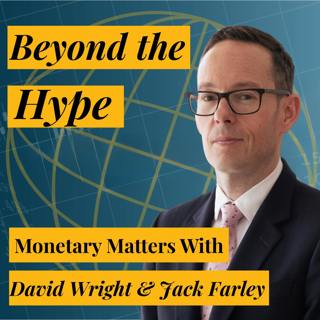
Why Generative AI Still Can’t Trade | David Wright on How Quant Alpha Actually Is Done With Machine Learning, Decision Trees, and Gradient Boosting

Why Generative AI Still Can’t Trade | David Wright on How Quant Alpha Actually Is Done With Machine Learning, Decision Trees, and Gradient Boosting

To learn more about Pictet AI Enhanced US Equity ETF ($PQUS), click here: https://etf.am.pictet.com/pqus/ This interview is brought to you by Pictet Asset Management. To learn more about Pictet AI-Enhanced International Equity ETF ($PQNT), click here: https://etf.am.pictet.com/pqnt/ Jack Farley sits down with David Wright, co-head of Quantitative Investments at Pictet Asset Management, to discuss the machine learning techniques his team uses in their $30 billion quant franchise, and the degree to which AI has impacted serious quantitative investing. Wright explains why he prefers to utilize many decision trees and use gradient boosting rather than Generative AI to generate return forecasts, citing the need to avoid "hallucinations" and ensure models remain interpretable. The conversation explores their sophisticated investment process, which analyzes over 400 features, including accounting data, market trends, and analyst sentiment, to predict relative stock performance over 20-day horizons. These strategies, which now are included in new ETFs $PQNT (Pictet AI Enhanced International Equity ETF) and $PQUS (Pictet AI Enhanced US Equity ETF) are designed as "passive replacements," aiming to maintain a Beta of 1.0 while aiming to deliver an additional 1–2% annual outperformance over the relevant benchmarks, S&P 500 and MSCI EAFE indices. Finally, Wright addresses the common "black box" misconception of quantitative finance, advocating instead for a "crystal box" approach that provides full transparency into the economic rationale behind every trade. Recorded April 21, 2026. For important information about the fund, please click: https://etf.am.pictet.com/” Important Information Before investing, carefully consider the fund’s investment objectives, risks, charges, and expenses. This and other information can be found in the fund’s prospectus or, if available, the summary prospectus, which may be obtained by calling (855) 994-4778 or visiting www.pictet.com/etf. Read it carefully before investing. (In Italic or Bold) Investing in Exchange Traded Funds (ETFs) involves risk, including possible loss of principal. The fund's principal investment risks include Artificial Intelligence Models and Data Risk, Non-Diversification Risk, Convertible Securities Risk, Rights and Warrants Risk, Real Estate Investment Trusts (REITs) Risk and Sustainability & ESG Data Risk. For additional information about these and other fund risks, please refer to the "Principal Investment Risks" section of the prospectus. ETFs are subject to additional risks that do not apply to conventional mutual funds, including the risks that the market price of an ETF's shares may trade at a premium or discount to its net asset value, an active secondary trading market may not develop or be maintained, or trading may be halted by the exchange in which they trade, which may impact an ETF's ability to sell its shares. Shares of any ETF are bought and sold at market price (not NAV) and are not individually redeemed from the ETF. Brokerage commissions will reduce returns. Foreside fund services, LLC, distributor. Definitions of terms used in the interview: 1. S&P 500 Index The Standard & Poor’s 500 Index (S&P 500) is a market-capitalization-weighted index of 500 leading publicly traded companies in the United States. It is widely regarded as the best single gauge of large-cap U.S. equities. Because it is weighted by market value, larger companies have a greater impact on the index's performance than smaller ones. 2. MSCI EAFE Index The MSCI EAFE Index is a stock market index that tracks the performance of large- and mid-cap securities across developed markets around the world, excluding the U.S. and Canada. The acronym stands for Europe, Australasia, and the Far East. It is commonly used as a benchmark for international equity funds. 3. Alpha Alpha represents the "excess return" of an investment relative to the return of a benchmark index. It is a measure of performance on a risk-adjusted basis. "Positive Alpha: indicates the investment outperformed its benchmark after accounting for risk and "Negative Alpha" indicates the investment underperformed relative to the benchmark. 4. Beta Beta measures the volatility—or systematic risk—of a security or portfolio in comparison to the market as a whole (usually the S&P 500, which has a Beta of 1.0) A Beta > 1.0 indicates the investment is more volatile than the market (e.g., if the market rises 10%, the investment might rise 12%) A Beta < 1.0 indicates the investment is less volatile than the market (e.g., if the market falls 10%, the investment might only fall 8%). 5. Basis Points (bps) A Basis Point is a standard unit of measure for interest rates and other percentages in finance. One basis point is equal to 1/100th of 1%, or 0.01%.

Det här avsnittet är hämtat från ett öppet RSS-flöde och publiceras inte av Podme. Det kan innehålla reklam.

Avsnitt(276)

What If It’s Still Early? | Erik YWR on $10,000 S&P 500 by 2027 Case, Hyperscaler ROIC, AI CapEx, Semis, Exchanges, and Reverse Crash Risk In “Project Zimbabwe”

What If It’s Still Early? | Erik YWR on $10,000 S&P 500 by 2027 Case, Hyperscaler ROIC, AI CapEx, Semis, Exchanges, and Reverse Crash Risk In “Project Zimbabwe”

In this episode, veteran investor and macro strategist Erik from the Erik YWR Substack breaks down his bold bull thesis projecting the S&P 500 to hit 10,000 by the end of 2027. Drawing on his past inv...

2 Juli 1h 6min

Top IPO Scholar on Unprecedented IPO Wave & Why IPOs Underperform the Market | Jay Ritter

Top IPO Scholar on Unprecedented IPO Wave & Why IPOs Underperform the Market | Jay Ritter

Leading IPO researcher Jay Ritter, widely known as "Mr. IPO" and the director of the IPO Initiative at the University of Florida's Warrington College of Business breaks down the historic 2026 public m...

30 Juni 51min

Rothschilds, Railroads, & Ruin | Liaquat Ahamed on “1873” (New Book!)

Rothschilds, Railroads, & Ruin | Liaquat Ahamed on “1873” (New Book!)

Liaquat Ahamed, legendary financial historian and author, joins Jack to discuss his latest book, "1873: The Rothschilds, the First Great Depression, and the Making of the Modern World.” Ahamed unpacks...

29 Juni 54min

Inside The Platform Helping to Invest Like Substack & FinTwit's Top Researchers | Plutus

Inside The Platform Helping to Invest Like Substack & FinTwit's Top Researchers | Plutus

In this episode of Other People's Money, host Max Wiethe sits down with Shashank Chiranewala, founder of the new investment platform Plutus, to explore the future of independent research and portfolio...

24 Juni 47min

Ed Zitron: The AI Bubble is Bleeding Cash, Here Are The Receipts

Ed Zitron: The AI Bubble is Bleeding Cash, Here Are The Receipts

Ed Zitron is one of the most prolific skeptic of the AI Boom. Having just reported OpenAI’s 2025 financial loss, he joins Jack to argue that the sheer size of the losses by the large language model (L...

21 Juni 1h 10min

Jim Chanos & Val Zlatev: Long and Short Alpha in AI, Semiconductors, Neoclouds, and Data Centers | MacroMinds Symposium 2026

Jim Chanos & Val Zlatev: Long and Short Alpha in AI, Semiconductors, Neoclouds, and Data Centers | MacroMinds Symposium 2026

In this panel at MacroMinds Symposium, Jack Farley sits down with legendary short seller Jim Chanos and Val Zlatev, Portfolio Manager and Partner at Analog Century Management, to analyze the long and ...

20 Juni 55min

The US Manufacturing and Electrification Megatrends Are Here and They’re Way More Than AI | Chris Semenuk

The US Manufacturing and Electrification Megatrends Are Here and They’re Way More Than AI | Chris Semenuk

In this episode of Other People’s Money, host Max Wiethe sits down with Chris Semenuk, an investment partner at Tema ETFs, to discuss the massive secular tailwinds driving the US manufacturing and ele...

18 Juni 1h 19min

Regulatory Risk is Coming For AI | David Woo on AI Data Center CapEx and Iran War

Regulatory Risk is Coming For AI | David Woo on AI Data Center CapEx and Iran War

Sponsor: Teucrium Corn Fund (NYSE Arca: CORN): https://teucrium.com/corn In this episode of Monetary Matters, host Jack Farley sits down with independent economist and strategist David Woo to brea...

15 Juni 1h 5min

Populärt inom Business & ekonomi

badfluence
framgangspodden
varvet
svd-tech-brief
rss-borsens-finest
uppgang-och-fall
avanzapodden
dynastin
lastbilspodden
bathina-en-podcast
rss-inga-dumma-fragor-om-pengar
fill-or-kill
rss-svart-marknad
borsmorgon
rss-dagen-med-di
tabberaset
rikatillsammans-om-privatekonomi-rikedom-i-livet
24fragor
kapitalet-en-podd-om-ekonomi
rss-dominoeffekten