
Andrew Jackson: Democracy, Blood, and the Trail of Tears

Andrew Jackson: Democracy, Blood, and the Trail of Tears

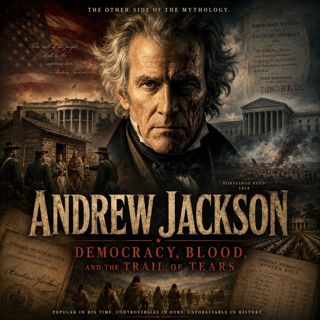
Andrew Jackson sold himself as the champion of the common man. His face has been on the twenty dollar bill since 1928. There are statues of him in city squares from Tennessee to Washington. He's been claimed, in successive eras, by Democrats and Republicans, by progressives and conservatives, by every politician who ever wanted to wrap himself in the language of populism without owning what that language actually delivered when Jackson was the one speaking it.

This episode is the other side of that mythology.We start in north Georgia in the spring of 1838, the morning soldiers arrive at a Cherokee family's door with orders to clear them out. Then we cut back to the man who set that morning in motion. Born in the Carolina backcountry in 1767.

Orphaned by the Revolution at fourteen. A lawyer, a duelist, a slave owner, a planter who built his fortune on the forced labor of more than one hundred and fifty enslaved men, women, and children at the Hermitage. The general who broke the Red Stick Creeks at Horseshoe Bend, took 23 million acres of their land in the Treaty of Fort Jackson, and went home to grieve over the death of a Creek child he'd adopted from a different battlefield in the same war.We follow him into the White House. The Bank War. The cabinet shakeups. The temperament that made him willing to ignore his own Treasury Department, his own Congress, and eventually his own Supreme Court when they got in his way.

We walk through the Indian Removal Act of 1830, passed by five votes in the House after Theodore Frelinghuysen spoke against it for six hours over three days. We follow the Cherokee Nation's legal fight to John Marshall's bench, where they won the ruling that should have saved them, and we sit with the fact that a Supreme Court decision is only as strong as the executive willing to enforce it.

Jackson was not willing. We talk about the Treaty of New Echota, signed by fewer than five hundred Cherokee out of a nation of more than sixteen thousand, ratified by the United States Senate in 1836 by a single vote. We talk about what happened to the men who signed it. We talk about the bureaucracy that turned removal from chaos into policy: the muster rolls, the contracts, the chain of small decisions made by ordinary people in offices who could tell themselves they were just doing their jobs.

We don't retell the Trail of Tears in this one. That road has its own episode. This one's about the man who pointed at it, and the country that picked up his face and put it in our pockets.

If you've ever wondered how a democratic republic, working more or less the way it was designed to work, ends up administering an atrocity, this is that story.

Have a forgotten historical mystery, disturbing event, unsolved crime, or hidden conspiracy you think deserves investigation?

Send your suggestions to brian@paranormalworldproductions.com.

Disturbing History is a dark history podcast exploring unsolved mysteries, secret societies, historical conspiracies, lost civilizations, and the shadowy stories buried beneath the surface of the past.

Follow the show and enable automatic downloads so you never miss a deep dive into history’s most unsettling secrets.

Because sometimes the truth is darker than fiction.

Det här avsnittet är hämtat från ett öppet RSS-flöde och publiceras inte av Podme. Det kan innehålla reklam.

Avsnitt(123)

FDR: The Man Who Could Have Been King

FDR: The Man Who Could Have Been King

He was elected President of the United States 4 times, and a whole generation of Americans grew up unable to remember anyone else in the office. In this episode of Disturbing History, we pull apart th...

17 Juli 1h 23min

The Fair Tax

The Fair Tax

Taxes don't sound like Disturbing History territory, until you learn the trail of blood and power behind them. This episode traces the entire violent history of taxation in America, from the Stamp Act...

15 Juli 1h 15min

The Smithsonian's Strange Phenomena Files

The Smithsonian's Strange Phenomena Files

There's a building in Washington where, for the better part of a century, ordinary Americans mailed in the impossible. Flesh that fell from a clear sky onto a Kentucky farmwife making soap. A swarm of...

12 Juli 1h 1min

Loving the Monster

Loving the Monster

Some nights the well runs dry, and I do what everybody does — I sink into the couch and let Netflix babysit me for a while. That's how I ended up watching The Worst Ex Ever, and that's how I ended up ...

10 Juli 1h 1min

The Rise and Ruin of the FLDS Church

The Rise and Ruin of the FLDS Church

He was the mouthpiece of God to ten thousand followers. To the FBI, he was a face on the Ten Most Wanted list. And to a Nevada state trooper working a dark stretch of Interstate Fifteen, he was just a...

8 Juli 1h 7min

Children Sent Through the Mail

Children Sent Through the Mail

In the winter of nineteen fourteen, a five-year-old girl named May Pierstorff stood on a train platform in Grangeville, Idaho, with fifty-three cents in postage stamps pinned to her coat. Her parents ...

5 Juli 1h 1min

The Poison Bottles America Trusted

The Poison Bottles America Trusted

Before the Food and Drug Administration, before warning labels, before anyone had to prove a medicine was safe or even admit what was inside it, America ran on the bottle.This episode opens the cabine...

3 Juli 59min

Nazi Propaganda & The American Mirror

Nazi Propaganda & The American Mirror

The word propaganda began as something holy. In sixteen twenty-two a committee of cardinals in Rome coined it to mean the spreading of the faith, and in this episode I follow that single word as it cu...

1 Juli 1h 4min

Populärt inom Samhälle & Kultur

podme-dokumentar
aftonbladet-krim
gynning-berg
p3-dokumentar
svenska-fall
en-mork-historia
tv4-nyheterna-story
badfluence
creepypodden-med-jack-werner
killradet
aftonbladet-daily
mardromsgasten
kod-katastrof
hor-har
flashback-forever
skaringer-nessvold
rss-mer-an-bara-morsa
de-fyras-gang
vad-blir-det-for-mord
p3-historia