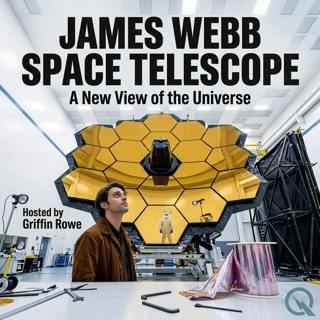
The James Webb Space Telescope and the Early Universe

The James Webb Space Telescope and the Early Universe

The James Webb Space Telescope and the Early Universe Welcome to The James Webb Space Telescope podcast, where we explore the latest discoveries from the world's most powerful telescope. In today's episode, we're going to be talking about the early universe, and how the James Webb Space Telescope is helping us to understand this mysterious time period. The James Webb Space Telescope is a powerful infrared telescope that can see the light from the very first stars and galaxies that formed in the universe. This is because infrared light is less affected by the expansion of the universe than visible light, so it can travel longer distances without being stretched out. The James Webb Space Telescope can also see through dust and gas, which is important for studying the early universe, because the first galaxies were surrounded by clouds of dust and gas. By studying the early universe in infrared light, the James Webb Space Telescope is helping us to answer some of the most fundamental questions about our universe, such as: How did the first stars and galaxies form? What role did dark matter and dark energy play in the evolution of the universe? The first stars and galaxies formed in the early universe, about 13.8 billion years ago, after the Big Bang. The Big Bang was a massive explosion that created all of the matter and energy in the universe. After the Big Bang, the universe was very hot and dense, but it quickly expanded and cooled. As the universe expanded, gravity began to pull clumps of matter together. These clumps of matter eventually became the first stars and galaxies. The first stars were very different from the stars that we see today. They were much larger and hotter, and they lived for much shorter periods of time. The first stars played an important role in the evolution of the universe. They produced the first heavy elements, such as carbon and oxygen, which are essential for life. The first stars also helped to ionize the gas in the universe, which made it possible for galaxies to form. Dark matter and dark energy are two of the most mysterious substances in the universe. Dark matter is a type of matter that we cannot see directly, but we know it exists because of its gravitational effects on visible matter. Dark energy is a force that is causing the universe to expand at an accelerating rate. Dark matter and dark energy played an important role in the evolution of the universe. Dark matter helped to seed the formation of the first stars and galaxies. Dark energy is causing the universe to expand at an accelerating rate, which is pulling galaxies apart. The James Webb Space Telescope is a powerful new tool that is helping us to understand the early universe. By studying the early universe in infrared light, the James Webb Space Telescope is helping us to answer some of the most fundamental questions about our universe, such as how the first stars and galaxies formed and what role dark matter and dark energy played in the evolution This content was created in partnership and with the help of Artificial Intelligence AI.

Det här avsnittet är hämtat från ett öppet RSS-flöde och publiceras inte av Podme. Det kan innehålla reklam.

Avsnitt(150)

James Webb Space Telescope - A New View of the Universe - Quasar Impostors and Little Red Dots

James Webb Space Telescope - A New View of the Universe - Quasar Impostors and Little Red Dots

Join your host as James Webb Space Telescope: A New View of the Universe unpacks six stunning discoveries—quasar impostors revealed as massive star-forming galaxies, ancient reionization bubbles, blac...

19 Sep 14min

James Webb Space Telescope Reveals Brown Dwarfs, Early Black Holes, and Dynamic Ring Systems in Latest Discoveries

James Webb Space Telescope Reveals Brown Dwarfs, Early Black Holes, and Dynamic Ring Systems in Latest Discoveries

# The Space Cowboy: Riding the Cosmic Range with James Webb's Latest Discoveries **Podcast Episode Description:** Saddle up for another journey across the cosmic frontier with The Space Cowboy as we...

19 Sep 9min

James Webb Space Telescope - A New View of the Universe - Fake Quasars, Neptune's Reborn Moons

James Webb Space Telescope - A New View of the Universe - Fake Quasars, Neptune's Reborn Moons

James Webb Space Telescope reveals surprises: early quasars are star-blazing galaxies, a mysterious black hole star, Neptune's moon origins, tiny trans-Neptunian objects, and a distant planet losing i...

12 Sep 10min

James Webb Space Telescope Discovers Massive Star Forming Galaxies and Exotic Exoplanet Atmospheres

James Webb Space Telescope Discovers Massive Star Forming Galaxies and Exotic Exoplanet Atmospheres

# The Space Cowboy Show: Riding Through JWST's Latest Cosmic Discoveries **Episode Description:** Saddle up for another wild ride through the cosmos! In this episode of The Space Cowboy Show, we exp...

12 Sep 11min

James Webb Space Telescope - A New View of the Universe - Black Hole Stars and Hidden Galaxies

James Webb Space Telescope - A New View of the Universe - Black Hole Stars and Hidden Galaxies

Join our AI host on James Webb Space Telescope: A New View of the Universe as we explore hidden faint stars reshaping galaxy mass estimates, a mysterious "black hole star" at cosmic dawn, an archival ...

5 Sep 12min

James Webb Space Telescope Discovers Exoplanet Atmospheres and Early Universe Black Holes in Latest Cosmic Findings

James Webb Space Telescope Discovers Exoplanet Atmospheres and Early Universe Black Holes in Latest Cosmic Findings

# The Space Cowboy: James Webb Space Telescope's Latest Cosmic Discoveries **Episode Description:** Ride along with The Space Cowboy on a journey through the universe's most fascinating recent disco...

5 Sep 11min

James Webb Space Telescope - A New View of the Universe - The Black Hole Star and Cosmic Mysteries

James Webb Space Telescope - A New View of the Universe - The Black Hole Star and Cosmic Mysteries

Host Griffin Rowe explores JWST's latest discoveries: a mysterious "black hole star" in Cetus, undercounted galaxies with hidden planet-forming potential, an "early galaxy crisis" resolved, heavy wate...

29 Aug 14min

James Webb Space Telescope Reveals Hidden Stars in Early Galaxies and Accelerates Planet Formation Timeline

James Webb Space Telescope Reveals Hidden Stars in Early Galaxies and Accelerates Planet Formation Timeline

# Episode Description **Riding the Infrared Frontier: James Webb's Latest Cosmic Discoveries** Join The Space Cowboy for an action-packed journey through the newest James Webb Space Telescope discov...

29 Aug 10min

Populärt inom Vetenskap

dumma-manniskor
p3-dystopia
allt-du-velat-veta
rss-mottagningen
rss-ronden
det-morka-psyket
kapitalet-en-podd-om-ekonomi
bildningspodden
rss-ufobortom-rimligt-tvivel
medicinvetarna
svd-nyhetsartiklar
rss-kriminologerna
rss-vetenskapsradion-2
sexet
rss-vetenskapsradion
ufo-sverige
rss-geopodden-2
rss-spraket
rss-odla
4health-med-anna-sparre