The Hidden Impact of 6PPD: What Salmon Are Telling Us

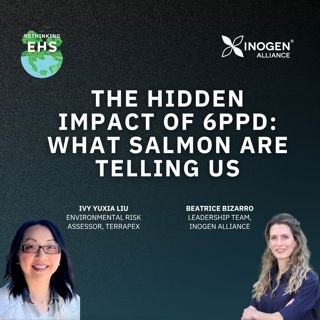
The Hidden Impact of 6PPD: What Salmon Are Telling Us

In this bonus episode of Rethinking EHS, Beatrice Bizzaro and Ivy Liu take a deeper dive into the environmental consequences of 6PPD-quinone, focusing on its devastating effects on coho salmon. As a keystone and indicator species, coho salmon play a critical role in ecosystem health and provide an early warning signal for water pollution.

The episode explains how 6PPD, a widely used tire additive, reacts with ozone to form a highly toxic byproduct that enters waterways through stormwater runoff. This has led to acute and often rapid mortality events in salmon populations, particularly in urban streams, with significant ecological, cultural, and economic implications.

Ultimately, the episode underscores the urgent need for improved stormwater management, stronger regulatory action, and the development of safer chemical alternatives. It calls on organisations and regulators to take proactive steps to reduce pollutant release and better protect aquatic ecosystems.

-----

Timestamps:

00:06 – Introduction & episode overview
00:43 – Why coho salmon are key indicator species
03:28 – How 6PPD enters waterways
05:04 – Why research is concentrated in the Pacific Northwest
06:09 – Key takeaways and urgency for action
07:28 – Salmon life cycle and vulnerability
09:25 – “Canary in the coal mine” explained
11:45 – Closing reflections

-----

Sponsor:

Rethinking EHS is brought to you by the Inogen Alliance. Inogen Alliance is a global network of 70+ companies providing environment, health, safety, and sustainability services, working together to provide one point of contact to guide multinational organizations to meet their global commitments locally. Visit inogenalliance.com to learn more.

-----

Links

https://www.Inogenalliance.com/resources

https://www.Inogenalliance.com/podcast

Beatrice on LinkedIn https://www.linkedin.com/in/beatrice-bizzaro/

Ivy on LinkedIn https://www.linkedin.com/in/ivy-liu-p-geo-qpra-4a797520/

Produced by https://www.madcontent.co.nz

Transcript

1

00:00:06,100 --> 00:00:12,000

Beatrice:

Hello everyone and welcome to Season 3 of Rethinking.

2

00:00:12,000 --> 00:00:20,000

Beatrice:

The EHS Global Goals, Local Delivery

and Inogen Alliance podcast.

3

00:00:20,000 --> 00:00:28,000

Beatrice:

My name is Beatrice Designer,

Water Stewardship Technology Lead at HPC Italy,

4

00:00:28,000 --> 00:00:32,200

Beatrice:

and your host for today’s bonus episode.

5

00:00:32,230 --> 00:00:43,140

Beatrice:

I’m joined by Ivy from Terrapex.

Thanks for being here again, Ivy.

6

00:00:43,190 --> 00:00:55,200

Beatrice:

Why is coho salmon used

as an early warning indicator?

7

00:00:55,220 --> 00:01:07,150

Ivy:

Coho salmon are extremely sensitive.

8

00:01:07,150 --> 00:01:14,010

Ivy:

It helps to view them in the broader

Pacific Northwest salmon context.

9

00:01:14,030 --> 00:01:26,000

Ivy:

They’re among the most affected species

by 6PPD-quinone contamination.

10

00:01:26,000 --> 00:01:38,000

Ivy:

Salmon are vital to ecosystems —

as predators, prey, and nutrient recyclers.

11

00:01:38,000 --> 00:01:50,000

Ivy:

They also act as indicator species,

reflecting overall water quality.

12

00:01:50,220 --> 00:02:05,000

Ivy:

Coho salmon are especially useful indicators

because their response is acute and repeatable.

13

00:02:05,000 --> 00:02:21,110

Ivy:

This makes them key for identifying

urban runoff contamination.

14

00:02:21,130 --> 00:02:28,190

Ivy:

6PPD-quinone has been recognised

as a global contaminant since 2023.

15

00:03:28,210 --> 00:03:36,000

Beatrice:

How does it enter surface water?

16

00:03:36,000 --> 00:03:44,080

Ivy:

It comes from 6PPD,

a chemical used in car tyres.

17

00:03:44,080 --> 00:03:56,140

Ivy:

When tyres wear down,

particles react with ozone.

18

00:03:56,140 --> 00:04:05,000

Ivy:

This creates the toxic byproduct,

6PPD-quinone.

19

00:05:04,120 --> 00:05:16,000

Beatrice:

Why did research start

in the Pacific Northwest?

20

00:05:16,000 --> 00:05:30,000

Ivy:

Because coho salmon are native there,

and mass die-offs were highly visible.

21

00:05:30,000 --> 00:05:51,000

Ivy:

That triggered strong local research efforts

across universities and institutions.

22

00:05:51,020 --> 00:06:03,000

Beatrice:

What’s the key takeaway

from your work?

23

00:06:03,000 --> 00:06:20,000

Ivy:

The chemical is highly toxic

and shouldn’t be taken lightly.

24

00:06:20,000 --> 00:06:34,000

Ivy:

We urgently need safer alternatives

and better stormwater management.

25

00:07:16,180 --> 00:07:28,140

Beatrice:

Why are salmon especially vulnerable?

26

00:07:28,160 --> 00:07:42,000

Ivy:

They are anadromous —

moving between ocean and freshwater.

27

00:07:42,000 --> 00:08:03,060

Ivy:

This exposes them to risks

across multiple environments.

28

00:08:03,080 --> 00:08:20,000

Ivy:

They hatch in streams, move through estuaries,

then mature in the ocean.

29

00:08:20,000 --> 00:08:41,000

Ivy:

Finally, they return to freshwater

to spawn — often in urban areas.

30

00:09:25,060 --> 00:09:35,060

Beatrice:

What does “canary in the coal mine” mean?

31

00:09:35,080 --> 00:09:50,000

Ivy:

They signal broader water quality issues

caused by urban runoff.

32

00:09:50,000 --> 00:10:07,230

Ivy:

Their response is rapid and often lethal.

33

00:10:08,000 --> 00:10:27,160

Ivy:

Mortality can reach 60–90%,

sometimes within 90 minutes.

34

00:10:27,180 --> 00:10:44,000

Ivy:

Even at extremely low concentrations.

35

00:11:02,110 --> 00:11:20,000

Ivy:

This makes them powerful indicators

of broader environmental contamination.

36

00:11:45,010 --> 00:11:47,230

Beatrice:

Thank you, Ivy.

37

00:11:48,000 --> 00:12:05,000

Beatrice:

Thanks for listening.

Follow the podcast on Spotify, YouTube, LinkedIn and Apple.

38

00:12:05,000 --> 00:12:30,000

Beatrice:

Until next time,

thank you for being part of this community.

Det här avsnittet är hämtat från ett öppet RSS-flöde och publiceras inte av Podme. Det kan innehålla reklam.

Avsnitt(45)

Navigating Energy Regulations: Lessons from Switzerland

Navigating Energy Regulations: Lessons from Switzerland

This bonus episode expands on the themes discussed in Episode 5 by providing a practical example of how energy resilience strategies are implemented at the local level. The discussion focuses on Switz...

21 Juli 8min
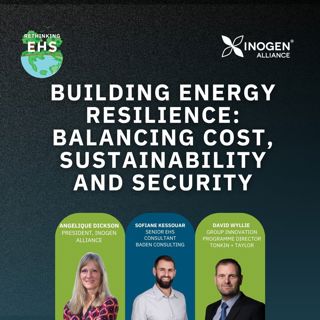
Building Energy Resilience: Balancing Cost, Sustainability and Security

Building Energy Resilience: Balancing Cost, Sustainability and Security

Episode 5 of Rethinking EHS, Season 3 focuses on energy resilience and the strategies organisations can adopt to navigate growing uncertainty in global energy systems. The episode explores how geopoli...

14 Juli 33min
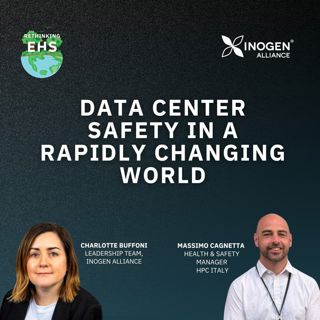
Data Center Safety in a Rapidly Changing World

Data Center Safety in a Rapidly Changing World

This bonus episode expands on the themes discussed in Episode 4 by taking a closer look at the practical safety challenges facing data center operators and EHS professionals. The conversation highligh...

30 Juni 15min
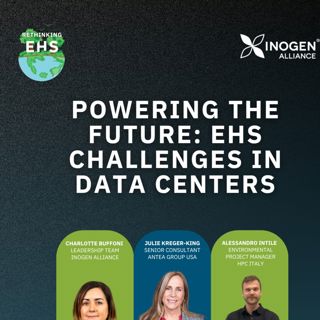
Powering the Future: EHS Challenges in Data Centers

Powering the Future: EHS Challenges in Data Centers

Episode 4 of Rethinking EHS, Season 3 focuses on the fast-growing data center sector and the need to balance speed, innovation, and sustainability. The episode explores how global demand for digital i...

23 Juni 38min

Beyond Compliance: Building a Strong Safety Culture

Beyond Compliance: Building a Strong Safety Culture

This bonus episode of Rethinking EHS, Season 3 focuses on the invisible cultural factors that shape organisational risk and safety performance. The discussion highlights how companies can have strong ...

9 Juni 16min

The New Era of Risk Management: From Compliance to Resilience

The New Era of Risk Management: From Compliance to Resilience

Episode 3 of Rethinking EHS, Season 3 focuses on the transformation of risk management in a rapidly changing global environment. The discussion highlights how modern risks now spread faster than ever ...

2 Juni 34min

From PFAS to Microplastics: The Rising Challenge of Emerging Contaminants

From PFAS to Microplastics: The Rising Challenge of Emerging Contaminants

Episode 2 of Rethinking EHS, Season 3 focuses on the rapid rise of emerging contaminants and their impact on environmental and human health. Advances in scientific research are revealing hidden risks ...

12 Maj 32min

Populärt inom Business & ekonomi

framgangspodden
badfluence
varvet
dynastin
uppgang-och-fall
rss-borsens-finest
avanzapodden
svd-tech-brief
rss-inga-dumma-fragor-om-pengar
fill-or-kill
tabberaset
lastbilspodden
rikatillsammans-om-privatekonomi-rikedom-i-livet
rss-dagen-med-di
borsmorgon
rss-kort-lang-analyspodden-fran-di
rss-hos-psykologen
borslunch-2
rss-veckans-trade
rss-borslunch