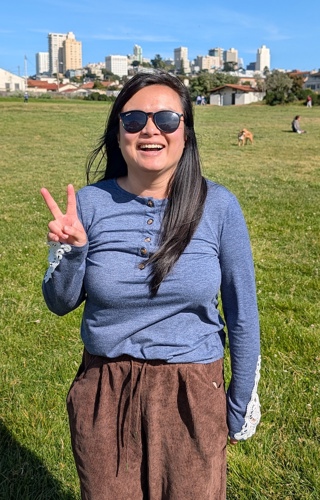
Jenny Chan/Pacific Atrocities Education, Part 2 (S8E18)

Jenny Chan/Pacific Atrocities Education, Part 2 (S8E18)

Ed. note: Please be advised that there's some very heavy subject matter discussed in this episode.

In Part 2, we pick up where we left off in Part 1. Jenny left San Francisco for college, heading east to go to school at the University of Illinois Urbana-Champaign. Part of it was wanting a change of scenery. As she says, she "wanted to see snow." But all it took was a few winters before she realized how good the weather in SF is. She also wanted to return to help take care of her mom, who was getting older.

This was around the time that Jenny went to China and came back determined to spread the untold histories of what happened in her homeland during WWII. The nonprofit learning curve was steep, and it was almost certainly going to mean shifting gears lifestyle-wise, due to not having as much income.

During the first year of Pacific Atrocities Education's life, it was fiscally sponsored by Intersection for the Arts, an SF-based arts nonprofit. Jenny enrolled in and went to as many workshops as she could. She felt generally well-respected and taken care of.

With her nascent nonprofit off and running, Jenny traveled to a part of China she had never been to before—Shanxi—to visit and talk with women who survived the war as so-called comfort women (think "sex slaves"). Jenny goes on a sidebar here to talk about some of the things the Japanese did to women during their occupation of China. It involved the Japanese not wanting their soldiers to pick up STDs while in a foreign country. If they could control the situation, i.e., enslave Chinese women to have sex with their soldiers, they could solve that "problem." So disgusting.

Hearing these women's stories wasn't easy for Jenny. One story involved one of the women being pregnant after the war ended. She went back to live with her mother, who helped her along. When the baby was born, they abandoned it. Just horrible all around. We sidebar, a little, to talk about the ripple effect of wars and how it's not just tanks and bombs and guns and soldiers fighting other soldiers. There are untold numbers of innocent folks caught up in the destruction, folks whose lives are forever upended, if they even survive.

Jenny says that the experience on that trip to China gave her perspective on her own childhood in the Tenderloin. She thought maybe it wasn't so bad after all.

It wasn't only women in China. She went and spoke with women in California's Central Coast area about their own experiences as "comfort women." These were Filipinas who relocated to the US after the war. Most of their families didn't know their stories. And it wasn't until the Obama era that light started to be shone on them and what they'd been through. Obama's administration was the first to recognize them, but it was complicated, to say the least.

Jenny talks about the delicacy of what she set out to do. Specifically, the difficulty of balancing the need to share these stories, but also to be respectful of the lives impacted by them. In addition to the research she was undertaking for Pacific Atrocities Education, Jenny was also writing a book on the topic. She was able to scan documents from the National Archives, documents the US has due to its occupation of Japan following World War II. One of the more alarming things she found in digging through archives was that the United States traded immunity with Japan's Unit 731 scientists, whose work involved developing biological weapons. Yikes.

She goes on to describe other atrocious acts the Japanese undertook in China, stuff so horrible and inhumane I have trouble enumerating it here. I ask Jenny how she handles learning about such terrible stuff. She chalks it up to its being mission-driven work. We chat a little about how the people doing bad things never get held accountable, something true to this day.

That immunity mentioned above was given to the Japanese scientists in exchange for the information contained in their research of biological weapons, naturally. You read that right: The US looked the other way while essentially poaching incredibly deadly weapons from its vanquished enemy.

Please visit pacificatrocities.org to learn more and get involved. Their YouTube channel is called Pacific Front Untold. Follow them on Instagram @pacificatrocitiesedu.

We recorded this episode at Fort Mason in April 2026.

Photography by Jeff Hunt

Det här avsnittet är hämtat från ett öppet RSS-flöde och publiceras inte av Podme. Det kan innehålla reklam.

Avsnitt(606)

Top Chefs, Part 2 (S8E23)

Top Chefs, Part 2 (S8E23)

In Part 2, Aft joins us to chat about the band—Top Chefs. We start with the story of how TJ met Aft. A mutual friend of his and Loveberry's, Lucas Hanson, put on a show at DNA Lounge called "Liam Ber...

30 Juli 23min
TJ, Loveberry and The Top Chefs Band, Part 1 (S8E23)

TJ, Loveberry and The Top Chefs Band, Part 1 (S8E23)

There's a band in San Francisco comprising musicians from The City and whom I discovered on social media playing shows on a stoop here in SF. I can't quite be sure when I discovered them, or whether i...

28 Juli 31min
Todd Kurnat, aka Ink Letterman, aka DJ Circuit 73, Part 2 (S8E22)

Todd Kurnat, aka Ink Letterman, aka DJ Circuit 73, Part 2 (S8E22)

In Part 2, we begin with Todd and me rapping about how much digital technology has changed just in our lifetimes. Even when he was in school in Colorado, San Francisco had been a goal for Todd, a des...

16 Juli 28min
Todd Kurnat, aka Ink Letterman, aka DJ Circuit 73, Part 1 (S8E22)

Todd Kurnat, aka Ink Letterman, aka DJ Circuit 73, Part 1 (S8E22)

Todd Kurnat is everywhere. In this episode, meet and get to know Todd. These days, he's also known as Ink Letterman for his art and DJ Circuit 73 for his musical stylings. We begin in Michigan. Both...

14 Juli 26min
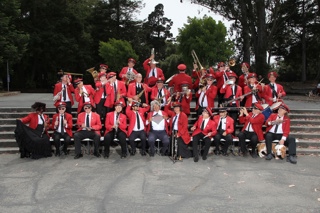
The Golden Gate Park Band (S8 Bonus)

The Golden Gate Park Band (S8 Bonus)

Listen in as I chat with German Gonzalez, musical conductor and principal director of the Golden Gate Park Band, now in its 144th year. We recorded this podcast in Golden Gate Park in June 2026.

7 Juli 23min
The San Francisco Mime Troupe, Part 3 (S8E21)

The San Francisco Mime Troupe, Part 3 (S8E21)

In Part 3, we hear from Keiko and Michael about the history of the San Francisco Mime Troupe. In the late-1950s, a San Franciscan named R.G. Davis taught a class in movement—mime, dance, physical inte...

2 Juli 35min
Michael Gene Sullivan of the San Francisco Mime Troupe (8E21)

Michael Gene Sullivan of the San Francisco Mime Troupe (8E21)

Both sides of Michael Gene Sullivan's family are from Detroit. In Part 2, we get to know Keiko's fellow SFMT collective member. Michael was born in Livonia, Michigan, a small town outside of Detroit. ...

1 Juli 35min
Keiko Shimosato Carreiro of the San Francisco Mime Troupe (S8E21)

Keiko Shimosato Carreiro of the San Francisco Mime Troupe (S8E21)

Keiko Shimosato Carreiro was born in the Bay Area … the Boston Bay Area. In Part 1 of this episode, meet Keiko. Today, she's a longtime member of the San Francisco Mime Troupe collective. But her stor...

30 Juni 30min
Populärt inom Samhälle & Kultur

podme-dokumentar
aftonbladet-krim
gynning-berg
p3-dokumentar
en-mork-historia
creepypodden-med-jack-werner
aftonbladet-daily
killradet
hor-har
rss-expressen-dok
kod-katastrof
svenska-fall
flashback-forever
mardromsgasten
rss-schyffert-sundin-ar-det-har-nat
rss-mer-an-bara-morsa
vad-blir-det-for-mord
rysarpodden
p1-dokumentar
rss-vill-du-veta-en-hemlis-2