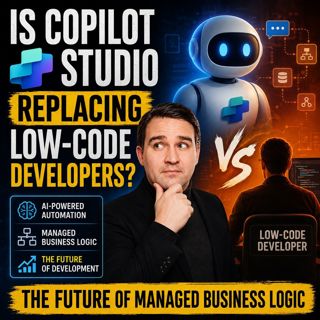
Is Copilot Studio Replacing Low-Code Developers: The Future of Managed Business Logic

Is Copilot Studio Replacing Low-Code Developers: The Future of Managed Business Logic

Most low-code developers inside the Microsoft ecosystem still spend their days building screens.Canvas apps, forms, navigation layers, Power Fx formulas, galleries, and buttons have defined the Power Platform development model for years. That approach solved real business problems and helped organizations move faster than traditional software development ever could.But the platform underneath those screens has changed.Microsoft is shifting the center of innovation away from UI-first development and toward AI-first orchestration. Copilot Studio is no longer just a chatbot builder or a conversational wrapper around Power Platform. It is becoming the reasoning layer that sits above flows, APIs, connectors, knowledge systems, and enterprise business processes.In this episode, Mirko Peters breaks down one of the biggest architectural shifts happening inside Microsoft 365 right now: the movement from screen-based low-code development toward managed business logic, declarative orchestration, and agentic AI systems.This conversation explores what Microsoft actually changed, why the old canvas model created structural problems at scale, and how Copilot Studio is redefining what enterprise developers, architects, and AI teams need to understand going into 2026.

THE OLD LOW-CODE MODEL

From 2018 through 2024, Power Apps Canvas dominated the Microsoft low-code ecosystem.The value proposition was simple. Business users needed solutions quickly, traditional development teams moved too slowly, and low-code developers could bridge the gap between business requirements and delivery speed.Canvas apps worked because they allowed organizations to rapidly build internal applications without waiting for large engineering projects.But the architecture underneath those apps had a hidden flaw.Business logic lived directly inside screens.Validation rules, formulas, variables, conditional formatting, and workflow decisions became tightly coupled to the UI itself. Over time, organizations created sprawling Power Platform estates filled with duplicated logic, disconnected formulas, and applications that became nearly impossible to maintain at enterprise scale.This episode explains why the original low-code model eventually collapsed under the pressure of governance, scalability, and maintainability.

THE PLATFORM SHIFT

The shift happening inside Microsoft’s ecosystem is not theoretical.It is visible in Microsoft’s release waves, developer tooling, Copilot investments, and architecture guidance.Mirko explains how Microsoft moved the center of innovation toward Copilot Studio, declarative agents, orchestration systems, and AI-first workflow models.Canvas apps are not disappearing. Microsoft is still supporting Power Apps and continuing to improve the platform.But support and strategic investment are not the same thing.The discussion explores how tools like the M365 Agent Toolkit and Copilot-first orchestration patterns reveal a major architectural transition away from UI-centric development.

COPILOT STUDIO IS NOT A CHATBOT

One of the biggest misconceptions in enterprise AI today is thinking of Copilot Studio as simply a conversational interface builder.This episode explains why that mental model is completely wrong.Copilot Studio functions as a goal-driven orchestration engine rather than a traditional chatbot.Instead of following rigid procedural steps like a Power Automate flow, agents interpret intent, reason across systems, dynamically select tools, and adapt to changing context during execution.Mirko explains why this creates a completely different execution model compared to traditional low-code development.The conversation also explores how declarative systems fundamentally change where business logic lives inside enterprise architectures.

JUDGMENT VS LOGIC

One of the most important concepts in this episode is the separation between judgment and logic.Power Automate owns deterministic execution.Copilot Studio owns probabilistic reasoning.Flows execute predefined actions in predefined ways. Agents decide which actions should happen based on goals, context, and system state.This architectural split fundamentally changes how enterprise workflows should be designed.Mirko explains why forcing Power Automate to handle judgment creates brittle automation systems while forcing AI agents to handle deterministic compliance workflows introduces governance and reliability risks.This becomes the new mental model for enterprise AI architecture.

WHY CANVAS APPS BECAME HARD TO SCALE

The episode explores why large Power Apps environments eventually became difficult to govern and maintain.The problem was not Power Fx itself.The problem was architectural coupling.Business logic became trapped inside UI controls, duplicated across screens, and disconnected from reusable governance layers. Over time, organizations created fragmented application ecosystems where critical business rules existed in dozens of slightly different versions spread across multiple apps.Mirko explains how delegation issues, duplicated formulas, UI-bound logic, and disconnected validation systems created long-term technical debt across enterprise Power Platform estates.

HOW AGENTIC ORCHESTRATION ACTUALLY WORKS

This episode goes deep into the mechanics of Copilot Studio orchestration.The conversation explores intent interpretation, tool selection, multi-step orchestration, adaptive execution, runtime reasoning, stateful workflows, and context-aware system behavior.Mirko explains how agents dynamically determine which tools, connectors, APIs, or flows should be used at runtime rather than relying on rigid procedural workflows.This section provides one of the clearest practical explanations of how enterprise agentic systems actually operate.

THE SAFETY SUMMARIZATION PROBLEM

One of the most valuable sections of the episode explores a hidden platform limitation many organizations discover too late.When multi-agent systems communicate with each other, orchestration layers often sanitize or summarize responses between agents.This can create major issues involving missing citations, removed links, incomplete payloads, and reduced data fidelity.Mirko explains why many organizations eventually shift toward API-first orchestration patterns using HTTP-triggered Power Automate flows rather than relying entirely on direct agent-to-agent communication.This section focuses heavily on practical architecture decisions based on real deployment experience rather than marketing slides.

THE RISE OF THE LOGIC ARCHITECT

Enterprise hiring patterns are changing rapidly.Organizations are no longer primarily searching for screen builders.They are increasingly looking for professionals who understand orchestration, governance, identity architecture, AI systems, human-in-the-loop design, and enterprise reasoning layers.This episode explores the emergence of roles including AI Product Owners, Logic Architects, Copilot Governance Leads, and AI Orchestration Architects.Mirko explains why architectural thinking is becoming more valuable than UI-centric low-code specialization.

THE ENTERPRISE SKILL GAP

The episode also breaks down the major gaps many low-code developers face entering the AI orchestration era.These gaps include data governance, model evaluation, integration architecture, AI risk management, retrieval systems, observability, and human-in-the-loop workflow design.Mirko explains why enterprise AI systems require understanding probabilistic behavior, permission-aware retrieval, RAG pipelines, AI governance operations, and orchestration-level system design.The conversation focuses heavily on the transition path from app builder to AI architect.

GOVERNANCE IS NOW ARCHITECTURE

Governance is no longer a post-deployment checklist.It has become part of the architecture itself.This episode explores agent governance, DLP expansion, AI lifecycle management, identity boundaries, prompt injection risks, conditional access, least-privilege design, and enterprise governance operations.Mirko explains why organizations must embed governance directly into orchestration systems from the beginning rather than trying to bolt it on later.

WHY POWER APPS STILL MATTER

This episode does not argue that Power Apps is disappearing.In fact, Mirko explains where traditional UI experiences still clearly outperform conversational systems.Canvas Apps remain extremely valuable for structured forms, offline scenarios, dense data grids, barcode scanning, device integration, precision workflows, and controlled data entry experiences.The future is not agents instead of apps.The future is hybrid architectures where agents handle orchestration and reasoning while apps handle structured execution and interaction.

WHAT HAPPENS TO LOW-CODE DEVELOPERS?

One of the most important discussions in the episode focuses on how AI is changing the traditional career ladder inside enterprise IT.The repetitive screen-building layer is becoming increasingly automated while orchestration, governance, reasoning design, and architecture are becoming dramatically more valuable.Mirko explains why the future belongs to developers who understand systems rather than just interfaces.Copilot Studio is not replacing developers.It is replacing a specific type of work.The developers who only build screens face pressure. The developers who understand orchestration, governance, and enterprise AI architecture are moving into some of the most valuable roles inside the Microsoft ecosystem. agents, flows, apps, and governance working together as a complete system.These shifts define the future of enterprise AI architecture inside Micro

Become a supporter of this podcast: https://www.spreaker.com/podcast/m365-fm-modern-work-security-and-productivity-with-microsoft-365--6704921/support.

Det här avsnittet är hämtat från ett öppet RSS-flöde och publiceras inte av Podme. Det kan innehålla reklam.

Avsnitt(705)

The Architecture of Agility: Bicep at Scale

The Architecture of Agility: Bicep at Scale

Modern cloud platforms don't fail because Azure isn't powerful enough—they fail because governance, automation, and developer experience weren't designed to scale together. In this episode of the M365...

11 Juli 1h 25min

Designing the Future. AI, UX, and the Next Generation of Microsoft Power Platform with Tchesco Ayih [MVP-MCT]

Designing the Future. AI, UX, and the Next Generation of Microsoft Power Platform with Tchesco Ayih [MVP-MCT]

In this episode of the M365 Podcast, Mirko Peters sits down with Tchesco Ayih, Microsoft MVP, Microsoft Certified Trainer (MCT), international speaker, mentor, and Power Platform expert. Tchesco share...

10 Juli 50min

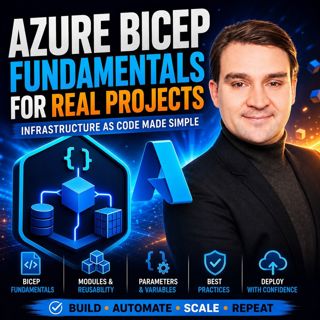
Azure Bicep Fundamentals for Real Projects

Azure Bicep Fundamentals for Real Projects

Learning Azure Bicep is easy. Building infrastructure that survives real-world enterprise environments is something entirely different. In this episode of the M365 FM Podcast, host Mirko Peters explor...

10 Juli 1h 17min

Beyond Prompt a Page: Building Enterprise-Ready AI Experiences in Power Apps with Sara Lagerquist [MVP]

Beyond Prompt a Page: Building Enterprise-Ready AI Experiences in Power Apps with Sara Lagerquist [MVP]

Artificial Intelligence is changing how organizations build business applications, but moving beyond simple demos requires much more than adding a chatbot or generating code with AI. In this episode o...

9 Juli 45min
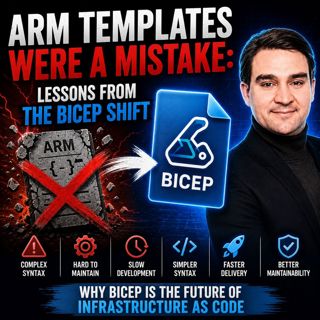
ARM Templates Were a Mistake: Lessons from the Bicep Shift

ARM Templates Were a Mistake: Lessons from the Bicep Shift

Infrastructure as Code transformed cloud computing by replacing manual portal clicks with version-controlled, repeatable deployments. But while Azure Resource Manager (ARM) templates represented a maj...

9 Juli 1h 19min
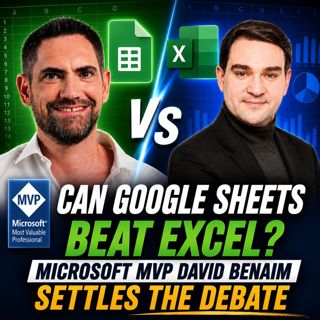
Can Google Sheets Beat Excel: Microsoft MVP David Benaim Settles the Debate

Can Google Sheets Beat Excel: Microsoft MVP David Benaim Settles the Debate

For decades, Microsoft Excel has been the undisputed king of spreadsheets. It powers everything from personal budgets to enterprise reporting, financial modeling, and business intelligence. But Google...

8 Juli 52min

LinkedIn + Dynamics 365: The Architecture of Modern Selling

LinkedIn + Dynamics 365: The Architecture of Modern Selling

Modern B2B sales is undergoing a fundamental transformation. For years, organizations have treated LinkedIn and Dynamics 365 as separate systems. One platform managed relationships and professional ne...

8 Juli 1h 14min

Azure Networking Unlocked: Secure Azure Functions, Virtual Network Manager & Infrastructure as Code with Rex de Koning [MVP-MCT]

Azure Networking Unlocked: Secure Azure Functions, Virtual Network Manager & Infrastructure as Code with Rex de Koning [MVP-MCT]

Cloud adoption has accelerated at an incredible pace, but modern cloud infrastructure is no longer just about deploying virtual machines or Azure services. Networking has become the backbone of every ...

7 Juli 54min

Populärt inom Politik & nyheter

svenska-fall
tv4-nyheterna-story
p3-krim
aftonbladet-krim
flashback-forever
aftonbladet-daily
rss-krimstad
motiv
de-fyras-gang
spar
rss-sanning-konsekvens
rss-vad-fan-hande
mannen-utan-spar
rss-aftonbladet-krim
rss-expressen-dok
kungligt
olyckan-inifran
rss-krimreportrarna
grans
rss-flodet