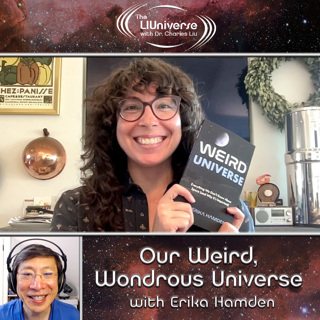
Our Weird, Wondrous Universe with Erika Hamden

Our Weird, Wondrous Universe with Erika Hamden

How do distant galaxies form? If you have two distant clouds of hydrogen, why does one turn into a star and another doesn’t? To find out, Dr. Charles Liu and co-host Allen Liu welcome Dr. Erika Hamden, Professor of Astrophysics at the University of Arizona. If Erika looks familiar, that might be because her TED Talk or “New Frontiers,” the TV show she hosts on Arizona Public Media.

As always, though, we start off with the day’s joyfully cool cosmic thing, Artemis II, our first manned mission around the moon since 1972. Chuck, Allen and Erika share their excitement watching the mission, and especially the landing, while we watch the “only good video of the moon ever taken with a phone” that Reid Wiseman shot on his iPhone.

Dr. Hamden tells us about her research into how distant stars and galaxies form. To fill in the blanks of this cosmic puzzle, she observes hydrogen in its elemental or molecular form – not looking at the stars themselves, but the emissions from hydrogen atoms. You’ll learn about star formation in our galaxy and how Erika discerns the moment that a new star “first turns on.”

Then it’s time for our first audience question. Emma B. asks, “How many galaxies are there?” Erika says that in the observable universe, it’s an outrageously large number, probably hundreds of billions or more. We take a look at the Hubble Ultra Deep Field image, which reflects a “tiny, tiny part of the sky,” where every dot except for the 3 stars is a galaxy. And that’s just the universe we can see.

Chuck asks Erika to tell us about her book, “Weird Universe: Everything We Don’t Know about Space (and why it’s important).” Professor Hamden shares her belief that anyone can understand anything if it’s explained the right way to them. She talks about a poem by Rebecca Elson called “Responsibility to Awe” and the responsibility scientists have to share the wonders of the world with everybody.

For our next audience question, Ava asks, “What is the craziest job in Astronomy that you have seen AI take over from humans?” Erika talks about using LLMs to review the digitized photographic plates of stars and the massive amount of data from the Vera Rubin Observatory, and also which activities still require human creativity.

Speaking of creativity, it turns out that before becoming an astrophysicist, Erika got a diploma at Le Cordon Bleu in London and had a career as a professional chef. She still loves to cook and shares her recipe (below) for the Swedish-style cardamom buns she shows us in the episode.

Finally, before we go, we congratulate Emily on recently being awarded a Guggenheim Fellowship. She shares some wisdom and advice she’s learned on her journey that she also tells her students, but according to her it’s a bit “cheesy” so we’ll let her tell you in the show.

If you’d like to know more about Dr. Hamden, you can keep up with her research, follow her on her social media accounts, and find out about her book by visiting her website.

We hope you enjoy this episode of The LIUniverse, and, if you do, please support us on Patreon.

Erika’s Cardamom Bun Recipe

You can find the original recipe here on Cecilia Tolone’s Substack.

Erika’s Modifications:

“My changes are that I add more milk- about 75 grams more, because American flour is drier and Tucson is especially dry! And I played around with adding chiltipin flakes (a local, very spicy pepper) to the filling to make it kind of spicy. It’s great! Finally, I use whole cardamom seeds from Penzey’s that I grind before putting in.”

Credits for Images Used in this Episode:

  • Artemis II end of mission splashdown. – Credit: NASA/ Bill Ingalls.
  • Artemis II astronaut Reid Wiseman’s iPhone video of the Earth and the Moon with his iPhone 17 ProMax, using 8x zoom, which he said is comparable to what he was seeing from the Artemis II capsule. – Credit: NASA /Reid Wiseman
  • Hydrogen observed in the Milky Way Galaxy. – Credit: HI4PI Collaboration
  • The Hubble Ultra Deep Field. – Credit: NASA/ESA
  • Example of a photographic plate of stars, including notation marks, aka a Schmidt ammonia-sensitized, near-IR (Kodak I-N) objective-prism plate exposed for 1 hr. – Credit: STScI/ESO/Carnegie.

Additional Credits:

A Responsibility to Awe, by Rebecca Elson

CHAPTERS

00:00 - We welcome University of Arizona Astrophysics Prof. Dr. Erika Hamden

02:43 - Joyfully Cool Cosmic Thing: Artemis II Mission and Return

08:14 - How Do Distant Stars and Galaxies Form?

15:46 -How Many Galaxies Are There?

18:25 - Weird Universe and Scientists’ Responsibility to Awe

24:06 - What Jobs in Astronomy Has AI Taken Over from Humans?

31:33 - Chef Erika and her Swedish-style Cardamom Buns

39:10 - Parting Advice and Wisdom from Professor Erika Hamden

#LIUniverse #CharlesLiu #AstronomyPodcast #ErikaHamden #GalaxyFormation

Det här avsnittet är hämtat från ett öppet RSS-flöde och publiceras inte av Podme. Det kan innehålla reklam.

Avsnitt(78)

ChuckGPT - Patreon Question Edition

ChuckGPT - Patreon Question Edition

It’s time for the Season 5 finale of The LIUniverse, which means another episode of ChuckGPT where we answer our audience’s most vexing questions – this time via video from our Patreon Patrons. And to...

13 Juni 38min
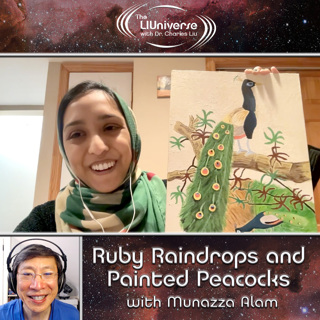
Ruby Raindrops and Painted Peacocks with Munazza Alam

Ruby Raindrops and Painted Peacocks with Munazza Alam

Are there really exoplanets with where it rains ruby and emerald raindrops? How do we measure the atmospheres of exoplanets light years away? To find out, Dr. Charles Liu and co-host Allen Liu welcome...

16 Maj 45min
Astrophotography with Astronaut Don Pettit

Astrophotography with Astronaut Don Pettit

Can the physics you learned in High School take you to the stars? Who is behind many of your favorite pictures of space? What is it actually like to live and work in space? You might be surprised to k...

2 Maj 47min
Finding the “Bubbles” Exoplanet and Crocheting Dinosaurs with Victoria DiTomasso

Finding the “Bubbles” Exoplanet and Crocheting Dinosaurs with Victoria DiTomasso

How do we find exoplanets? What is the Milky Way’s “Thick Disk” and what makes it so special? To find out, Dr. Charles Liu and co-host Allen Liu welcome Harvard astronomer Dr. Victoria DiTomasso, who ...

11 Apr 47min
Supernovas and Space Gold with Dr. Ashley Villar

Supernovas and Space Gold with Dr. Ashley Villar

How do stars die? And what happens when they do? To find out, Dr. Charles Liu and co-host Allen Liu welcome Dr. Ashley Villar, who teaches astronomy at Harvard and whose team studies supernovas as the...

21 Mars 40min

Building Worlds with Luke Skywatcher

Building Worlds with Luke Skywatcher

How do planetary systems form? If you wanted to observe them, where would you look and what would you look for? To find out, Dr. Charles Liu and co-host Allen Liu welcome Luke Keller, professor of Ast...

8 Mars 43min

Chuck GPT: Astrotech

Chuck GPT: Astrotech

How can a helicopter fly in space? How does LIGO detect gravitational waves? How do quantum electronic devices like Josephson junctions work? Could AI turn evil and destroy humanity? What about those ...

8 Feb 55min

Populärt inom Vetenskap

p3-dystopia
dumma-manniskor
allt-du-velat-veta
hacka-livet
ufo-sverige
rss-vetenskapsradion
rss-kriminologerna
svd-nyhetsartiklar
bildningspodden
det-morka-psyket
rss-vetenskapsradion-2
halsorevolutionen
ufo-sverige-2
medicinvetarna
dumforklarat
vetenskapsradion
sexet
rss-odla
barnpsykologerna
paranormalt-med-caroline-giertz