Nationalities Across the Union ☭

Nationalities Across the Union ☭

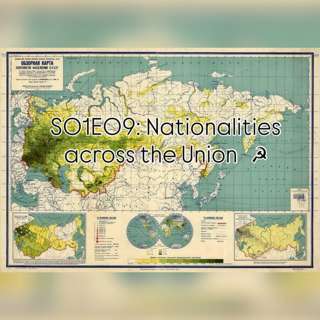
The Soviet Union was not born as a nation-state, but as a multinational federation. Stretching from the forests of Eastern Europe to the deserts of Central Asia and the mountains of the Caucasus, it was home to hundreds of ethnic groups, dozens of languages, and an extraordinary diversity of cultures, religions, and historical experiences. The collapse of the Russian Empire and the upheavals of revolution and civil war had unleashed powerful forces of national self-determination, raising one of the greatest challenges facing the Bolsheviks: how could a socialist state unite so many different peoples without simply recreating the old imperial order?

In this episode, we're exploring the ethnic composition of the Soviet Union in the years immediately following the Russian Civil War. We'll examine the remarkable diversity of the new state, from the Russians, Ukrainians, and Belarusians of the western republics to the peoples of the Caucasus, Central Asia, Siberia, and the Far East. We'll look at how geography, language, religion, and history shaped the experiences of these different communities, and why the national question became one of the defining issues of the early Soviet period.

We'll also explore the Bolsheviks' approach to nationality policy. Rejecting the chauvinism associated with the old Tsarist Empire, the new government proclaimed the equality of nations, recognized the right of self-determination, and sought to build a voluntary union of socialist republics. We'll discuss the creation of the Union of Soviet Socialist Republics in 1922, the process of national delimitation, and the policy of korenizatsiya, or "indigenization," which encouraged the development of local languages, cultures, and national elites within the framework of the new Soviet state.

Understanding the ethnic mosaic of the early Soviet Union is essential to understanding the history of the USSR itself. It was a state that inherited the immense diversity of the former Russian Empire but attempted to organize it on fundamentally different principles. The debates and institutions established during the 1920s would shape Soviet nationality policy for decades to come and leave a lasting imprint on Eurasia long after the Soviet Union itself ceased to exist.

So join us as Matthew journeys across the vast expanse of the early Soviet Union, exploring the peoples, cultures, and nationalities that came together to form one of the most diverse states in modern history, and the bold political experiment that sought to unite them under the banner of socialism.

Bibliography

Det här avsnittet är hämtat från ett öppet RSS-flöde och publiceras inte av Podme. Det kan innehålla reklam.

Avsnitt(17)

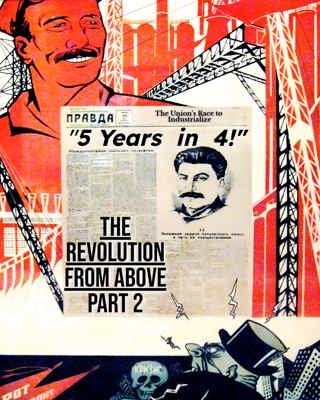
Five Years in Four! The Union's Race to Industrialize (The Revolution From Above Part 2)

Five Years in Four! The Union's Race to Industrialize (The Revolution From Above Part 2)

From the launch of the First Five-Year Plan in 1928 to the eve of the German invasion in 1941, the Soviet Union underwent one of the most dramatic economic transformations in modern history. In little...

31 Juli 1h 23min
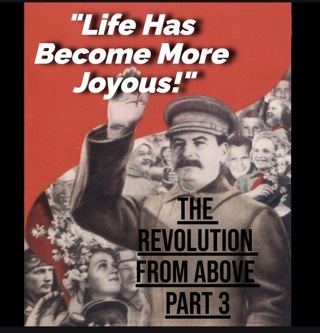
Collectivization and the Union's Great Gamble (The Revolution From Above Part 1)

Collectivization and the Union's Great Gamble (The Revolution From Above Part 1)

Beginning in 1928, the Soviet Union embarked on one of the most radical and thoroughgoing economic experiments in human history: to transform its agricultural base from a quasi-feudal to a comprehensi...

17 Juli 1h 22min
They Are Both Worse Part 2

They Are Both Worse Part 2

Matthew narrates the final clashes of the inner-party conflict that dominated soviet politics during its first decade and left Joseph Stalin and the marjoritist leadership in clear command of the USSR...

1 Juli 1h 14min
The First Ten Years of Soviet Power

The First Ten Years of Soviet Power

Season Two is Here! From revolution to the consolidation of power - join us as we recap the first decade of Soviet history and examine how it set the stage for the turbulent and transformative USSR of...

17 Juni 1h 26min
They Are Both Worse Part 1: The Soviet Inner Party Conflict 1922-1927

They Are Both Worse Part 1: The Soviet Inner Party Conflict 1922-1927

The decade following the Russian Civil War was one of reconstruction, experimentation, and extraordinary uncertainty. The Soviet Union had survived foreign intervention, economic collapse, and armed c...

4 Mars 1h 8min

The Sword and Shield of the Revolution: The Red Army and the Intelligence Services of the USSR

The Sword and Shield of the Revolution: The Red Army and the Intelligence Services of the USSR

Few institutions of the early Soviet state have generated as much fascination, or controversy, as its military and security services. Born in the turmoil of revolution and civil war, the Red Army and ...

4 Feb 1h 13min

World Revolution & Rapprochement Policies Compared

World Revolution & Rapprochement Policies Compared

The Soviet Union emerged from revolution and civil war isolated, exhausted, and surrounded by a world that was, at best, deeply suspicious of its existence. Many of the major powers had intervened in ...

21 Jan 1h 9min

Populärt inom Utbildning

historiepodden-se
rss-bara-en-till-om-missbruk-medberoende-2
det-skaver
nu-blir-det-historia
harrisons-dramatiska-historia
not-fanny-anymore
allt-du-velat-veta
roda-vita-rosen
johannes-hansen-podcast
rss-viktmedicinpodden
sa-in-i-sjalen
rikatillsammans-om-privatekonomi-rikedom-i-livet
rss-max-tant-med-max-villman
sektledare
i-vantan-pa-katastrofen
rss-autismandan
rss-basta-livet
rss-traningsklubben
psykologsnack
rss-okrystat