
George W. Bush: The War On Terror

George W. Bush: The War On Terror

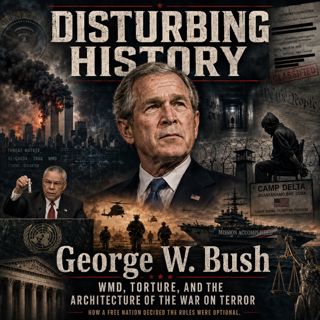
In this episode of the Disturbing History presidential series, we cross out of settled history and into living memory to examine the presidency of George W. Bush through the architecture of the War on Terror.

Beginning with the attacks of September 11, 2001, and the fear that reshaped American government overnight, we trace how that fear was translated into law, policy, and ultimately a global apparatus of detention, interrogation, surveillance, and war.

We walk through the legal scaffolding built inside the Justice Department's Office of Legal Counsel, where attorneys John Yoo and Jay Bybee drafted the August 1, 2002 "torture memos" that redefined torture so narrowly that only pain equivalent to organ failure or death would qualify, and that advanced the unitary executive theory placing the president's wartime authority beyond the reach of Congress and the courts.

We examine the opening of the Guantánamo Bay detention camp on January 11, 2002, deliberately sited beyond the expected reach of American courts, and the roughly 780 men held there, the overwhelming majority eventually released without charge.We follow the CIA's enhanced interrogation program from its first subject, Abu Zubaydah, through the network of secret black sites in Thailand, Poland, Romania, Lithuania, and Afghanistan, including the death of Gul Rahman from hypothermia at the site known as COBALT or the Salt Pit in November 2002. We cover the extraordinary rendition of innocent men, among them Canadian engineer Maher Arar, German citizen Khaled el-Masri, and the Milan cleric Abu Omar, whose abduction led to the in-absentia conviction of more than twenty CIA operatives in Italian courts.

The episode then turns to the case for the Iraq War: the aluminum tubes claim disputed by the Department of Energy and the State Department, the mobile biological weapons labs invented by the fabricator code-named Curveball (Rafid Ahmed Alwan al-Janabi), and the "sixteen words" about Niger uranium built on forged documents, along with the leak that exposed CIA officer Valerie Plame.

We revisit Secretary of State Colin Powell's February 5, 2003 presentation to the United Nations, which he later called a "blot" on his record, and the invasion of March 19, 2003, followed by the "Mission Accomplished" banner of May 1, 2003.

We document the conclusion of weapons inspectors David Kay and Charles Duelfer that no stockpiles ever existed.We confront the Abu Ghraib photographs that surfaced in April 2004, the death of detainee Manadel al-Jamadi, and the line connecting low-ranking soldiers to the policies authorized at the top.

We cover the warrantless surveillance program Stellar Wind, the 2004 hospital-room confrontation over its reauthorization, and its eventual legalization. We trace the Supreme Court's slow pushback through Rasul v. Bush, Hamdi v. Rumsfeld, Hamdan v. Rumsfeld, and Boumediene v. Bush. And we close with the December 9, 2014 Senate Intelligence Committee report, its findings that the program was ineffective and far more brutal than disclosed, that at least 26 of 119 detainees were wrongfully held, and that no senior official was ever prosecuted.

Throughout, we ask the question that outlives the administration: how a free nation decided the rules were optional, and why the machinery it built has never been turned off.This episode draws on the public record, including the Senate Select Committee on Intelligence report on the CIA's Detention and Interrogation Program, the Iraq Survey Group's Duelfer Report, the Senate's prewar intelligence assessment, declassified Office of Legal Counsel memoranda, and Supreme Court opinions.

Where the historical record remains genuinely contested, such as the question of intent versus error in the WMD case and the British Butler Report's defense of the uranium claim, both sides are presented.

This episode discusses torture, death in custody, and wartime atrocity. Listener discretion is advised.

Have a forgotten historical mystery, disturbing event, unsolved crime, or hidden conspiracy you think deserves investigation?

Send your suggestions to brian@paranormalworldproductions.com.

Disturbing History is a dark history podcast exploring unsolved mysteries, secret societies, historical conspiracies, lost civilizations, and the shadowy stories buried beneath the surface of the past.

Follow the show and enable automatic downloads so you never miss a deep dive into history’s most unsettling secrets.

Because sometimes the truth is darker than fiction.

Det här avsnittet är hämtat från ett öppet RSS-flöde och publiceras inte av Podme. Det kan innehålla reklam.

Avsnitt(123)

FDR: The Man Who Could Have Been King

FDR: The Man Who Could Have Been King

He was elected President of the United States 4 times, and a whole generation of Americans grew up unable to remember anyone else in the office. In this episode of Disturbing History, we pull apart th...

17 Juli 1h 23min

The Fair Tax

The Fair Tax

Taxes don't sound like Disturbing History territory, until you learn the trail of blood and power behind them. This episode traces the entire violent history of taxation in America, from the Stamp Act...

15 Juli 1h 15min

The Smithsonian's Strange Phenomena Files

The Smithsonian's Strange Phenomena Files

There's a building in Washington where, for the better part of a century, ordinary Americans mailed in the impossible. Flesh that fell from a clear sky onto a Kentucky farmwife making soap. A swarm of...

12 Juli 1h 1min

Loving the Monster

Loving the Monster

Some nights the well runs dry, and I do what everybody does — I sink into the couch and let Netflix babysit me for a while. That's how I ended up watching The Worst Ex Ever, and that's how I ended up ...

10 Juli 1h 1min

The Rise and Ruin of the FLDS Church

The Rise and Ruin of the FLDS Church

He was the mouthpiece of God to ten thousand followers. To the FBI, he was a face on the Ten Most Wanted list. And to a Nevada state trooper working a dark stretch of Interstate Fifteen, he was just a...

8 Juli 1h 7min

Children Sent Through the Mail

Children Sent Through the Mail

In the winter of nineteen fourteen, a five-year-old girl named May Pierstorff stood on a train platform in Grangeville, Idaho, with fifty-three cents in postage stamps pinned to her coat. Her parents ...

5 Juli 1h 1min

The Poison Bottles America Trusted

The Poison Bottles America Trusted

Before the Food and Drug Administration, before warning labels, before anyone had to prove a medicine was safe or even admit what was inside it, America ran on the bottle.This episode opens the cabine...

3 Juli 59min

Nazi Propaganda & The American Mirror

Nazi Propaganda & The American Mirror

The word propaganda began as something holy. In sixteen twenty-two a committee of cardinals in Rome coined it to mean the spreading of the faith, and in this episode I follow that single word as it cu...

1 Juli 1h 4min

Populärt inom Samhälle & Kultur

podme-dokumentar
aftonbladet-krim
gynning-berg
p3-dokumentar
svenska-fall
en-mork-historia
tv4-nyheterna-story
badfluence
creepypodden-med-jack-werner
killradet
aftonbladet-daily
mardromsgasten
kod-katastrof
hor-har
flashback-forever
skaringer-nessvold
rss-mer-an-bara-morsa
de-fyras-gang
vad-blir-det-for-mord
p3-historia