Eyam: The Village That Chose to Stay

Eyam: The Village That Chose to Stay

In 1665, the plague arrived in the Derbyshire village of Eyam inside a parcel of cloth from London. Faced with contagion, fear, and the risk of spreading disease across the region, the villagers made an extraordinary choice: they quarantined themselves for over a year, allowing the plague to burn through their own community rather than escape into the Peak District beyond.


In this episode, we follow Eyam through its darkest year — from the first deaths to the boundary stones, the outdoor sermons, the heavy losses, and the strange mix of faith and intuition that created one of the most remarkable public health decisions in British history.


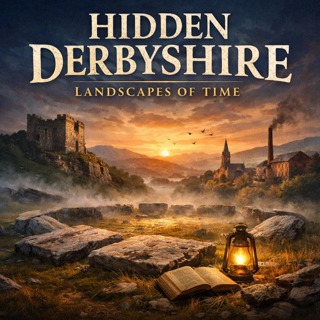
*Hidden Derbyshire: Landscapes of Time*

A documentary storytelling podcast about the places where history, folklore, and landscape intersect.

**Primary Historical Sources**


* **Mompesson, William** — Surviving letters & parish documents

— Key firsthand clerical perspective on quarantine & losses.

* **London Bills of Mortality (1665–1666)**

— Context for plague spread, mortality scale, and chronology.

* **Parish Registers (Eyam)**

— Burial records, household groupings, mortality sequencing.


**Secondary Historical Works (Core Eyam Scholarship)**


* **Clifford, Tim** (1993). *Eyam: Plague Village*.

— Accessible narrative history; foundational for modern public memory.

* **Ranger, Terence** (1995). *Plague, Quarantine and Memory: Eyam Revisited*.

— Examines how the story has been interpreted over time.

* **Waddington, K.** (2014). *The Plague Revisited: Eyam and the Politics of Disease Memory*.

— Memory studies; Victorian romanticisation & epidemiological framing.


**Epidemiology & Disease Context**


* **Slack, Paul** (1985). *The Impact of Plague in Tudor and Stuart England*.

— Key epidemiological/social history resource.

* **Cohn, S.** (2003). *The Black Death Transformed*.

— Broader context for plague interpretation, contagion vs miasma theory.

* Public health analysis of Eyam used in:

— **Rosen, G.** (1958). *A History of Public Health*

— **Public Health Reports** (20th c. case studies; quarantine comparison)


**Theological & Social Context**


* Division & cooperation between:

✔ Rev. **William Mompesson** (Anglican)

✔ **Thomas Stanley** (Puritan, ejected minister)

* Useful analyses in:

— **Spufford, Margaret** (1984). *Small Books and Pleasant Histories* (religiosity & literacy)

— **Walsham, Alexandra** (2016). *The Reformation of the Landscape* (memory & sacred space)


**Demography & Mortality**


* Population estimates: **~750–800 residents** pre-plague

* Deaths: records vary, typically **~260+ deaths** (≈30–35% mortality)

* Unequal household distribution noted in parish registers.


**Consensus Statements**


Historians broadly agree:

✔ Quarantine was locally initiated & locally enforced

✔ Clerical partnership (Mompesson + Stanley) was crucial

✔ Boundary stones + vinegar coins + outdoor sermons documented

✔ Decision likely prevented wider regional spread

✔ Eyam’s story persists due to moral clarity + rarity of community quarantine


### **Interpretive Gaps**


Uncertainties remain:

• Exact role of fleas vs human-to-human pneumonic cases

• Degree of compliance vs coercion

• Motivation: faith vs duty vs fear vs practicality

• How many external lives were saved (absence of epidemic is data, not number)


**Memory & Tourism**


* Victorian reinterpretation transformed Eyam into exemplary moral narrative

* 20th c. = epidemiological case study

* 21st c. = heritage + tourism + pedagogy (museum, trail, plaques)


**Accessible Public Sources**


* Eyam Museum (interpretation, objects, chronology)

* Peak District NPA heritage notes

* Church of St Lawrence visitor panels

* Local walking trails & plague cottage signage


Advertising Inquiries: https://redcircle.com/brands

Privacy & Opt-Out: https://redcircle.com/privacy

Det här avsnittet är hämtat från ett öppet RSS-flöde och publiceras inte av Podme. Det kan innehålla reklam.

Avsnitt(12)

The Ghost of Anne Stanhope: Hardwick Hall’s Lingering Presence

The Ghost of Anne Stanhope: Hardwick Hall’s Lingering Presence

Hardwick Hall stands as one of Derbyshire’s most striking historic houses—built to display power, wealth, and permanence. But behind its symmetry and glass-lined walls lies a more unsettled story.Anne...

16 Apr 9min

The Devil’s Arse of Castleton: Echoes Beneath the Peak

The Devil’s Arse of Castleton: Echoes Beneath the Peak

At the edge of Castleton lies a vast opening in the earth—one of the largest cave entrances in Britain, and a place once known by a name few would use today.For centuries, Peak Cavern was called the “...

16 Apr 12min

The Nine Ladies of Stanton Moor: A Dance Turned to Stone

The Nine Ladies of Stanton Moor: A Dance Turned to Stone

High on Stanton Moor, a small circle of weathered stones stands quietly among the heather. Known as the Nine Ladies, their origins lie deep in prehistory—but their meaning has long been shaped by stor...

16 Apr 14min

Cromford: The Mill That Invented Time

Cromford: The Mill That Invented Time

On the banks of the Derwent, Richard Arkwright built a new kind of landscape — one powered not by feudal obligation or aristocratic prestige, but by water, machinery, capital, and the disciplined mana...

27 Jan 6min

Peveril Castle: Stone, Feudalism & the View from the Edge

Peveril Castle: Stone, Feudalism & the View from the Edge

High above Castleton, the ruins of Peveril Castle overlook the Hope Valley — a fortress less defined by battles than by law, revenue, and administration. Built in the aftermath of the Norman Conquest,...

27 Jan 6min

Haddon Hall: Stone, Marriage & Power

Haddon Hall: Stone, Marriage & Power

Haddon Hall stands above the River Wye as one of England’s finest surviving medieval houses. From the Peverils to the Vernons and the Manners, the hall became a stage for marriage, inheritance, religi...

22 Jan 7min

Navio: The Roman Fort in the Mist

Navio: The Roman Fort in the Mist

High above the Hope Valley lie the remains of Navio — a Roman fort built not for spectacle, but for logistics. Positioned among lead mines, roads, and rugged frontier landscapes, Navio reveals how the...

21 Jan 7min

Populärt inom Samhälle & Kultur

podme-dokumentar
en-mork-historia
badfluence
gynning-berg
svenska-fall
p3-dokumentar
aftonbladet-krim
spar
creepypodden-med-jack-werner
skaringer-nessvold
de-fyras-gang
tv4-nyheterna-story
killradet
rss-expressen-dok
hor-har
mardromsgasten
flashback-forever
aftonbladet-daily
kod-katastrof
vad-blir-det-for-mord