TLDR Paul Klee | Twittering Machine

TLDR Paul Klee | Twittering Machine

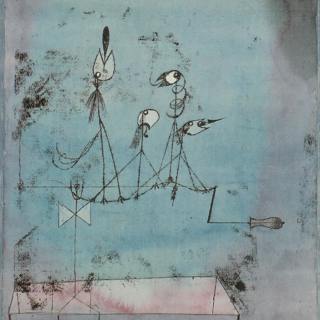
Paul Klee, born on December 18, 1879, in Switzerland, developed into one of modern art's most influential figures, crossing paths with major movements such as Expressionism, Cubism, and Surrealism. Raised in a deeply musical family, he trained extensively as a violinist and played with the Bern Music Association by age eleven before pivoting to the visual arts and moving to Munich in 1900 to study at the Academy of Fine Arts. Klee believed that classical music lacked further room for creative innovation, prompting his shift toward painting. While his early work consisted mainly of monochromatic etchings and drawings, a pivotal two-week trip to Tunisia in 1914 with August Macke and Louis Moilliet completely transformed his relationship with color, marking a permanent transition toward vibrant, abstract compositions. He later achieved significant professional success as a faculty member at the Bauhaus school from 1921 to 1931, where his highly structured teaching methodology and analytical lectures were compiled into the Paul Klee Notebooks, a text considered as foundational to modern art as Leonardo da Vinci’s treatises were to the Renaissance. The ascent of the Nazi regime dramatically disrupted Klee's career when the government classified his avant-garde creations as "degenerate art," forcing his dismissal from the Düsseldorf Academy in 1933 and leading to the systemic purge of 102 of his works from public museums. He spent his remaining years in Swiss exile fighting scleroderma, a severe autoimmune disease that hardened his skin and internal organs, rendering fine, intricate linework painful and difficult. Rather than stopping, Klee adjusted his style to accommodate his physical limitations, shifting toward simplified geometric forms, larger canvases, thick black outlines, and a somber color palette ultimately producing 1,254 paintings and drawings in 1939 alone. Over a lifetime that yielded more than 9,000 works bridging abstraction and representation, his 1922 oil transfer and watercolor masterpiece, Twittering Machine, remains a definitive highlight. The painting, which satirizes the industrial automation of nature through four wire-like birds operated by a hand crank, was confiscated by the Nazis from Berlin's National Gallery before being sold abroad and permanently acquired by the Museum of Modern Art in 1939. Related Episodes Bauhaus Parties Wassily Kandinsky Helen Frankenthaler ⁠Listen Ad-Free on Patreon. ⁠ For just $3 per month, you can get ad-free versions of Fun Facts Daily, Who ARTed and Art Smart. Head over to ⁠https://www.patreon.com/cw/FunFactsDailyPod⁠ if you are interested. Check out my other podcasts Fun Facts Daily | Art Smart | Rainbow Puppy Science Lab Who ARTed is an Airwave Media Podcast. If you are interested in advertising on this or any other Airwave Media show, email: advertising@airwavemedia.com Learn more about your ad choices. Visit megaphone.fm/adchoices

Det här avsnittet är hämtat från ett öppet RSS-flöde och publiceras inte av Podme. Det kan innehålla reklam.

Avsnitt(783)

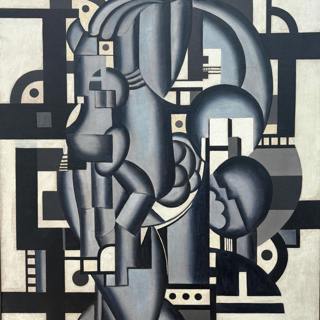
Fernand Léger | Composition in Blue

Fernand Léger | Composition in Blue

Fernand Léger was a pioneering French modernist painter whose foundational training as an architectural draftsman profoundly shaped his structured, geometric approach to art. After absorbing the influ...

17 Aug 11min

Stuart Davis | Swing Landscape

Stuart Davis | Swing Landscape

Stuart Davis was an influential 20th-century American modernist painter who bridged European abstract movements like Cubism with distinctively American subjects and aesthetics. Born in 1892, Davis stu...

10 Aug 12min

Tamara de Lempicka | Tamara in a Green Bugatti (encore)

Tamara de Lempicka | Tamara in a Green Bugatti (encore)

Tamara de Lempicka remains the definitive icon of the Art Deco era, blending polished Cubist techniques with the glamorous, high-stakes atmosphere of the Roaring Twenties. From her harrowing escape du...

7 Aug 10min

Artist Interview Emil Wilson | The Nightingales

Artist Interview Emil Wilson | The Nightingales

My guest this week is Emil Wilson, the author and illustrator behind the new graphic novel, The Nightingales. Wilson started his career in advertising before attending art school in his fifties, spurr...

3 Aug 43min

Francisco Goya | The Third of May 1808 (encore)

Francisco Goya | The Third of May 1808 (encore)

Francisco Goya (1746-1828) is one of Spain's most important and complex artists. His career bridged the gap between the Old Masters and the modern era. He found success as a court painter for the Span...

31 Juli 16min

Neil Harbisson | Cyborg Artist (encore)

Neil Harbisson | Cyborg Artist (encore)

Neil Harbisson is a contemporary artist who hears colors. He deliberately chose to hear colors and to make that happen, he underwent surgery which has caused him to become the first person ever to be ...

27 Juli 9min

David Hockney | A Bigger Splash (encore)

David Hockney | A Bigger Splash (encore)

Explore the life and work of David Hockney, one of the most influential British artists of the 20th and 21st centuries. Born in Yorkshire in 1937, Hockney's rebellious spirit and prodigious talent wer...

24 Juli 16min

5 Artists Who Take Playing with Their Food to a Whole New Level (encore)

5 Artists Who Take Playing with Their Food to a Whole New Level (encore)

Today I thought it would be fun to switch things up a little bit. Instead of focusing on just one artist and artwork, I’ve got 5 artists who work with food in ways most people would never consider. ⁠J...

20 Juli 9min

Populärt inom Samhälle & Kultur

podme-dokumentar
aftonbladet-krim
p3-dokumentar
gynning-berg
en-mork-historia
creepypodden-med-jack-werner
aftonbladet-daily
hor-har
svenska-fall
killradet
rss-schyffert-sundin-ar-det-har-nat
rss-mer-an-bara-morsa
p1-dokumentar
rss-krimreportrarna
mardromsgasten
flashback-forever
badfluence
rss-vill-du-veta-en-hemlis-2
fredagspodden
vad-blir-det-for-mord