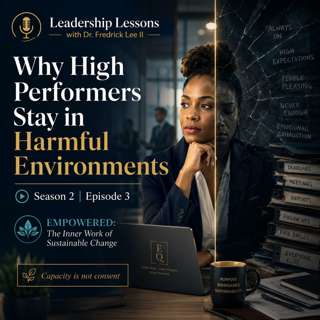
Why High Performers Stay in Harmful Environments

Why High Performers Stay in Harmful Environments

Leadership Lessons with Dr. Fredrick Lee II

Season 2: EMPOWERED - The Inner Work of Sustainable Change

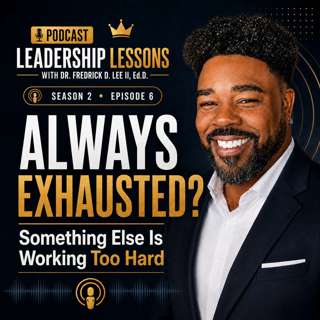
Episode 3: Why High Performers Stay in Harmful Environments

Episode Summary

High performers are often praised for being dependable, resilient, committed, and capable. But what happens when that performance starts hiding exhaustion, disconnection, anxiety, resentment, and burnout?

In this episode of Leadership Lessons with Dr. Fredrick Lee II, Dr. Lee explores why smart, committed, emotionally intelligent people often remain in harmful workplace environments long after they realize, “Something isn’t right.”

This episode is rooted in the awareness stage of sustainable change. It is not about shame, blame, or telling people to make impulsive decisions. It is about helping listeners recognize the emotional, neurological, behavioral, and systemic patterns that keep high performers stuck in environments that drain them.

Dr. Lee explains how high performance can hide real harm, why capacity is not consent, and how harmful systems can reward over-functioning while under-protecting well-being. Through the lens of emotional intelligence, neuroscience, and change management, this episode helps listeners move from self-blame to clarity, and from unconscious survival to empowered awareness.

In This Episode

· Why the first sign of harm is not always collapse, but often disconnection.

· How high performers minimize their own exhaustion because they are still functioning.

· Why being needed can feel rewarding, but can also become a trap.

· How strengths like discipline, empathy, loyalty, competence, and responsibility can become survival strategies in harmful environments.

· Why burnout is not simply being tired, but a sign of chronic misalignment between the body, mind, values, and environment.

· How fight, flight, freeze, and fawn responses show up in workplace settings.

· Why high performers often over-please, overwork, and over-adapt in order to maintain safety.

· How toxic systems reward over-functioning and mistake compliance for engagement.

· Why silence is not always agreement.

· The difference between loyalty and self-abandonment.

· How awareness becomes action when it begins to change behavior.

· Why sustainable change requires alignment between behavior, emotions, and systems.

Key Message

Change does not fail because people do not care.

It fails because behavior, emotions, and systems are misaligned.

High performers often care deeply. They care about the work, the mission, the team, the quality of outcomes, and being responsible. But care without alignment becomes exhaustion. Care without boundaries becomes self-sacrifice. Care without emotional honesty becomes burnout. And care without supportive systems creates cultures where the strongest people quietly absorb the most damage.

Memorable Quotes from the Episode

“The first sign of harm is not always collapse. The first sign can be disconnection.”

“Your ability to keep functioning does not prove the environment is healthy.”

“High performance can hide real harm.”

“Capacity is not consent.”

“Capability without boundaries becomes depletion.”

“Burnout is deeper than tired.”

“Your emotions are not always instructions, but they are information.”

“Silence is not always agreement.”

“Staying in harm is not always loyalty. Sometimes it is conditioning.”

“Your ability to handle it is not proof that it is healthy.”

“Awareness is not the finish line. Awareness is the moment you stop participating in the pattern unconsciously.”

“Healthy workplace cultures are not built by accident.”

Practical Action Steps

This episode gives listeners five grounded actions they can take this week.

1. Name the environment, not just yourself.

Shift the question from, “What is wrong with me?” to “What is happening around me?” Write down three to five specific patterns in your environment that feel harmful, draining, or misaligned.

2. Create one non-negotiable boundary.

Choose one realistic boundary that supports your well-being. It may be not responding to non-urgent messages after a certain time, pausing before accepting new work, or asking, “What should be deprioritized to make room for this?”

3. Listen to your body once a day.

Pause for two or three minutes and ask: Where do I feel tension? How is my breathing? If my body could speak one sentence about work, what would it say?

4. Map the misalignment.

Create three columns: behavior, emotions, and systems/culture. Identify what you are doing to cope, what you are actually feeling, and what the organization may be reinforcing.

5. Have one honest micro-conversation.

Choose one trusted person and say, “I’ve been noticing that something isn’t right for me at work.” Share one specific pattern. The goal is not to solve everything. The goal is to break isolation and begin telling the truth.

Reflection Questions

· What have I been calling normal that may actually be harmful?

· Where am I performing through exhaustion?

· What is my body trying to tell me about my work environment?

· What am I teaching by what I tolerate?

· Am I acting from values, or from fear, guilt, and conditioning?

· What is one boundary I can practice this week?

· Where do I see misalignment between my behavior, emotions, and the system around me?

Listener Engagement Prompts

· Comment: “Something isn’t right” if this episode gives language to something you have been feeling.

· Comment: “Capacity is not consent” if you have been praised for carrying something that should not have been yours to carry.

· Comment: Fight, Flight, Freeze, or Fawn to name the nervous-system response you recognize most in yourself.

· Comment: “Silence is not always agreement” if you have ever stopped speaking up because the environment did not feel safe.

· Comment one word that describes what you are recognizing right now: clarity, boundaries, tired, awake, misalignment, courage, enough.

F...

Det här avsnittet är hämtat från ett öppet RSS-flöde och publiceras inte av Podme. Det kan innehålla reklam.

Avsnitt(30)

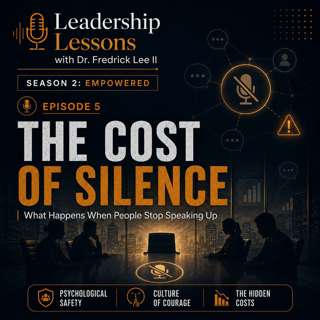
The Cost of Silence: What Happens When People Stop Speaking Up

The Cost of Silence: What Happens When People Stop Speaking Up

The Cost of Silence: What Happens When People Stop Speaking UpOne of the first signs that a culture, relationship, team, or family system is in trouble is not always noise.Sometimes it is quiet.A litt...

5 Juli 32min
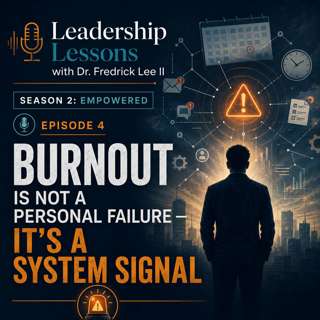
Burnout Is Not a Personal Failure — It’s a System Signal

Burnout Is Not a Personal Failure — It’s a System Signal

Episode SummaryIn this episode of Leadership Lessons, Dr. Fredrick Lee II explores burnout not as a personal weakness, but as a signal that something deeper is out of alignment. Burnout is often misun...

22 Juni 37min
Toxic Isn't Loud - It's Subtle, Chronic, and Normalized

Toxic Isn't Loud - It's Subtle, Chronic, and Normalized

content  typeSolo  primary  goalDiscussion  summaryThis episode explores the subtle, chronic toxicity that often goes unnoticed in organizations. It emphasizes the importance of awareness, emotional i...

6 Apr 33min

When Work Stops Feeling Safe (But You Can't Explain Why) | Psychological Safety at Work

When Work Stops Feeling Safe (But You Can't Explain Why) | Psychological Safety at Work

Does work suddenly feel different—even though nothing obvious has changed?In this episode of Leadership Lessons with Dr. Fredrick Lee II, we explore why many professionals feel a growing sense of unea...

8 Mars 19min

Ep. 14 When Professional Meets Petty: Leading Through Disrespect with Emotional Intelligence

Ep. 14 When Professional Meets Petty: Leading Through Disrespect with Emotional Intelligence

Episode 14: When Professional Meets Petty – Leading Through Disrespect with Emotional IntelligenceWhat do you do when professionalism meets pettiness — when the person you supervise challenges your au...

3 Nov 202539min

Bonus Episode #11 Why Do Men Think Natural Human Emotions Are a Sign of Weakness

Bonus Episode #11 Why Do Men Think Natural Human Emotions Are a Sign of Weakness

In this follow-up to Bonus Episode 6 – Men Are Not OK, Dr. Fredrick D. Lee II sits down with Te’Ana (she/her) — an esthetician from McKinney, Texas — for a raw, honest, and heartfelt conversation abou...

28 Okt 202530min

Bonus Episode #10 Beyond Survival – A Conversation on Healing, Identity, and Self-Efficacy

Bonus Episode #10 Beyond Survival – A Conversation on Healing, Identity, and Self-Efficacy

SummaryIn this episode of Leadership Lessons, Dr. Fredrick Lee II engages in a profound conversation with Dr. Cynthia Payne, a breast cancer survivor and healthcare leader. They explore the intersecti...

20 Okt 202535min

Populärt inom Utbildning

historiepodden-se
det-skaver
rss-bara-en-till-om-missbruk-medberoende-2
harrisons-dramatiska-historia
nu-blir-det-historia
roda-vita-rosen
not-fanny-anymore
rss-viktmedicinpodden
i-vantan-pa-katastrofen
sektledare
johannes-hansen-podcast
allt-du-velat-veta
rss-foraldramotet-bring-lagercrantz
kan-jag-sa-kan-du-podden
rss-ar-det-rimligt
rikatillsammans-om-privatekonomi-rikedom-i-livet
sa-in-i-sjalen
sex-pa-riktigt-med-marika-smith
vi-gar-till-historien
rss-traningsklubben