Decoding the BOAT: GRB 221009A and the Hunt for High-Energy Neutrinos

Decoding the BOAT: GRB 221009A and the Hunt for High-Energy Neutrinos

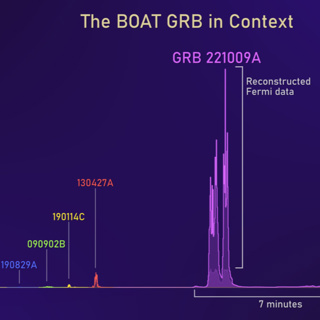
In this episode, we dive into the astrophysics behind GRB 221009A, an event widely known as the Brightest-Of-All-Time (BOAT) gamma-ray burst. Detected in October 2022, this extraordinary explosion shattered records by producing ultra-high-energy photons exceeding 10 TeV.


We discuss a recent multi-messenger study that models the burst's very-high-energy (VHE) afterglow using a Gaussian structured jet expanding into an interstellar medium. We explore how this smooth, angular jet structure explains the extreme TeV output observed at a mildly off-axis viewing angle, cleanly resolving the "energy crisis" that standard uniform (top-hat) jet models face.


Finally, we tackle the mystery of the missing neutrinos. Despite the immense energy of the BOAT, observatories like IceCube have not detected any coincident neutrinos. We break down the calculations for photo-hadronic ($p\gamma$) neutrino production and explain why the expected flux still falls below the sensitivity limits of even the next generation of detectors, like IceCube Gen2 and GRAND200k.


Key Takeaways:

  • The BOAT GRB: GRB 221009A was a remarkably luminous and relatively nearby event, offering an unprecedented opportunity to test emission models and ultra-high-energy cosmic ray acceleration.
  • The Power of a Gaussian Jet: By using a Gaussian structured jet model, scientists can accurately reproduce the burst's gradual light curve steepening and immense brightness without requiring physically unrealistic energy budgets.
  • A Mildly Off-Axis View: The study reveals that the optimal way to interpret the data is a mildly off-axis viewing geometry, which allows the observer to receive intense early-time emission from the jet's core.
  • Neutrino Non-Detection Explained: Mathematical models of the photo-pion decay channel show that even under highly optimistic microphysical parameters, the predicted muon neutrino events remain below current and future detection limits, confirming that the null results from IceCube are consistent with the physics.


Reference to the Article Discussed:

Mondal, T., Razzaque, S., Joshi, J. C., Majumder, S., & Bose, D. (2026). Multi messenger study of GRB 221009A with VHE gamma-ray and neutrino Afterglow from a Gaussian structured jet. Journal of High Energy Astrophysics, 53, 100636.


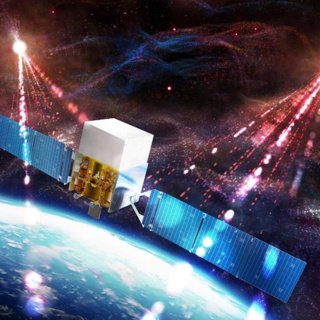
Acknowledements: Podcast prepared with Google/NotebookLM. Illustration credits: NASA's Goddard Space Flight Center and Adam Goldstein (USRA)

Det här avsnittet är hämtat från ett öppet RSS-flöde och publiceras inte av Podme. Det kan innehålla reklam.

Avsnitt(104)

Echoes of Annihilation: Solving the 10 MeV Mystery of GRB 221009A

Echoes of Annihilation: Solving the 10 MeV Mystery of GRB 221009A

In this episode, we dive into the fascinating astrophysics surrounding GRB 221009A, the brightest gamma-ray burst observed to date. While its sheer energy is staggering, we focus on an even more intri...

22 Juni 22min

FRB 20191221A or "the telescope that hallucinated in the rain"

FRB 20191221A or "the telescope that hallucinated in the rain"

In 2022, the astronomy community was buzzing about FRB 20191221A, an unusual Fast Radio Burst that made headlines for exhibiting a highly significant 217-millisecond periodicity. But what if this grou...

10 Juni 20min

Record-Breaker: Catching Gamma Rays from the Distant Quasar OP 313

Record-Breaker: Catching Gamma Rays from the Distant Quasar OP 313

In this episode, we dive into a groundbreaking astronomical discovery: the detection of very-high-energy (VHE) gamma rays from the quasar OP 313. Located at a redshift of $z = 0.997$, OP 313 has shatt...

1 Juni 20min

Ripples in Spacetime: Unpacking the GWTC-5.0 Catalog

Ripples in Spacetime: Unpacking the GWTC-5.0 Catalog

In this episode, we dive into the monumental release of the Gravitational-Wave Transient Catalog version 5.0 (GWTC-5.0) and the open data from the second part of the fourth observing run (O4b) by the ...

29 Maj 21min

SN 2017egm : Fermi-LAT's Breakthrough Gamma-Ray Detection

SN 2017egm : Fermi-LAT's Breakthrough Gamma-Ray Detection

In today’s episode, we dive into the mystery of superluminous supernovae (SLSNe)—rare, extreme astronomical events that shine 10 to 100 times brighter than standard core-collapse supernovae. For years...

22 Maj 23min

Supernovae on the RISE: Why Dead Stars Wake Up Decades Later

Supernovae on the RISE: Why Dead Stars Wake Up Decades Later

In this episode, we explore the fascinating phenomenon of core-collapse supernovae that refuse to fade away quietly. Years, or even decades, after their initial explosion, some of these stellar deaths...

20 Maj 17min

The SVOM Satellite: A New Era in Multi-Messenger Astronomy

The SVOM Satellite: A New Era in Multi-Messenger Astronomy

In this episode, we dive into the fascinating world of gamma-ray bursts (GRBs) and high-energy transients through the lens of the SVOM (Space-based Multi-band Variable Object Monitor) mission. Launche...

29 Apr 24min

Populärt inom Vetenskap

p3-dystopia
dumma-manniskor
allt-du-velat-veta
kapitalet-en-podd-om-ekonomi
medicinvetarna
doden-hjarnan-kemisten
svd-nyhetsartiklar
rss-kriminologerna
bildningspodden
ufo-sverige
sexet
dumforklarat
rss-spraket
rss-vetenskapsradion
rss-arkeologi-historia-podden-som-graver-i-vart-kulturlandskap
4health-med-anna-sparre
rss-ufobortom-rimligt-tvivel
vetenskapsradion
rss-tidslinjen-podcast
hacka-livet