Nursing School Wasn't Built for the Way You Learn

Nursing School Wasn't Built for the Way You Learn

Take a SIMCLEX at: SIMCLEX.com

I want to talk to the student who has started to believe something quietly devastating: that the reason nursing school is so hard for you is that something is wrong with you. Maybe you have ADHD. Maybe you're dyslexic. Maybe you process things more slowly, or anxiety hijacks you the second a test starts. And somewhere along the way you started to wonder if you're just not built for this.

I want to flip that whole thing on its head. Nursing school wasn't built for the way you learn. That is not the same as you being incapable of learning nursing. Those are two completely different statements, and the difference between them might be the difference between you quitting and you becoming a nurse.

Here's what I mean. The traditional nursing school model is built for one specific kind of brain — the one that can sit through a three-hour lecture, read fifty dense pages, hold it all in working memory, and reproduce it on a timed test. If that's not your brain, the system doesn't bend. It just makes you feel like you're failing. But notice what's actually happening there: the system is testing how well you fit its method, not how good a nurse you'll be. And those are not the same thing. Some of the most extraordinary nurses I've known are people who struggled badly in that lecture-hall model.

So let's talk about what actually works when school wasn't built for you. If you have ADHD and a three-hour study block is a fantasy, stop pretending it isn't. Work in short, intense bursts with real breaks. Use questions to create the stimulation and feedback your brain craves, instead of fighting to stay awake over highlighted notes. If you're dyslexic and reading is slow and exhausting, stop making reading your primary input — lean on questions, audio, diagrams, and patterns. If you process more slowly, give yourself permission to go deep on fewer things instead of skimming everything badly. And if anxiety is the enemy, the antidote isn't "calm down" — it's evidence. Anxiety thrives on uncertainty, and the cure for uncertainty is data about where you actually stand.

Notice the thread running through all of those. The fix is never "try to be a different kind of brain." The fix is "study in a way that gives your brain feedback and patterns instead of brute-force memorization." Feedback is the great equalizer. It doesn't care how you learn. It just tells you what you know and what you don't — and that works for every kind of mind.

Det här avsnittet är hämtat från ett öppet RSS-flöde och publiceras inte av Podme. Det kan innehålla reklam.

Avsnitt(200)

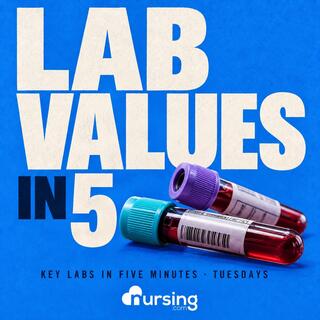
LAB VALUES IN 5: Bilirubin for NCLEX

LAB VALUES IN 5: Bilirubin for NCLEX

Bilirubin — the must-know liver lab value for the NCLEX, covered in 5 minutes.   In this episode: what bilirubin measures, the normal reference range of 0.3-1.2 mg/dL, why bilirubin matters — a byprod...

10 Nov 5min
MED OF THE DAY: Bupropion (Wellbutrin)

MED OF THE DAY: Bupropion (Wellbutrin)

Welcome to Med of the Day — new episodes drop every Monday. It's Med Monday!   Bupropion (Wellbutrin) is an antidepressant and smoking deterrent (pharmacologic class: aminoketone) for depression, smok...

9 Nov 2min

The 3 A.M. Spiral: New Nurse Stories | First Shift

The 3 A.M. Spiral: New Nurse Stories | First Shift

"I survived, somehow."   Her first night on her own. Five patients, meds on time, chart checks ahead of the orders — and then all hell broke loose: IV pumps beeping, call bells nonstop, ten antibiotic...

6 Nov 4min
QOD: Nosey Cup | NCLEX Practice Question

QOD: Nosey Cup | NCLEX Practice Question

Today's NCLEX Question of the Day:   The nursing category is neuro. The NCLEX category is basic care and comfort. A nurse is caring for an 80-year-old client who is in rehabilitation after having a st...

5 Nov 2min
K Up D Down Acidosis and Alkalosis | Nursing Mnemonics for NCLEX

K Up D Down Acidosis and Alkalosis | Nursing Mnemonics for NCLEX

Welcome to Nursing Mnemonics — new episodes drop every Wednesday. Which side of the pH scale is which? Remember: alkalosis has a K, so it's kicking the pH up — acidosis has a D, so it's dropping the p...

4 Nov 1min

LAB VALUES IN 5: Aspartate Aminotransferase for NCLEX

LAB VALUES IN 5: Aspartate Aminotransferase for NCLEX

Aspartate Aminotransferase (AST) — the must-know liver lab value for the NCLEX, covered in 5 minutes.   In this episode: what AST measures, the normal reference range of about 8-40 (ranges differ slig...

3 Nov 3min

MED OF THE DAY: Bismuth subsalicylate (Pepto-Bismol)

MED OF THE DAY: Bismuth subsalicylate (Pepto-Bismol)

Welcome to Med of the Day — new episodes drop every Monday. It's Med Monday!   Bismuth subsalicylate (Pepto-Bismol, Kaopectate) is an adsorbent antidiarrheal/antiulcer med for diarrhea, heartburn, ind...

2 Nov 2min

The Baby Who Wouldn't Wait: New Nurse Stories | First Shift

The Baby Who Wouldn't Wait: New Nurse Stories | First Shift

"She was trying to place a catheter. She almost delivered a baby instead."   A new L&D nurse, still orienting. Her preceptor steps out for lunch — and in that window, a routine in-and-out cath turns i...

30 Okt 4min

Populärt inom Utbildning

husmodern-med-amanda-schulman
historiepodden-se
det-skaver
rosceremoni
rss-bara-en-till-om-beroende-medberoende
nu-blir-det-historia
harrisons-dramatiska-historia
rss-viktmedicinpodden
not-fanny-anymore
roda-vita-rosen
rss-dr-bjorklund
i-vantan-pa-katastrofen
allt-du-velat-veta
sektledare
sa-in-i-sjalen
rss-basta-livet
johannes-hansen-podcast
rss-traningsklubben
sektpodden
rss-max-tant-med-max-villman