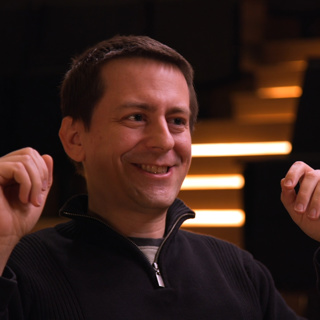

He won a Nobel here for AlphaFold. Then he left. - John Jumper

He won a Nobel here for AlphaFold. Then he left. - John Jumper

This episode is sponsored by Notion. Learn more about Notion's Developer Platform today at https://notion.com/mlstProtein folding stalled biology for fifty years. A sequence of amino acids dictates a three-dimensional shape, but reading that shape meant a year and roughly $100,000 of crystallography per structure. Then AlphaFold 2 won CASP14 so decisively the organizers called the problem essentially solved.In this documentary cut, John Jumper, who shared the 2024 Nobel Prize in Chemistry and has since left DeepMind for Anthropic, walks Tim Scarfe through what the system did and, more interestingly, what it did not. The architecture gets a proper dissection: MSAs, the Evoformer, invariant point attention, the FAPE loss, and Jumper's correction of the equivariance story, which ablations valued at roughly 2.5 of 30 GDT points rather than the whole win. He is blunt about the limits. AlphaFold predicts one experiment extraordinarily well; it is not a model of the cell, it does not capture dynamics, and on a given drug target it is "wrong nine times out of ten."From there: the AlphaFold Database of 200M+ predicted structures, AlphaFold 3 and ligands, Isomorphic Labs, and Jumper's quarrel with the bitter lesson, where finite data and human hypotheses still matter. Emmanuel Nji of BioStruct Africa closes the film on what changes when work that took years now takes months, and on training the next thousand structural biologists across Africa.---TIMESTAMPS:00:00:00 Cold open: predicting nature with a button press00:01:03 The protein folding bottleneck and CASP00:04:39 The Nobel, the database, and the move to Anthropic00:05:50 Sponsor (Notion) and framing: what AlphaFold does not claim00:07:39 Proteins as self-assembling nanomachines00:12:24 From structures to biology: drug discovery and Midnolin00:17:37 The humility of AlphaFold: a narrow predictor00:22:18 Inside the architecture: Evoformer, IPA and FAPE00:30:20 Ruthless empiricism: ablations and 100x in data00:35:20 Predict, control, understand00:40:00 Against the bitter lesson; AlphaFold 3 as diffusion00:45:07 Intelligence, representations and AGI00:49:23 Epilogue: AlphaFold in Africa00:52:16 Closing: the case for hybrid science models---REFERENCES:organization:[00:01:55] Critical Assessment of Structure Prediction (CASP)https://predictioncenter.org/[00:04:39] The Nobel Prize in Chemistry 2024https://www.nobelprize.org/prizes/chemistry/2024/summary/[00:05:18] BioStruct Africahttps://www.biostructafrica.org/[00:18:03] Isomorphic Labshttps://www.isomorphiclabs.com/paper:[00:03:09] AlphaFold Protein Structure Databasehttps://doi.org/10.1093/nar/gkab1061[00:17:25] Accurate structure prediction of biomolecular interactions with AlphaFold 3https://www.nature.com/articles/s41586-024-07487-w[00:22:18] Highly accurate protein structure prediction with AlphaFoldhttps://www.nature.com/articles/s41586-021-03819-2[00:23:10] Midnolin promotes degradation of substrates independent of ubiquitinationhttps://doi.org/10.1126/science.adh5021[00:27:00] Improved protein structure prediction using potentials from deep learninghttps://www.nature.com/articles/s41586-019-1923-7tool:[00:03:09] AlphaFold Protein Structure Database (EBI)https://alphafold.ebi.ac.uk/[00:45:55] AlphaEvolve: a coding agent for designing advanced algorithmshttps://deepmind.google/blog/alphaevolve-a-gemini-powered-coding-agent-for-designing-advanced-algorithms/other:[00:39:40] The Bitter Lessonhttp://www.incompleteideas.net/IncIdeas/BitterLesson.html---ReScript: https://app.rescript.info/share/d8cde5c221fb71e2c0f5aafe94f90dfaDisclaimer - not sponsored, editorial with us - we filmed it at GDM, London

Det här avsnittet är hämtat från ett öppet RSS-flöde och publiceras inte av Podme. Det kan innehålla reklam.

Avsnitt(271)

What Most People Get Wrong About Evolution | Akarsh Kumar

What Most People Get Wrong About Evolution | Akarsh Kumar

A lot of people in AI treat evolution as a dumb fallback, basically random search for when you can't take a gradient. Akarsh Kumar thinks that is wrong. Selection hangs on to partial solutions, so mut...

10 Okt 47min

How a Voice Agent Learns the Rhythm of Conversation — Shawn Wen

How a Voice Agent Learns the Rhythm of Conversation — Shawn Wen

Tsung-Hsien (Shawn) Wen, CTO of PolyAI, tells Tim Scarfe why voice agents are harder than text agents. Voice adds time, and a good conversation depends on adapting to the person on the line, not just ...

1 Okt 1h 10min

Who Checks a Proof No Human Can Read? — Leo de Moura

Who Checks a Proof No Human Can Read? — Leo de Moura

Leonardo de Moura created Lean and co-created Z3. ---This episode is sponsored by Parallel.Parallel, where agents find answers: web search, extraction and deep research APIs built for AI agents.Start ...

30 Sep 1h 14min

When AI Research Starts Moving Faster Than Human Research - Zhengyao Jiang

When AI Research Starts Moving Faster Than Human Research - Zhengyao Jiang

Weco let an AI coding agent rewrite the harness around another agent for eight days: its code, prompts and tools, while the underlying language model stayed fixed. Tim Scarfe asks Weco co-founder Zhen...

26 Sep 43min

How Deep Learning Finally Cracked Messy Tables - Frank Hutter

How Deep Learning Finally Cracked Messy Tables - Frank Hutter

Frank Hutter, co-founder of Prior Labs, talks about TabPFN, a tabular foundation model that makes predictions in a single forward pass, and the research behind it.TabPFN is pre-trained on synthetic da...

23 Sep 1h 53min

Why Scaling Prediction Cannot Create Intelligence - Alexander Mattick

Why Scaling Prediction Cannot Create Intelligence - Alexander Mattick

Alexander Mattick is a researcher at Fraunhofer IIS and a PhD researcher at the University of Technology Nuremberg (UTN), and a regular on Yannic Kilcher's Discord. He first came on MLST in 2022, afte...

21 Sep 2h 14min

How Physical AI Learns Across Language, Video and Action — Ming-Yu Liu

How Physical AI Learns Across Language, Video and Action — Ming-Yu Liu

The car making a left turn at the start of this episode was never filmed. Cosmos 3 generated it. Ming-Yu Liu, who leads the Cosmos research at NVIDIA, explains how one model can describe a video, gene...

15 Sep 25min

Speech Recognition Is Not a Solved Problem — Pavan Kumar Reddy

Speech Recognition Is Not a Solved Problem — Pavan Kumar Reddy

Pavan Kumar Reddy leads audio research at Mistral AI. He joins Tim Scarfe for a deep technical tour of Voxtral — and explains why the frontier of deployed voice is still a cascade of specialised model...

14 Sep 1h 42min

Populärt inom Teknik

uppgang-och-fall
rss-ai-med-jonas-benjamin
market-makers
elbilsveckan
rss-technokratin
natets-morka-sida
bilar-med-sladd
rss-laddstationen-med-elbilen-i-sverige
skogsforum-podcast
rss-snacka-om-ai
rss-elektrikerpodden
gubbar-som-tjotar-om-bilar
rss-upplyst-entreprenordirektor
bli-saker-podden
vi-bilagares-podcast
rss-veckans-ai
rss-uppgang-och-fall
rss-en-ai-till-kaffet
rss-fabriken-2
hej-bruksbil