The Man Who Turned Down $1.3 Million to Stay in School — And Changed Medicine Forever

The Man Who Turned Down $1.3 Million to Stay in School — And Changed Medicine Forever

What does it actually take to solve a scientific puzzle that stumped researchers for fifty years — and why are the same AI tools that cracked it still getting basic financial math catastrophically wrong?

In 2024, Demis Hassabis won the Nobel Prize in Chemistry for something that sounds almost too ambitious to be real: teaching artificial intelligence to predict the three-dimensional shape of any protein, a problem that had resisted traditional science for half a century. The breakthrough, called AlphaFold, has already mapped over 200 million proteins, a feat with profound implications for how we understand and treat disease.

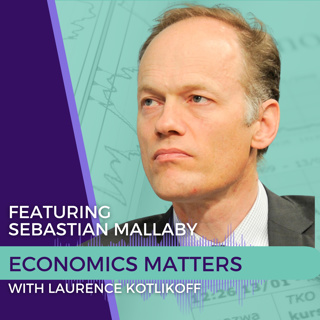
In this episode, Larry Kotlikoff sits down with Sebastian Mallaby, the New York Times bestselling author and veteran journalist behind The Infinity Machine, his deeply reported new biography of Hassabis and the rise of DeepMind. Mallaby walks through the improbable arc of Hassabis's career - from chess prodigy to video game programmer to the architect of some of the most consequential AI breakthroughs of the last decade. Then turns to a sharper, more urgent question: what can AI actually be trusted to get right, and where does it quietly, confidently fail?


What You'll Learn:

  • [00:32:01] The $1.3 million check Demis Hassabis turned down — and why he chose to study computer science instead of cashing in on his teenage video game fortune
  • [00:33:00] Why AI was considered a dead field as recently as 2012 — and how Hassabis convinced Peter Thiel to fund a company built on a technology that, at the time, couldn't do much of anything
  • [00:34:05] What "agentic AI" actually means — and how DeepMind's early systems learned to master Atari games through pure trial and error, years before "agentic" became a buzzword
  • [00:35:08] Reinforcement learning vs. deep learning, explained simply — the difference between an AI that learns from reading and one that learns from doing
  • [00:43:56] How neural networks actually work — a plain-language breakdown of "weights," layers, and how a system tweaks itself toward a correct answer through millions of small adjustments
  • [00:41:00] Why AI is fundamentally inductive, not deductive — and why that distinction explains both its remarkable strengths and its most dangerous blind spots
  • [01:04:57] How AlphaFold's protein-folding breakthrough connects directly to disease research — including new frontiers in understanding conditions like Parkinson's
  • [01:05:59] Inside Isomorphic Labs — Hassabis's newest venture, aimed at using AI to dramatically accelerate (not replace) the drug discovery pipeline
  • [01:16:00] Why AI tools are getting deterministic financial questions wrong — Larry's own real-world tests show major AI models disagreeing wildly on life insurance needs, optimal savings, and Roth conversion strategy, even though these problems have one mathematically correct answer
  • [01:12:43] What this means for the future of work — a candid exchange on AI adoption timelines, productivity's "jagged edge," and whether human labor markets have time to adjust

Sebastian Mallaby is an award-winning journalist and author of six books, including the New York Times bestseller The Infinity Machine: How an AI Pioneer Reshaped the Future, as well as The Power Law: Venture Capital and the Making of the New Future and More Money Than God. A former correspondent for The Economist and longtime member of the Washington Post editorial board. He co-hosts the podcast The Spillover with Rebecca Patterson of the Council on Foreign Relations.


Det här avsnittet är hämtat från ett öppet RSS-flöde och publiceras inte av Podme. Det kan innehålla reklam.

Avsnitt(138)

"We're Running a 20th Century Operating System on a 21st Century Economy — And It's Crashing"

"We're Running a 20th Century Operating System on a 21st Century Economy — And It's Crashing"

What happens when five completely unrelated thinkers, writing across five different decades, all point to the exact same moment in history as a coming crisis point...and that moment is now?Samuel Hunt...

2 Juli 1h 5min

The Regime We Were Supposed to Topple Just Got Stronger

The Regime We Were Supposed to Topple Just Got Stronger

What if everything you've been told about the new Iran deal — and what "winning" the war even meant — is built on a comparison that doesn't hold up, and a strategic outcome that's the opposite of what...

25 Juni 1h 7min

The $83 Billion Scam Hidden Inside Medicare (And the Economist Who Proved It)

The $83 Billion Scam Hidden Inside Medicare (And the Economist Who Proved It)

What if the system designed to protect your health in retirement was actually engineered (from the inside) to profit from keeping you confused, underserved, and locked out of the care you've already p...

9 Juni 58min

Are Netanyahu's Policies Reshaping Israel For the Better Or Worse?

Are Netanyahu's Policies Reshaping Israel For the Better Or Worse?

Can Israel reverse its political and social trajectory as elections approach amid ongoing wars and rising international isolation? Economics Matters co-host, Alex Kotlikoff, reunites with Israel's mos...

21 Maj 51min

Andrew Fesiak's Update on the Ukraine War

Andrew Fesiak's Update on the Ukraine War

Andrew Fesiak rejoins Economics Matters with reassuring news about the war in Ukraine. As I'm traveling in Europe until early June, my son and occasional co-host, Alex, interviews Andrew.  This is And...

8 Maj 1h 3min

Economics-Based Financial Planning with Wade Pfau's Retirement Income Institute

Economics-Based Financial Planning with Wade Pfau's Retirement Income Institute

This will be of interest to anyone who seeks more money, less risk, and a better life. Wade Pfau is one of our country’s truly exceptional thought leaders when it comes to personal finance. He holds a...

27 Apr 1h 39min

Kevin Esler Returns to Build You A TIPS Ladder

Kevin Esler Returns to Build You A TIPS Ladder

Forget what Wall Street says, risky investing is an option, not a starting point when it comes to your financial plan. No investment is perfectly safe and Economics Matters does not provide investment...

30 Mars 1h 8min

Populärt inom Utbildning

historiepodden-se
rss-bara-en-till-om-missbruk-medberoende-2
det-skaver
nu-blir-det-historia
harrisons-dramatiska-historia
not-fanny-anymore
roda-vita-rosen
rss-viktmedicinpodden
sektledare
johannes-hansen-podcast
kan-jag-sa-kan-du-podden
i-vantan-pa-katastrofen
allt-du-velat-veta
sa-in-i-sjalen
rikatillsammans-om-privatekonomi-rikedom-i-livet
rss-max-tant-med-max-villman
rss-foraldramotet-bring-lagercrantz
rss-ar-det-rimligt
vi-gar-till-historien
rss-basta-livet