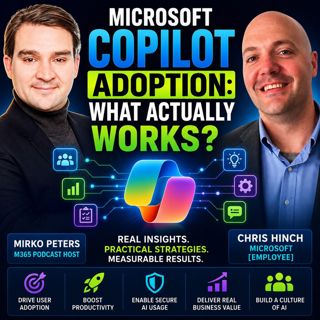
Microsoft Copilot Adoption: What Actually Works - With Chris Hinch [Microsoft]

Microsoft Copilot Adoption: What Actually Works - With Chris Hinch [Microsoft]

Artificial Intelligence has moved beyond experimentation and into the heart of modern business. Yet while organizations are investing heavily in Microsoft Copilot, many struggle to achieve meaningful adoption and measurable business value. Simply assigning licenses is no longer enough. Successful AI transformation requires governance, training, executive sponsorship, security, and a well-defined adoption strategy that helps employees integrate AI into their daily work. In this episode, Microsoft Cloud Solution Architect Chris Hinch shares practical lessons learned from working with enterprise customers adopting Microsoft Copilot at scale. Together, we separate marketing hype from real-world implementation and explore what organizations should focus on to maximize productivity, improve employee satisfaction, and build a sustainable AI culture.

WHY MOST COPILOT DEPLOYMENTS STRUGGLE
Many organizations approach Microsoft Copilot expecting immediate productivity gains. They purchase licenses, enable the service, and assume employees will naturally discover how to use AI effectively. Unfortunately, this approach often leads to disappointing adoption rates and limited return on investment. Chris explains that AI is not a magic solution capable of fixing broken business processes overnight. Like any enterprise technology, Copilot requires clear objectives, structured onboarding, continuous learning, and organizational leadership. Companies that define measurable business outcomes before deployment consistently achieve stronger adoption than those implementing AI simply because it is the latest technology trend.

ADOPTION IS A PEOPLE CHALLENGE, NOT A TECHNOLOGY CHALLENGE
Technology rarely becomes the biggest obstacle during deployment. Instead, successful adoption depends on helping employees change how they work. Every department has unique workflows, challenges, and productivity goals, making a one-size-fits-all rollout ineffective. Rather than deploying Copilot across the entire organization immediately, Chris recommends identifying practical business problems that AI can solve quickly. Demonstrating measurable improvements builds confidence, encourages wider adoption, and creates internal momentum for future AI initiatives. Successful adoption strategies include:
  • Department-specific use cases
  • Clear business objectives
  • Continuous employee training
  • Executive sponsorship
  • Ongoing success measurement
THE POWER OF CHAMPIONS PROGRAMS
One of the most effective strategies discussed in this episode is establishing an internal Champions Program. Instead of relying solely on IT departments, organizations identify enthusiastic employees from different business units who become early adopters and advocates for Microsoft Copilot. These champions experiment with prompts, discover practical workflows, and share successful techniques with colleagues. Their real-world experience makes AI more approachable than traditional technical documentation or generic training sessions. As adoption grows, these internal experts naturally become trusted advisors who accelerate organizational learning while reducing resistance to change.

PROMPTING IS ABOUT CONTEXT, NOT COMPLEXITY
The conversation also explores one of the biggest misconceptions surrounding AI—prompt engineering. Rather than memorizing complicated prompt structures, users should focus on providing meaningful context. Chris explains Microsoft's simple prompting framework, emphasizing goals, context, available information, and expected outcomes. AI produces significantly better responses when users explain why they need something instead of simply asking for a task to be completed. Whether summarizing emails, creating presentations, analyzing documents, or generating reports, context consistently improves the quality and relevance of AI-generated responses.

COPILOT, COPILOT STUDIO, AND AI FOUNDARY
Microsoft's AI ecosystem continues expanding rapidly, which often creates confusion about the different products available. This episode breaks down where Microsoft Copilot, Copilot Studio, Agent Builder, and Azure AI Foundry fit within an enterprise AI strategy. Organizations beginning their AI journey should focus on end-user productivity with Microsoft Copilot before gradually expanding into custom agents and enterprise automation through Copilot Studio. As maturity increases, Azure AI Foundry enables more advanced AI scenarios involving custom models, orchestration, and enterprise-grade AI development. Core AI technologies discussed include:
  • Microsoft Copilot
  • Copilot Studio
  • Agent Builder
  • Azure AI Foundry
  • Microsoft 365 Copilot Chat
SECURITY, GOVERNANCE, AND TRUST
Security remains one of the most common concerns organizations raise before deploying AI. Chris explains that Microsoft Copilot respects existing Microsoft 365 permissions, meaning users can only access information they already have permission to view. At the same time, AI frequently exposes governance weaknesses that already exist within organizations. Poor SharePoint permissions, excessive file sharing, outdated ownership, and inconsistent access controls become much more visible when AI begins searching organizational content. Rather than creating new security risks, Copilot often highlights governance issues that should have been addressed long before AI entered the organization.

MICROSOFT PURVIEW, ENTRA ID, AND DEFENDER
Enterprise AI adoption extends well beyond productivity tools. Microsoft Purview, Microsoft Entra ID, Microsoft Defender, and SharePoint Advanced Management all play essential roles in creating secure AI environments. These technologies allow organizations to classify sensitive information, enforce access policies, monitor AI usage, detect Shadow AI, prevent unauthorized data sharing, and ensure compliance across Microsoft 365. Important governance capabilities include:
  • Data classification
  • Identity management
  • Shadow AI detection
  • Information protection
  • Secure AI governance
THE FUTURE OF MICROSOFT COPILOT
Looking ahead, Chris shares his excitement about Microsoft's rapid AI innovation, including Copilot enhancements, advanced PowerPoint generation, collaborative AI experiences, Agent capabilities, Microsoft Scout, and expanding Model Context Protocol (MCP) support. Rather than replacing employees, future Copilot experiences will increasingly automate repetitive work, orchestrate complex business processes, generate sophisticated business assets, and assist knowledge workers throughout their daily workflows. As AI becomes more deeply integrated into Windows, Microsoft 365, and enterprise applications, organizations that invest today in governance, training, and adoption strategies will be best positioned to capitalize on these emerging capabilities.

FINAL THOUGHTS
Microsoft Copilot adoption is not simply an IT deployment—it is an organizational transformation that combines technology, leadership, governance, security, and continuous learning. As Chris Hinch explains throughout this conversation, organizations achieve the greatest success when they focus first on solving real business problems rather than deploying AI for its own sake. With strong executive sponsorship, Champions Programs, practical training, secure governance, and department-specific use cases, Microsoft Copilot becomes far more than another productivity tool. It becomes a trusted digital assistant that helps employees reclaim time, improve collaboration, reduce repetitive work, and unlock the full potential of AI across the modern workplace.


Become a supporter of this podcast: https://www.spreaker.com/podcast/m365-fm-modern-work-security-and-productivity-with-microsoft-365--6704921/support.

Det här avsnittet är hämtat från ett öppet RSS-flöde och publiceras inte av Podme. Det kan innehålla reklam.

Avsnitt(690)

Everything Microsoft Didn't Tell You About Teams with Everything Microsoft Didn't Tell You About Teams with Josh Blalock [MVP]

Everything Microsoft Didn't Tell You About Teams with Everything Microsoft Didn't Tell You About Teams with Josh Blalock [MVP]

Microsoft Teams has evolved from a simple collaboration platform into the digital workplace at the heart of modern business. But behind every successful Teams meeting lies far more than software. In t...

3 Juli 45min

Beyond the Portal: The Strategic Architecture of Microsoft Graph and PowerShell

Beyond the Portal: The Strategic Architecture of Microsoft Graph and PowerShell

For years, Microsoft 365 administration has been defined by portals. Administrators spend their days inside the Microsoft 365 Admin Center, Exchange Admin Center, SharePoint Admin Center, Teams Admin ...

3 Juli 1h 10min

Think Like an Attacker: Microsoft Security Exposure Management with Uros Babic [MVP-MCT]

Think Like an Attacker: Microsoft Security Exposure Management with Uros Babic [MVP-MCT]

Traditional cybersecurity focuses on vulnerabilities, alerts, and dashboards. Attackers don't. They look for opportunities, weak identities, exposed cloud resources, excessive permissions, forgotten e...

2 Juli 1h 9min
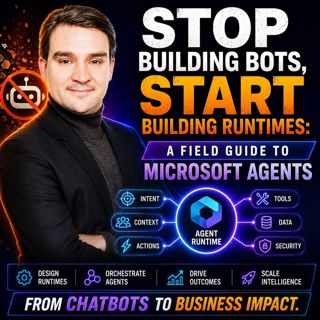
Stop Building Bots, Start Building Runtimes: A Field Guide to Microsoft Agents

Stop Building Bots, Start Building Runtimes: A Field Guide to Microsoft Agents

Everyone is calling Build 2026 the AI conference. Most of the attention went toward new copilots, voice experiences, and increasingly capable models. But beneath the headlines, Microsoft quietly intro...

2 Juli 1h 16min

EXTENSIBILITY FIRST: Building .NET Systems That Survive Change with Miguel Castro [MVP]

EXTENSIBILITY FIRST: Building .NET Systems That Survive Change with Miguel Castro [MVP]

Software rarely fails because developers cannot write code. It fails because applications are designed for today's requirements instead of tomorrow's changes. In this episode of the m365.fm Podcast, M...

1 Juli 1h 4min
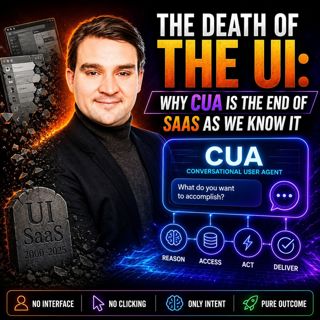
The Death of the UI: Why CUA is the End of SaaS as We Know It

The Death of the UI: Why CUA is the End of SaaS as We Know It

For more than forty years, enterprise software has been built around one fundamental assumption: humans need graphical interfaces to interact with machines. Dashboards, forms, navigation menus, search...

1 Juli 1h 8min
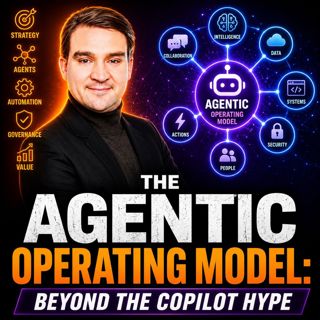
The Agentic Operating Model: Beyond the Copilot Hype

The Agentic Operating Model: Beyond the Copilot Hype

Most organizations believe they are implementing AI transformation. In reality, many are simply deploying chat interfaces on top of existing systems. While copilots and retrieval-based AI solutions ha...

30 Juni 1h 14min

Populärt inom Politik & nyheter

aftonbladet-krim
svenska-fall
tv4-nyheterna-story
p3-krim
rss-krimstad
motiv
de-fyras-gang
spar
flashback-forever
aftonbladet-daily
rss-expressen-dok
rss-sanning-konsekvens
rss-krimreportrarna
rss-flodet
rss-vad-fan-hande
politiken
rss-frandfors-horna
krimmagasinet
kungligt
svd-dokumentara-berattelser-2