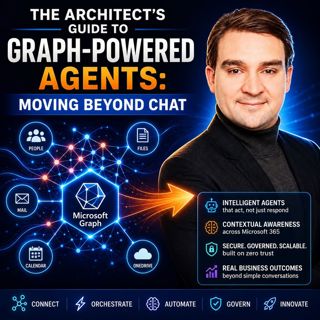
The Architect's Guide to Graph-Powered Agents: Moving Beyond Chat

The Architect's Guide to Graph-Powered Agents: Moving Beyond Chat

Artificial Intelligence has rapidly evolved from simple chatbots into sophisticated enterprise agents capable of reasoning, orchestrating workflows, and executing business processes. Yet many organizations are still approaching AI from the wrong perspective. They focus on building conversational interfaces while overlooking the critical infrastructure that transforms a chatbot into a true business agent. In this episode, we explore why Microsoft Graph has become the foundation for enterprise AI and how modern organizations are building Graph-powered agents that understand organizational context, securely access business data, coordinate across systems, and deliver measurable business outcomes.

WHY CHAT ALONE ISN'T ENOUGH
Large Language Models are incredibly powerful at generating text, summarizing information, and answering questions. However, they know nothing about your organization unless you provide context. Without access to company knowledge, relationships, permissions, workflows, and governance, AI simply predicts likely answers based on public training data rather than making informed business decisions.Enterprise AI requires far more than conversational intelligence. Successful agents combine organizational context, persistent memory, secure identities, and the authority to execute business actions. Microsoft Graph provides this missing layer by connecting people, documents, meetings, communications, identities, and workflows into a unified knowledge graph.

MICROSOFT GRAPH AS THE ENTERPRISE MEMORY
Microsoft Graph is much more than an API. It serves as the digital nervous system of Microsoft 365, exposing relationships between employees, Teams conversations, Outlook calendars, SharePoint content, OneDrive files, and Entra identities.Instead of treating information as isolated documents, Graph allows AI agents to understand how work actually flows throughout an organization. Rather than simply searching files, Graph-powered agents discover experts, identify collaboration patterns, recognize business relationships, and provide recommendations based on real organizational behavior.This dramatically improves AI accuracy while reducing hallucinations because decisions are grounded in live enterprise data instead of generic internet knowledge.

MOVING FROM ASSISTANTS TO AUTONOMOUS AGENTS
Most AI deployments today remain read-only assistants. They retrieve information but require humans to perform every business action manually. Modern enterprise agents go much further by interacting directly with Microsoft Graph, business applications, and enterprise systems.Typical capabilities include:
  • Scheduling meetings automatically
  • Updating CRM records
  • Creating Microsoft Planner tasks
  • Sending emails
  • Managing approvals
  • Executing business workflows
The shift from assistant to autonomous worker requires careful governance, permission boundaries, and comprehensive auditing to ensure every action remains secure, traceable, and compliant.

TOOL CALLING, MCP, AND MODERN AGENT ARCHITECTURE
One of the most important architectural advances is the introduction of structured tool calling and the Model Context Protocol (MCP). Rather than manually building integrations for every AI model, MCP provides a standardized communication layer between enterprise agents and business systems.This significantly reduces integration complexity while allowing organizations to expose Microsoft Graph capabilities securely across multiple AI platforms. Combined with orchestration frameworks such as LangGraph, organizations can build sophisticated workflows where AI agents reason, invoke tools, validate results, request human approval when necessary, and continue execution without losing context.Modern agent architectures rely on:
  • Microsoft Graph
  • Model Context Protocol (MCP)
  • Azure OpenAI Function Calling
  • LangGraph orchestration
  • Enterprise APIs
  • Shared workflow state
Together these technologies enable scalable, production-ready AI systems rather than isolated chatbot experiments.

GRAPH CONNECTORS AND GRAPH DATA CONNECT
Enterprise knowledge rarely lives inside Microsoft 365 alone. Critical business information is often distributed across Salesforce, Jira, ServiceNow, SAP, Google Drive, Box, and countless other systems.Microsoft Graph Connectors solve this challenge by indexing external enterprise content into Microsoft Graph, allowing agents to reason across multiple platforms through a unified interface.At the same time, Microsoft Graph Data Connect enables organizations to move Microsoft 365 data into Azure for advanced analytics, behavioral intelligence, and machine learning. This creates powerful opportunities for predictive AI, allowing agents to identify operational trends, forecast business outcomes, and recommend proactive actions rather than simply reacting to events.

MULTI-AGENT ORCHESTRATION
Enterprise workflows quickly become too complex for a single AI agent. Instead, organizations are adopting supervisor-worker architectures where specialized agents collaborate under the coordination of an orchestration layer.Examples include:
  • HR recruitment agents
  • IT operations agents
  • Sales qualification agents
  • Customer Success agents
  • Compliance agents
Each specialist performs one well-defined task while a supervisor agent coordinates execution, validates results, manages approvals, and handles exceptions. This approach improves scalability, transparency, resilience, and overall system quality.

IDENTITY, SECURITY, AND GOVERNANCE
Security cannot be an afterthought when deploying enterprise AI. Every production agent should operate using its own Microsoft Entra workload identity with least-privilege permissions rather than shared service accounts or user credentials.Successful organizations combine Managed Identities, Conditional Access, Microsoft Purview, Data Loss Prevention, sensitivity labels, audit trails, and approval workflows into a comprehensive governance framework.Every AI action should be attributable, explainable, monitored, and fully auditable. This creates confidence for both IT teams and business leaders while satisfying regulatory and compliance requirements.

AGENT 365 AND THE FUTURE OF ENTERPRISE AI
Managing dozens—or even hundreds—of AI agents requires centralized governance. Agent 365 introduces a dedicated control plane for discovering, managing, monitoring, and securing enterprise AI agents across Microsoft 365.Organizations gain visibility into deployed agents, permission models, risk classifications, ownership, policy compliance, and operational health through a single management experience. This transforms AI governance from reactive security into proactive operational excellence.

FINAL THOUGHTS
The future of enterprise AI extends far beyond chat interfaces. Organizations that continue viewing AI as a conversational tool risk missing the much larger opportunity of intelligent business automation. Microsoft Graph provides the organizational context, Model Context Protocol delivers standardized connectivity, and modern orchestration frameworks enable collaborative AI systems capable of executing real business processes securely and at scale.The next generation of enterprise architecture will be built around Graph-powered agents that understand organizational relationships, coordinate across business systems, operate within governance boundaries, and continuously improve business productivity. Companies investing today in Graph, MCP, multi-agent orchestration, identity-first security, and enterprise governance will be positioned to lead the AI-powered workplace of the future.

Become a supporter of this podcast: https://www.spreaker.com/podcast/m365-fm-modern-work-security-and-productivity-with-microsoft-365--6704921/support.

Det här avsnittet är hämtat från ett öppet RSS-flöde och publiceras inte av Podme. Det kan innehålla reklam.

Avsnitt(692)

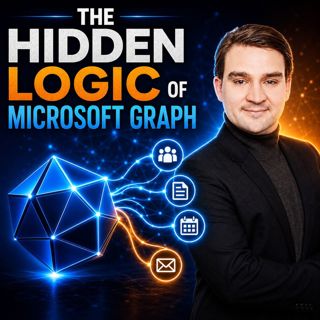
The Hidden Logic of Microsoft Graph

The Hidden Logic of Microsoft Graph

Most Microsoft 365 professionals know Microsoft Graph as the API behind users, groups, Teams, and SharePoint. But beneath those familiar endpoints lies a much larger reality. Microsoft Graph has evolv...

4 Juli 1h 11min

Everything Microsoft Didn't Tell You About Teams with Everything Microsoft Didn't Tell You About Teams with Josh Blalock [MVP]

Everything Microsoft Didn't Tell You About Teams with Everything Microsoft Didn't Tell You About Teams with Josh Blalock [MVP]

Microsoft Teams has evolved from a simple collaboration platform into the digital workplace at the heart of modern business. But behind every successful Teams meeting lies far more than software. In t...

3 Juli 45min

Beyond the Portal: The Strategic Architecture of Microsoft Graph and PowerShell

Beyond the Portal: The Strategic Architecture of Microsoft Graph and PowerShell

For years, Microsoft 365 administration has been defined by portals. Administrators spend their days inside the Microsoft 365 Admin Center, Exchange Admin Center, SharePoint Admin Center, Teams Admin ...

3 Juli 1h 10min

Think Like an Attacker: Microsoft Security Exposure Management with Uros Babic [MVP-MCT]

Think Like an Attacker: Microsoft Security Exposure Management with Uros Babic [MVP-MCT]

Traditional cybersecurity focuses on vulnerabilities, alerts, and dashboards. Attackers don't. They look for opportunities, weak identities, exposed cloud resources, excessive permissions, forgotten e...

2 Juli 1h 9min
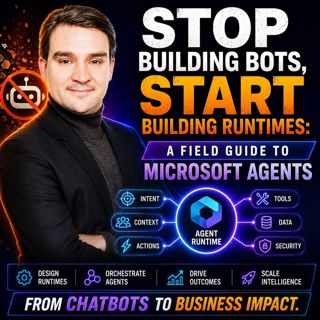
Stop Building Bots, Start Building Runtimes: A Field Guide to Microsoft Agents

Stop Building Bots, Start Building Runtimes: A Field Guide to Microsoft Agents

Everyone is calling Build 2026 the AI conference. Most of the attention went toward new copilots, voice experiences, and increasingly capable models. But beneath the headlines, Microsoft quietly intro...

2 Juli 1h 16min

EXTENSIBILITY FIRST: Building .NET Systems That Survive Change with Miguel Castro [MVP]

EXTENSIBILITY FIRST: Building .NET Systems That Survive Change with Miguel Castro [MVP]

Software rarely fails because developers cannot write code. It fails because applications are designed for today's requirements instead of tomorrow's changes. In this episode of the m365.fm Podcast, M...

1 Juli 1h 4min

The Death of the UI: Why CUA is the End of SaaS as We Know It

The Death of the UI: Why CUA is the End of SaaS as We Know It

For more than forty years, enterprise software has been built around one fundamental assumption: humans need graphical interfaces to interact with machines. Dashboards, forms, navigation menus, search...

1 Juli 1h 8min

Populärt inom Politik & nyheter

aftonbladet-krim
svenska-fall
tv4-nyheterna-story
p3-krim
rss-krimstad
motiv
de-fyras-gang
aftonbladet-daily
flashback-forever
spar
rss-expressen-dok
rss-sanning-konsekvens
politiken
rss-vad-fan-hande
krimmagasinet
rss-krimreportrarna
kungligt
svd-dokumentara-berattelser-2
olyckan-inifran
rss-flodet