The Rulebook You Never Read

The Rulebook You Never Read

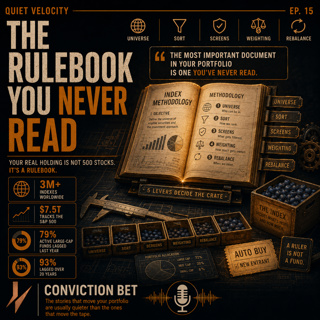
At Monday's close, funds tracking the Nasdaq-100 lined up to buy an estimated $4 billion of SpaceX stock. Nobody at those funds decided SpaceX was worth owning — a rulebook decided. And three weeks earlier, S&P Dow Jones looked at the biggest IPO in history and walked away from an estimated $14 billion in forced buying rather than bend its own rules.

This episode is about those rulebooks — the methodology documents that quietly decide what millions of people own, why two indexes with nearly identical names can be completely different animals, and why the most important document in your portfolio is one you've never read.

In this episode:

Three million rulers, thousands of funds. The index industry has counted more than 3 million indexes; the world's index funds number only in the thousands. Most indexes were never meant to be bought — they're benchmarks. And the benchmark keeps winning: 79% of active large-cap U.S. funds underperformed the S&P 500 in 2025, and 93% did over 20 years.

The blueberry sort. Every index methodology answers five questions — universe, sort, screens, weighting, rebalance. Change one lever and the whole crate changes: in 2025, the cap-weighted S&P 500 — with technology at 34% of its weight — left its own equal-weight twin far behind, and only 30% of its stocks beat the index they were standing in.

The machine doesn't chase. Tesla, December 2020: up nearly 40% in the two weeks after the inclusion announcement, added at more than 180x forward earnings, down 6.5% on its first day inside — then a 65% crash in 2022 that the index didn't cause. Harvard's Greenwood and Sammon found the average "index pop" faded to roughly zero in 2010–2020. Over decades, returns come from earnings and payouts: dividends alone account for roughly 31% of S&P 500 total return since 1926.

The trap in the sweetest aisle. A dividend yield is a fraction — cut the stock price in half and the yield "doubles." The rulebooks fight back: the Dividend Aristocrats demand 25 consecutive years of increases (69 companies qualify), and low-volatility screens keep the 50 calmest of 75 high yielders. But "low volatility" is a relative term: the Invesco fund tracking that strategy returned about 36% over five years, versus about 92% for the main S&P 500 fund.

The $14 billion no. SpaceX raised $75 billion in June and, under the rulebooks as they stood on IPO day, qualified for almost nothing. Nasdaq rewrote its rules and added it in 15 trading days at a roughly 1.3% weight; FTSE Russell moved in 5. S&P Dow Jones, after a formal public consultation, changed nothing: no profits (SpaceX lost $4.94 billion in 2025), no 12 months of trading history, no entry — an estimated $14 billion of index demand, declined in a press release. We also steel-man the bear case: cap-weighting really can't correct the market's mistakes — and the remedy is a different rulebook, not a stock picker.

What it means for you: before you buy any index fund, read the methodology — universe, sort, screens, weighting, rebalance. It's public, it's free, it's maybe twenty pages, and it tells you in advance, in writing, what it will do with your money. Rules, discretion, and all.

New episodes weekly. Subscribe on Apple Podcasts, Spotify, YouTube, or Amazon Music.

Conviction Bet is independent investment commentary. Nothing in this episode is investment advice.

Det här avsnittet är hämtat från ett öppet RSS-flöde och publiceras inte av Podme. Det kan innehålla reklam.

Avsnitt(21)

Why You Won't Spend Your Own Money

Why You Won't Spend Your Own Money

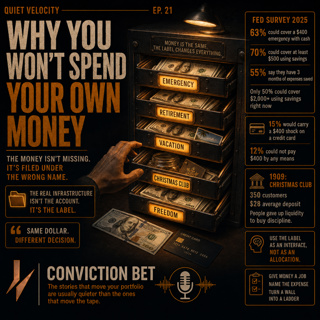
Your balance tells you what you have. The label shapes what you'll actually use. And you're the one who wrote it.The Federal Reserve asked Americans two versions of the same question. 70% said they co...

25 Aug 32min
You Can Copy The Key, Not The Locksmith: Nick Sleep's 921% Manual Is Free

You Can Copy The Key, Not The Locksmith: Nick Sleep's 921% Manual Is Free

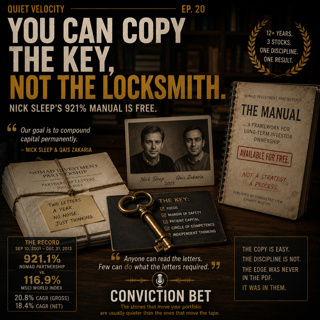
Two men, no analysts, no leverage, two letters a year. Twelve and a quarter years later: 921.1% against 116.9% for the MSCI World. A dollar became $10.21. Then they closed the fund, handed the capital...

13 Aug 37min
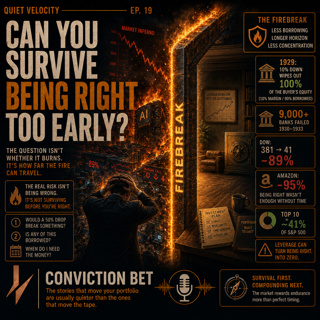
Can You Survive Being Right Too Early?

Can You Survive Being Right Too Early?

In late July, the market decided the AI build-out had gone too far. The Nasdaq fell into its second correction of the year, the Philadelphia Semiconductor Index dropped into a technical bear market, a...

6 Aug 32min
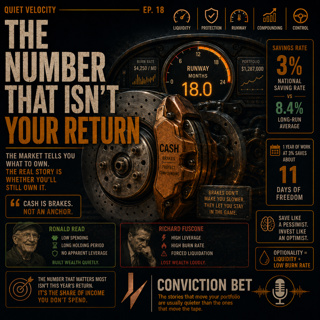
The Number That Isn't Your Return

The Number That Isn't Your Return

A Vermont gas station attendant died in 2014 holding $8 million and a five-inch stack of stock certificates. That same year, a former Merrill Lynch executive who once ran the firm's Latin America arm ...

30 Juli 39min
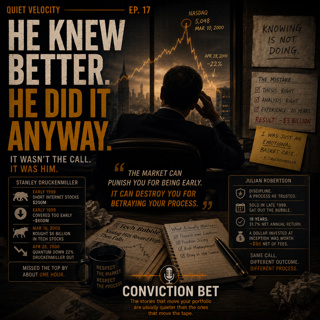
He Knew Better. He Did It Anyway

He Knew Better. He Did It Anyway

In March 2000, Stanley Druckenmiller had the internet bubble exactly right. He had shorted it, written the thesis, and run money for two decades without a losing year. Then he watched two junior trade...

23 Juli 33min
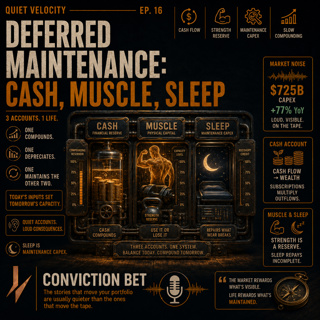
Deferred Maintenance: Cash, Muscle, Sleep

Deferred Maintenance: Cash, Muscle, Sleep

The four biggest tech companies are planning as much as $725 billion of capital spending this year — up 77% in a single year — much of it on machines that never have to sleep. The people underwriting ...

16 Juli 39min
The Four Cards You're Not Playing

The Four Cards You're Not Playing

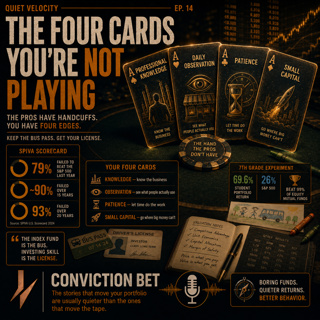
79% of professional large-cap fund managers lost to the S&P 500 last year. Stretch the window to fifteen years and the failure rate hits roughly 90%. The internet's favorite conclusion: if the pros ca...

1 Juli 28min

Populärt inom Business & ekonomi

framgangspodden
varvet
rss-jossan-nina
rss-borsens-finest
24fragor
svd-tech-brief
avanzapodden
badfluence
uppgang-och-fall
lastbilspodden
fill-or-kill
rss-inga-dumma-fragor-om-pengar
rss-kort-lang-analyspodden-fran-di
tabberaset
rss-dagen-med-di
bathina-en-podcast
rikatillsammans-om-privatekonomi-rikedom-i-livet
kapitalet-en-podd-om-ekonomi
affarsvarlden
borsmorgon