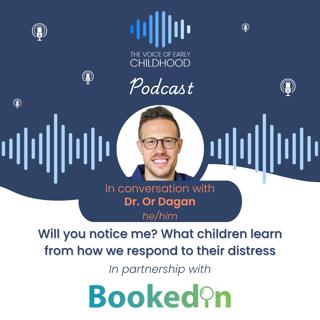
Will you notice me? What children learn from how we respond to their distress

Will you notice me? What children learn from how we respond to their distress

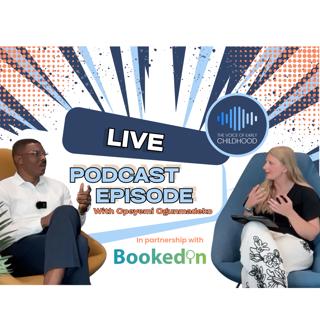
What if children's distress is not just a problem to solve, but a signal of their need to be seen? This article and podcast episode explore how children's expectations about availability and effectiveness of support from close others develop through repeated interactions with multiple caregivers. Using a psychological lens - in particular looking at attachment theory - we explore how educators and parents/carers can shape these expectations of care through their everyday responses to children's distress.

Read the article here:

https://thevoiceofearlychildhood.com/will-you-notice-me-what-children-learn-from-how-we-respond-to-their-distress/

This episode is in partnership with BookedIn

BookedIn is a CPD booking platform that connects organisations with verified speakers, trainers and consultants – so you can find the right fit faster, based on your brief, audience and outcomes.

You can discover, compare, and manage bookings in one place – designed to help you book with more clarity and confidence.

Whether you're booking CPD or are a speaker yourself, they're opening early access soon, and if you want to be first to hear when it's live, join the waiting list today!

To find out more and sign up to the wait list visit: https://waitlist.bookedin.online/

Listen to more:

If you enjoyed this episode, you might also like:

An introduction to John Bolwby - https://thevoiceofearlychildhood.com/an-introduction-to-john-bowlby/

An introduction to Mary Ainsworth - https://thevoiceofearlychildhood.com/an-introduction-to-mary-ainsworth/

Unconditional positive regard in early childhood: What we can still learn from Carl Rogers and Mister Rogers? - https://thevoiceofearlychildhood.com/unconditional-positive-regard-in-early-childhood-what-we-can-still-learn-from-carl-rogers-and-mister-rogers/

Understanding the impact of childhood trauma and how to develop trauma-informed practices - https://thevoiceofearlychildhood.com/understanding-the-impact-of-childhood-trauma-and-how-to-develop-trauma-informed-practices/

Get in touch and share your voice:

Do you have thoughts, questions or feedback? Get in touch here! – https://thevoiceofearlychildhood.com/contact/

Episode break down:

00:00 – Welcome and episode focus

02:05 – Understanding distress as communication

04:14 – Why children's distress can be misunderstood

05:55 – Can you notice me?

06:57 – Repeated interactions and attachment

10:08 – Secure base script knowledge

10:46 – How children learn whether support is available

12:30 – Scripts, shortcuts and everyday experiences

15:10 – What attuned responses look like in practice

16:45 – Opening the gates of learning

17:55 – Acknowledging distress

19:57 – Feeling seen before setting limits

20:13 – Acknowledging feelings, not validating behaviour

21:34 – Sensitive limit setting

21:50 – Multiple caregivers and attachment networks

22:12 – Moving beyond one primary attachment relationship

23:54 – The role of educators and professional caregivers

25:54 – A village of caregivers

26:24 – Patterns over perfection

26:41 – Good enough care

29:30 – Children need patterns, not perfect adults

29:54 – Current research and longitudinal findings

32:30 – Secure base script knowledge and later wellbeing

33:26 – Supporting parents and the network of care

35:08 – Reflecting on the long-term impact of early relationships

36:19 – Responding to distress over time

37:17 – Intergenerational patterns of care

37:36 – A key shift in mindset

37:47 – From fixing the problem to being there

38:57 – Closing reflections and thanks

For more episodes and articles visit The Voice of Early Childhood website: https://www.thevoiceofearlychildhood.com

Det här avsnittet är hämtat från ett öppet RSS-flöde och publiceras inte av Podme. Det kan innehålla reklam.

Avsnitt(165)

The hidden hearing crisis in early years – and the free solution every nursery can use

The hidden hearing crisis in early years – and the free solution every nursery can use

Too many children are quietly struggling to hear in early years settings, and it is often missed until their speech, learning and behaviour are already affected. This article and podcast episode share...

3 Aug 34min

Who gets to feel seen in our classrooms? Culturally inclusive practice through books

Who gets to feel seen in our classrooms? Culturally inclusive practice through books

How do books shape children's sense of identity, belonging and understanding of others? In this podcast episode and article, we explore the importance of representation in children's literature and wh...

27 Juli 30min

Moving beyond 3 percent: Recruiting more men into early years

Moving beyond 3 percent: Recruiting more men into early years

Drawing on personal experience, research and the Greater Than 3 mentor programme, Robert Harris explores why men remain underrepresented in early childhood. He considers the impact of gender diversity...

20 Juli 34min

Growing brains, growing bodies: Understanding ultra-processed foods

Growing brains, growing bodies: Understanding ultra-processed foods

The first five years are a once-in-a-lifetime window of opportunity for brain development. During this period, food does far more than fill tummies, it helps support learning, behaviour, emotional wel...

6 Juli 46min

What does good quality CPD look like?

What does good quality CPD look like?

Professional development is something every early childhood setting invests in, yet it does not always lead to meaningful or lasting change. Training sessions may be delivered, feedback forms may be c...

22 Juni 23min

What is relationship-based parenting?

What is relationship-based parenting?

Raising happy, healthy, successful kids with the Core4Connectors - A relationship-based approach. Today's parents and carers are shifting their hopes for children from outward success to inner securi...

8 Juni 38min

Early years leadership stories

Early years leadership stories

The stories we carry shape how we lead, often without us realising. In early years, these narratives influence who we see as a leader and how we show up. This article and podcast episode explore how l...

1 Juni 42min

Populärt inom Utbildning

historiepodden-se
rss-bara-en-till-om-missbruk-medberoende-2
det-skaver
nu-blir-det-historia
allt-du-velat-veta
harrisons-dramatiska-historia
johannes-hansen-podcast
not-fanny-anymore
rss-viktmedicinpodden
roda-vita-rosen
i-vantan-pa-katastrofen
rikatillsammans-om-privatekonomi-rikedom-i-livet
sa-in-i-sjalen
sektledare
rss-max-tant-med-max-villman
rss-autismandan
rss-traningsklubben
rss-i-skenet-av-blaljus
rss-basta-livet
sex-pa-riktigt-med-marika-smith