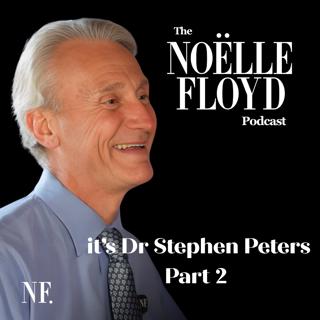

Horse Training and the Nervous System: What's Really Happening in Your Horse's Brain | Dr. Stephen Peters (Pt. 2)

Horse Training and the Nervous System: What's Really Happening in Your Horse's Brain | Dr. Stephen Peters (Pt. 2)

We say we want a willing horse.

Then we climb on, and we start cramming.

And when the horse gets tight, or slow, or stuck, we do the one thing that guarantees it gets worse — we add pressure.

This is Part 2 of my conversation with Dr. Stephen Peters, and this time he brought a horse's brain. Cut in half, in his hands, on the table between us. He points to the cingulate. He points to the little kidney-bean pituitary. And he shows me, physically, the difference between a horse who can talk itself back down and a horse who has no way back.

That difference has a name. It's a chemical called GABA.

An empowered horse can produce it — can send the "stand down" signal before the cortisol ever floods the system. A horse in learned helplessness can't reach it. Same event, two completely different animals, and most of what separates them is what we wired in, and the state we wired it in.

We get into the cocktail — dopamine, norepinephrine, acetylcholine, oxytocin, serotonin — and why drilling the same exercise seven times flattens every one of them. Why release is not the same thing as relief, and only the horse gets to tell you which one it was. Why recovery, the part everyone skips, is where the learning actually locks in. And why an hour on the clock is a human invention your horse never agreed to.

Then it opens out — touch, exercise, diet, the five domains, allo-grooming, the prairie voles who fall apart in isolation and settle the second the herd rushes back in.

And we close on Charles Darwin. Not the line everyone quotes. The one almost nobody does — the one where he says it's the cooperative communities, the ones that bond and help each other, that represent the highest level of evolution.

Horses have the chemistry for that built in. Dr. Peters' whole argument is simple: let's use it.

Start with Part 1 if you haven't — this picks up right where we left off.

Dr. Stephen Peters is a neuroscientist who directed a clinic for brain health and memory, and co-author of Evidence-Based Horsemanship (with Martin Black). His most recent books are Horse Brain Science and A Horse's Life (with Mark Rashid and Chrissy McDonald), which pairs 19 real case studies with the neurological detective work behind each one.

You can find all the books by Dr. Stephen Peters here: https://www.horsebrainscience.info/books

  1. Horse Brain Science: The Neuroscience of Ethical Horsemanship
  2. Horse Brain Science: A Foundation for Equine Neuroscience
  3. The Book of Neuropoetry
  4. Evidence Based Horsemanship
  5. A Horse's Life: The Neuroscience of Equine Welfare

You can find out more about Dr. Stephen Peters on his website - Horse Brain Science

And on Substack

Episode Sponsored by: Total Feeds

Our mission to provide quality nutrition to people and animals puts us in contact with all manner of interesting folks. Whether you're interested in our animal feed, or the people involved in the animal industry: you'll find it at Total Feeds!

Check out our line of Quality Animal Feeds here: https://totalfeeds.com

0:00 Why we get in the way of our own horses
2:00 A horse brain, cut in half: corpus callosum & the cingulate
5:00 The stress circuit — HPA axis, cortisol, and GABA
8:00 Empowered vs. helpless: who can reach the brake
9:06 Wiring confidence vs. wiring fear
11:15 Lady's three stations: rebuilding a horse's love of learning
13:40 The neurochemical cocktail — and why drilling drains it
16:00 Sending the horse away: oxytocin, prediction, and the payoff
18:00 Release is not relief
19:25 A word from Total Feeds
23:00 Recovery, hippocampal replay & why silence matters
27:38 Short sessions, switching horses & the neurodivergent brain
28:57 Spaced vs. massed learning; every nervous system is a snowflake
32:11 The petals on the flower: touch, exercise, diet & the five domains
40:45 Allo-grooming, oxytocin & the prairie voles
44:13 Darwin's Descent of Man: cooperation as the highest evolution
46:43 Dr. Peters' books, Substack & wrap

Interested in more from Noëlle?

Noëlle's writing again — head to her Substack for essays, observations, and the kind of thinking that doesn't fit in an episode. https://noellefloyd.substack.com

Every episode is also on YouTube, where the conversation continues in the comments.

https://www.youtube.com/@noellefloyd_plus

And if you're ready to go deeper, NF+ is where the real work happens — masterclasses, curated content, and a community that takes horses seriously. https://noellefloydplus.com

You can also download the app - NF+ App

Thank you for your listening!

Det här avsnittet är hämtat från ett öppet RSS-flöde och publiceras inte av Podme. Det kan innehålla reklam.

Avsnitt(93)

Why You Should Stop Patting Your Horse | Martin Black on Western Horse Training

Why You Should Stop Patting Your Horse | Martin Black on Western Horse Training

We pat our horses to tell them they did well. Martin Black says the horse would rather we kept our hands to ourselves. He has spent a life inside western horse training — starting close to five hundre...

10 Aug 1h
Monty Roberts, Alexandra Kurland, and the Future of Horse Training

Monty Roberts, Alexandra Kurland, and the Future of Horse Training

When I was eleven, my mom handed me The Man Who Listens to Horses. Last week, the man who wrote it died. Within days, the horse world also lost Alexandra Kurland — the woman who spent decades convinci...

4 Aug 18min

Your Saddle Fits a Horse That No Longer Exists — Letitia Glenn on Horse Care

Your Saddle Fits a Horse That No Longer Exists — Letitia Glenn on Horse Care

You measure with your hand while he stands there. Then he takes a step, and the horse you measured is gone. Saddle fit is horse care. I rode my whole life before anyone said that to me plainly. I met ...

22 Juli 1h 16min

Your Horse Isn't Being Bad — Dr. Stephen Peters on Horse Behavior, the Nervous System & Learned Helplessness Part 1 sponsored by Total Feeds

Your Horse Isn't Being Bad — Dr. Stephen Peters on Horse Behavior, the Nervous System & Learned Helplessness Part 1 sponsored by Total Feeds

Every rider has said it. He's being stubborn. She's testing me. He knows better. Here's the harder, truer thing underneath: the horse isn't being anything. The horse is a nervous system, doing the one...

7 Juli 52min

Joe Stockdale on Riding Confidence, Grief & the Show Jumping Career He Inherited

Joe Stockdale on Riding Confidence, Grief & the Show Jumping Career He Inherited

Everybody wants the clear round. The win. The photo at the top of the podium. Here's the part the sport keeps offstage — the doubt, the grief, the voice at the in-gate asking if you even belong here. ...

30 Juni 1h 5min

How to Read Horse Behavior — Elsa Sinclair on the 5 Types of Leadership

How to Read Horse Behavior — Elsa Sinclair on the 5 Types of Leadership

There is a question almost every one of us carries to the barn and never says out loud. Not how do I get him to do this. But: does he actually trust me — or is he just complying? This is Part 2 of my ...

23 Juni 1h 5min

What If Your Horse Could Say No? Elsa Sinclair on Freedom Based Training Part 1

What If Your Horse Could Say No? Elsa Sinclair on Freedom Based Training Part 1

Most of us learned to ride before we ever learned to ask. We learned the halter, the rope, the pressure, the release. We learned how to make a horse do the thing. And somewhere in there, quietly, a lo...

16 Juni 57min

Populärt inom Utbildning

historiepodden-se
rss-bara-en-till-om-missbruk-medberoende-2
det-skaver
nu-blir-det-historia
harrisons-dramatiska-historia
not-fanny-anymore
allt-du-velat-veta
roda-vita-rosen
johannes-hansen-podcast
rss-viktmedicinpodden
sa-in-i-sjalen
rikatillsammans-om-privatekonomi-rikedom-i-livet
rss-max-tant-med-max-villman
sektledare
i-vantan-pa-katastrofen
rss-autismandan
rss-basta-livet
rss-traningsklubben
psykologsnack
rss-okrystat