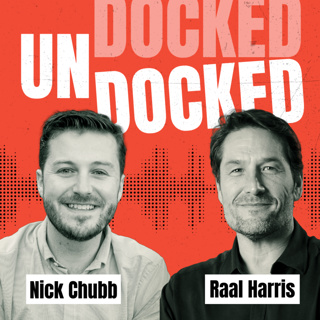
Freedom of Navigation Under Fire, China's Unexpected Green Push, and Trusting AI at Sea

Freedom of Navigation Under Fire, China's Unexpected Green Push, and Trusting AI at Sea

Freedom of navigation comes under renewed pressure as proposals to charge for transit through the Strait of Hormuz raise profound questions about international maritime law. The conversation then turns to China's accelerating maritime decarbonisation strategy before exploring how AI is reshaping shipping, and why its biggest challenge may be governance rather than capability.

CHAPTERS

  • 00:00 Freedom of navigation under pressure
  • 05:04 Why charging for the Strait of Hormuz matters
  • 08:12 China's accelerating electric shipping strategy
  • 12:20 Smart ships, autonomy and China's maritime infrastructure
  • 17:02 AI, geopolitics and competing development models
  • 21:14 AI ends shipping's copy-and-paste era
  • 25:03 Why maritime software is beginning to look the same
  • 32:22 Emergence World and AI societies
  • 39:44 Explainable AI and the human element
  • 44:36 Shipping's next digital bottleneck
  • 50:08 A lesson from computer-based training

This week begins with the deteriorating security situation in the Strait of Hormuz, following renewed attacks on merchant shipping and proposals to introduce charges for transiting one of the world's most important waterways. Nick and Raal examine what this could mean for the long-standing principle of freedom of navigation, and why weakening that norm would have consequences far beyond the Middle East.

The discussion then shifts to China, where rapid investment in electric vessels, autonomous shipping and digital maritime infrastructure paints a more nuanced picture of the country's decarbonisation strategy than many in the West assume. Rather than simply replacing one fuel with another, China appears to be redesigning parts of the maritime system around new technologies and long-term industrial planning.

From there, the conversation moves into artificial intelligence. Recent consolidation across maritime software providers prompts a discussion about whether competitive advantage will come from owning proprietary data or building the best interfaces to it. As AI increasingly becomes the layer connecting multiple systems, attention turns to the quality of underlying data, explainability and the limits of automation.

Finally, an extraordinary AI experiment, where different frontier models were allowed to govern virtual societies, provides a springboard into a wider debate about AI behaviour, accountability and what safe deployment should look like in highly regulated industries such as shipping.

EPISODE PARTNER

This episode of UnDocked is brought to you by IEC Telecom.

Connectivity today goes far beyond a single service. IEC Telecom delivers a fully integrated ecosystem for modern maritime operations, combining multi-orbit connectivity, cybersecurity, network management and crew welfare into one platform.

Learn more at https://iec-telecom.com

Det här avsnittet är hämtat från ett öppet RSS-flöde och publiceras inte av Podme. Det kan innehålla reklam.

Avsnitt(56)

Are We Making Seafaring Harder Than It Needs to Be? With Steven Jones

Are We Making Seafaring Harder Than It Needs to Be? With Steven Jones

Steven Jones joins Nick Chubb and Raal Harris to examine what the latest Seafarers Happiness Index reveals about life at sea, crew relationships, shore-based wellbeing.Chapters02:16 The origins of the...

6 Aug 57min

The Trust Problem Behind Digital Training Records and Maritime’s Third Mobile Ecosystem

The Trust Problem Behind Digital Training Records and Maritime’s Third Mobile Ecosystem

Mintra’s integration with Norway’s competence registry opens a wider discussion about digital training records, trust and interoperability in maritime. Nick and Raal revisit failed technology forecast...

30 Juli 50min

The Battle for Shipbuilding Capacity and Private Equity Targets Vessel Operations

The Battle for Shipbuilding Capacity and Private Equity Targets Vessel Operations

Nick and Raal explore shipbuilding’s geopolitical revival, friendshoring, autonomous vessel insurance, and the risks of an overheated global orderbook cycle ahead for shipping. They also examine how s...

23 Juli 58min

Compliance Over Competence, Human APIs, and Cognitive Load

Compliance Over Competence, Human APIs, and Cognitive Load

This week, Nick and Raal explore two new research reports examining the gap between maritime systems as they're designed and how they're actually used at sea. They discuss cognitive overload on modern...

9 Juli 54min

$600 Ship Data Collection, Digital Literacy, and Preventive Healthcare

$600 Ship Data Collection, Digital Literacy, and Preventive Healthcare

Nick and Raal discuss leadership change at Hafnia, falling costs for onboard vessel data collection, the continuing debate over software ecosystems versus single platforms, digital literacy and STCW r...

2 Juli 57min

Adaptive Learning and the Death of the Manager: UnDocked Live from Bergen

Adaptive Learning and the Death of the Manager: UnDocked Live from Bergen

Nick and Raal mark Undocked’s first live episode from Bergen with two competing visions for AI in maritime: scalable human expertise and the decline of middle management. The discussion explores perfo...

25 Juni 34min

The End of Easy Globalisation: Bergen Maps the New Maritime Order

The End of Easy Globalisation: Bergen Maps the New Maritime Order

Nick and Raal report from Bergen after Undocked’s first live stage appearance, capturing interviews with Michael Beckley, Sabrina Chao, Andreas Enger, Julian Bray, Pia Melling and Göran Persson. Acros...

18 Juni 1h 26min

Populärt inom Teknik

uppgang-och-fall
market-makers
rss-laddstationen-med-elbilen-i-sverige
skogsforum-podcast
elbilsveckan
 och-bilen-gar-bra
bli-saker-podden
rss-uppgang-och-fall
natets-morka-sida
rss-veckans-ai
rss-en-ai-till-kaffet
developers-mer-an-bara-kod
hej-bruksbil
rss-technokratin
rss-milpodden
solcellskollens-podcast
rss-it-sakerhetspodden
algoritmen
ai-sweden-podcast
rss-fabriken-2