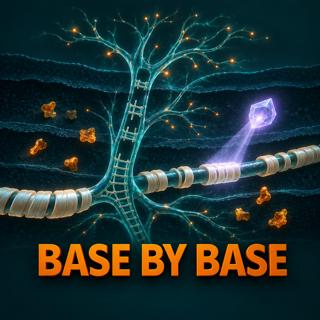
129: NPIP — Structural variation, selection, and paralog diversification
Base by Base6 Sep 2025

129: NPIP — Structural variation, selection, and paralog diversification

Dishuck PC et al., Cell Genomics - Using 169 long-read human haplotypes and 1.4 billion full-length cDNA reads, Dishuck et al. resolve the complex NPIP gene family on chromosome 16, revealing extreme copy-number and structural variation, widespread interlocus gene conversion and inversions, ongoing positive selection at specific paralogs, and paralog-specific full-length gene models with tissue-biased expression. Key terms: NPIP, segmental duplications, positive selection, long-read sequencing, gene conversion.

Study Highlights:
The authors use haplotype-resolved long-read assemblies and Iso-Seq to catalog 4,665 NPIP copies across 169 haplotypes and define 28 paralogs. They detect frequent interlocus gene conversion and multiple large inversion polymorphisms mediated by NPIP duplications. Population-level tests (Tajima’s D, nSL) reveal ongoing positive selection at several paralogs while Iso-Seq uncovers paralog-specific ORFs and tissue-biased expression, with 56% of common isoforms previously unreported. VNTR expansion in a human-specific NPIPB subfamily predicts a β-helix domain and novel signal peptide evolution.

Conclusion:
High-resolution pangenomic sequencing shows NPIP is an exceptionally dynamic, human-specific gene family with structural rearrangements, gene conversion, and positive selection shaping paralog-specific gene models and expression; these resolved paralogs now provide targets for functional and clinical follow-up.

Music:
Enjoy the music based on this article at the end of the episode.

Article title:
Structural variation, selection, and diversification of the NPIP gene family from the human pangenome

First author:
Dishuck PC

Journal:
Cell Genomics

DOI:
10.1016/j.xgen.2025.100977

Reference:
Dishuck PC, Munson KM, Lewis AP, Dougherty ML, Underwood JG, Harvey WT, Hsieh P, Pastinen T, Eichler EE. Structural variation, selection, and diversification of the NPIP gene family from the human pangenome. Cell Genomics. 2025;5:100977. doi:10.1016/j.xgen.2025.100977

License:
This episode is based on an open-access article published under the Creative Commons Attribution 4.0 International License (CC BY 4.0) – https://creativecommons.org/licenses/by/4.0/

Support:
Base by Base is independent and ad-free — no sponsors, no paywall. If an episode was worth your time, chip in and keep the papers audited and the original songs coming:
❤️ Support monthly: https://buy.stripe.com/cNifZhclVebvagk2JDgEg01
☕ One-time donation: https://donate.stripe.com/7sY4gz71B2sN3RWac5gEg00
More at basebybase.com

On PaperCast Base by Base you'll discover the latest in genomics, functional genomics, structural genomics, and proteomics.

Episode link: https://basebybase.com/episodes/structural-variation-and-diversification-of-the-npip-gene-family-from-the-human-pangenome

QC:
This episode was checked against the original article PDF and publication metadata for the episode release published on 2025-09-06.

QC Scope:
- article metadata and core scientific claims from the narration
- excludes analogies, intro/outro, and music
- transcript coverage: Audited transcript sections describing NPIP copy-number variation, long-read pangenome mapping, interlocus gene conversion (IGC) and inversion polymorphisms, resurrection/open reading frames of paralogs, brain/testis protein innovations, NPIP-PKD1 fusion transcripts, and population-genetic selection signals (Tajima's D
- transcript topics: NPIP copy-number variation across humans and primates; Long-read sequencing and pangenome mapping of NPIP; Interlocus gene conversion (IGC) and inversion polymorphisms; Resurrection of NPIP pseudogenes and open reading frames; Human-specific protein innovations: signal peptide and VNTR beta-helix; NPIP-PKD1 fusion transcripts

QC Summary:
- factual score: 10/10<...

Det här avsnittet är hämtat från ett öppet RSS-flöde och publiceras inte av Podme. Det kan innehålla reklam.

Avsnitt(462)

461: Adult Ank3 loss quiets neurons and lowers a myelin protein

461: Adult Ank3 loss quiets neurons and lowers a myelin protein

Yoon et al., Proceedings of the National Academy of Sciences - ANK3, which encodes the scaffolding protein ankyrin-G, is a major risk gene for bipolar disorder and schizophrenia, yet what it does in a...

24 Sep 24min
460: The lupus variant that also sharpens antiviral defense

460: The lupus variant that also sharpens antiviral defense

Virolainen et al., The American Journal of Human Genetics - A lupus signal on chromosome 11p15 narrows to a coding haplotype in IRF7 that most people in the world carry. This study shows the risk form...

21 Sep 24min

459: Cerebral palsy genetics: 515 candidate genes, evidence for 89

459: Cerebral palsy genetics: 515 candidate genes, evidence for 89

Arterbery et al., The American Journal of Human Genetics - Hundreds of genes have been reported as causes of cerebral palsy, yet there is no agreed model of what a pathogenic variant in a child with C...

13 Sep 24min
458: Somatic or inherited? Reading TP53 risk from shared DNA

458: Somatic or inherited? Reading TP53 risk from shared DNA

MacGregor et al., The American Journal of Human Genetics - Pathogenic TP53 variants found in blood have long been read as inherited Li-Fraumeni alleles, but many turn out to be somatic clones that gre...

10 Sep 25min

457: A deletion that raises Alzheimer risk, a duplication that lowers it

457: A deletion that raises Alzheimer risk, a duplication that lowers it

Quenez O et al., The American Journal of Human Genetics - Rare copy-number variants were called from 22,319 exomes covering early-onset Alzheimer disease, late-onset disease and unaffected controls, t...

9 Sep 24min

456: Beyond exons: where heritability hides as traits get more polygenic

456: Beyond exons: where heritability hides as traits get more polygenic

Fuhrer J et al., The American Journal of Human Genetics - Across 34 complex traits and disorders, a MiXeR-based framework partitions SNP heritability over 74 functional annotations and finds that exon...

8 Sep 45min

455: Agentic genomics: the bottleneck moves from code to judgment

455: Agentic genomics: the bottleneck moves from code to judgment

Corpas M et al., Cell Genomics - A Perspective arguing that autonomous AI agents which discover, configure and chain bioinformatics operations from natural-language instructions have shifted the bottl...

7 Sep 13min

454: Efavirenz retarda a doença priônica mexendo no colesterol do cérebro [PT]

454: Efavirenz retarda a doença priônica mexendo no colesterol do cérebro [PT]

Ali T et al., JCI Insight - Um antirretroviral aprovado para HIV, dado por via oral em microdose, prolongou a sobrevida de camundongos que carregam a proteína priônica humana e foram infectados com pr...

2 Sep 17min

Populärt inom Vetenskap

dumma-manniskor
p3-dystopia
rss-mottagningen
allt-du-velat-veta
angestpodden
kapitalet-en-podd-om-ekonomi
rss-ronden
det-morka-psyket
ufo-sverige
svd-nyhetsartiklar
4health-med-anna-sparre
sexet
rss-vetenskapsradion
rss-arkeologi-historia-podden-som-graver-i-vart-kulturlandskap
bildningspodden
rss-spraket
rss-vetenskapsradion-2
ideer-som-forandrar-varlden
rss-ufobortom-rimligt-tvivel
rss-geopodden-2