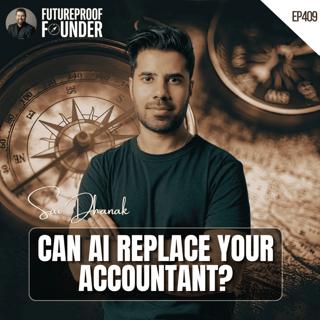
409 | Can AI Replace Your Accountant? | Sai Dhanak

409 | Can AI Replace Your Accountant? | Sai Dhanak

In this episode, Sai breaks down why he deliberately chose a services business over pure SaaS, how a human-in-the-loop model creates a defensible moat in a world increasingly disrupted by Claude and ChatGPT, and why acquiring books of business from retiring CPAs is one of the most underrated go-to-market strategies nobody is talking about. He also shares the three categories of SaaS he believes will survive the AI disruption — and why everything else is in serious trouble.

If you're building in a high-stakes industry or trying to compete where trust is currency, this episode is essential listening.

Key Takeaways

4:12 – Guest intro: Sai Dhanak — two exits, four patents, from Caribou to Latch to Deduction

4:33 – What shipping early and obsessing over design taught Sai about building products people want

5:35 – The connecting thread across cybersecurity, IoT, and service design patents

7:00 – Seven years at Latch: What going from seed to IPO really teaches you about scale

7:45 – "More money, more problems" — why lean is a feature, not a constraint

8:28 – The compounding risk of bad hires at scale

8:57 – What Deduction actually does: AI-native H&R Block for a fraction of the price

9:33 – Real-time example: How Sai's wife emailed a charitable donation to the AI agent mid-year

12:38 – The deliberate bet on services over pure SaaS — and why it was the right call

14:07 – The AI SaaSpocalypse: Three types of SaaS that will survive disruption

16:27 – How the human-in-the-loop model works operationally (Deduction OS)

20:04 – Why Sai left Latch right after the IPO — the mental playbook he was building

22:00 – The co-founder advantage: Moving faster because you already trust each other

23:33 – The fractional-to-full-time hiring model that built the team efficiently

25:17 – The critical fork in the road: Full-stack tax firm vs. selling software to accountants

28:00 – Why the B2B SaaS tax market is flooded and the personal accountant market is fragmented

29:20 – The personal accountant market: 18B, fragmented, no dominant player except H&R Block

32:00 – Why TurboTax and DIY tax software are getting eaten by ChatGPT and Claude

30:00 – Email as the primary channel: The internal debate and why async won

31:24 – Why email is more enduring than it looks — even for Gen Z

32:23 – The trust premium of human touch in an increasingly AI world

36:15 – The onboarding call insight: 15 minutes with a human = customers happily working with AI

37:57 – Acquiring books of business from retiring CPAs as a go-to-market engine

40:57 – The referral flywheel: Emailing taylor@deduction.com directly, no app required

41:25 – What Sai would do differently: Start acquiring firms sooner; build partnerships earlier

43:40 – Flat architecture, "everyone is a builder," and why the 1-person company is the wrong aspiration

45:36 – The most fulfilling part of building a company is always the people

46:10 – The question every founder should be asking: Do you love this problem enough to work on it for 10 years?

Tweetable Quotes"The most interesting opportunity in the AI era isn't building tools that replace humans. It's building businesses that use AI to make humans dramatically better — while keeping the one thing AI can't provide: trust." — Jeff Mains"AI can process the data. But it can't sign its name to it. Can't sit across from a client and take the blame when things go wrong. That's still you." — Jeff Mains"The intelligence of AI with the trust of a human. That's Deduction." — Sai Dhanak"In an ever-increasingly AI world, the human touch will have an ever-increasing premium." — Sai Dhanak"People don't want to sit in front of a chat box doing their taxes. The whole point of having an accountant is so you can go do something else." — Sai Dhanak"More money, more problems. When you're lean and scrappy, you stay focused. Raise too much capital and focus becomes exponentially harder." — Sai Dhanak"Do you love this problem enough to still be working on it in 10 years? Not the trend — the problem." — Sai Dhanak"Every founder, when asked what the highlight was, says the same thing: bringing on amazing people who are now my friends." — Sai Dhanak"Trends fade. Trust doesn't." — Jeff MainsSaaS Leadership Lessons

1. The three types of SaaS that survive AI disruption Sai identified a clear framework early: the only SaaS that holds value long-term are (1) businesses with hardcore integration moats you can't vibe-code (like Stripe), (2) ledgers and systems of record that are structurally difficult to disrupt, and (3) anything that requires a human liability backstop. If your SaaS doesn't fit one of those three, it's at risk.

2. The human in the loop is a competitive moat, not a limitation Rather than chasing full automation, Deduction deliberately built a model where licensed tax professionals review, verify, and sign off on AI-generated work. That signature requirement — mandated by the IRS — is baked-in defensibility. In high-stakes industries, the human backstop isn't a workaround. It's the whole product.

3. Ship early, obsess over design Going back to his first company, Caribou (sold to Mattel), Sai learned two lessons that still guide him: launch before you're ready to get real feedback fast, and invest heavily in design and experience. In an AI world where anyone can build anything, experience is what differentiates.

4. Lean is a feature, not a constraint After watching Latch raise hundreds of millions of dollars and experience the chaos that came with it, Sai deliberately built Deduction as a lean, flat organization. The goal isn't a one-person billion-dollar company — it's high margins with a small team that can move fast, maintain quality, and stay culturally tight. Every hire matters exponentially more in a small company.

5. Choose your channel based on operational reality, not trend The decision to lead with email over chat or SMS wasn't a legacy move — it was a strategic one. Email's async nature gave Deduction manageable response windows as an early-stage company while also matching the customer expectation: "I hired an accountant so I don't have to sit and do this myself." Build for your operational reality first, then open faster channels as you can guarantee the experience.

6. Acquire instead of just acquiring customers One of Deduction's most powerful go-to-market moves is buying books of business from retiring CPAs. The market for small accounting firms is fragmented and surprisingly liquid — entire websites are dedicated to the sale of these practices. Instead of competing cold for customers, Deduction inherits trusted relationships already built. It's an asymmetric growth lever that most founders never consider.

Guest Resources

sai@deduction.com

https://deduction.com/

www.linkedin.com/in/saayuj

https://x.com/SaiDhanak

Episode Sponsor

The Futureproof Series - https://www.youtube.com/playlist?list=PLfkXKUPZ5xuOqMPR7_gzGybncTtavyR1N

The Captain's Keys

Small Fish, Big Pond – https://smallfishbigpond.com/ Use the promo code ‘SaaSFuel’

Champion Leadership Group – https://championleadership.com/

https://jeffmains.com/books/

SaaS Fuel Resources

Website - https://championleadership.com/

Jeff Mains on LinkedIn - https://www.linkedin.com/in/jeffkmains/

Twitter - https://twitter.com/jeffkmains

Facebook - https://www.facebook.com/thesaasguy/

Instagram - https://instagram.com/jeffkmains

Det här avsnittet är hämtat från ett öppet RSS-flöde och publiceras inte av Podme. Det kan innehålla reklam.

Avsnitt(433)

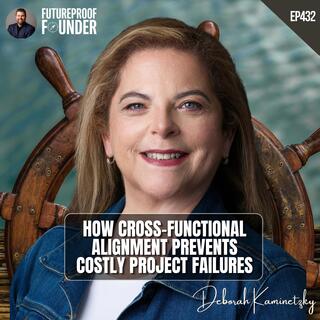
432 | How Cross-Functional Alignment Prevents Costly Project Failures | Deborah Kaminetzky

432 | How Cross-Functional Alignment Prevents Costly Project Failures | Deborah Kaminetzky

A software implementation can be delivered on time and on budget, then fail the moment people refuse to use it.In this episode, Jeff Mains talks with Deborah Kaminetzky, founder of De Facto Project Ma...

15 Okt 47min

431 | The Hidden Work Behind Cross-Border Supply Chains | Daman Grewal

431 | The Hidden Work Behind Cross-Border Supply Chains | Daman Grewal

Daman Grewal grew a logistics company from $1 million to $24 million in four years, working across dispatch, safety, accounts receivable, and sales before he fully recognized the skills he was buildin...

13 Okt 53min
430 | Revenue Per Employee, Capital Efficiency, and the Future of Startup Growth | Lindsey Mignano

430 | Revenue Per Employee, Capital Efficiency, and the Future of Startup Growth | Lindsey Mignano

Are you raising venture capital because your business needs it—or because getting funded feels like proof you’ve made it?In this episode of Futureproof Founder, Jeff Mains sits down with Lindsey Migna...

8 Okt 54min

429 | AI, Education, and the Decline of Independent Thinking | Jonathan Schaeffer

429 | AI, Education, and the Decline of Independent Thinking | Jonathan Schaeffer

Are you using AI to make better decisions—or letting a confident answer do your thinking for you?In this episode of Futureproof Founder, Jeff Mains sits down with AI researcher and entrepreneur Jonath...

6 Okt 57min

428 | Intellectual Property for Founders: Trademarks, Patents, Copyright, and Trade Secrets | James Gourley

428 | Intellectual Property for Founders: Trademarks, Patents, Copyright, and Trade Secrets | James Gourley

Jeff Mains sits down with James Gourley, a patent attorney and IP litigator who has spent 20 years on both sides of intellectual property disputes — from filing patents and trademarks to defending com...

1 Okt 42min
427 | Customer Outcomes, AI Adoption, and the New Software Economy | Carl Lenocker

427 | Customer Outcomes, AI Adoption, and the New Software Economy | Carl Lenocker

Jeff Mains sits down with Carl Lenocker, a 30-year enterprise software veteran who started in Silicon Valley in the '80s, survived the dot-com bust, and now consults founders on what actually creates ...

29 Sep 45min
426 | How Founders Can Turn AI Whiplash Into Strategic Focus | David Fung

426 | How Founders Can Turn AI Whiplash Into Strategic Focus | David Fung

David Fung spent 15 years at Salesforce as a Senior Director before walking away from unvested RSUs to launch Coachful Coaching. He now coaches CTOs and tech leaders on the pattern he calls "AI whipla...

24 Sep 46min
425 | Product-Market Fit Starts with Understanding the User | Erin Rollenhagen

425 | Product-Market Fit Starts with Understanding the User | Erin Rollenhagen

Erin Rollenhagen learned the most expensive lesson in product development the hard way: she spent years building software without ever talking to a single end user—and people took early retirement to ...

22 Sep 46min

Populärt inom Business & ekonomi

framgangspodden
varvet
rss-jossan-nina
rss-borsens-finest
24fragor
uppgang-och-fall
badfluence
avanzapodden
rss-inga-dumma-fragor-om-pengar
rss-dr-bjorklund
bathina-en-podcast
rss-svart-marknad
lastbilspodden
fill-or-kill
kapitalet-en-podd-om-ekonomi
rss-kort-lang-analyspodden-fran-di
tabberaset
rikatillsammans-om-privatekonomi-rikedom-i-livet
rss-hos-psykologen
rss-dagen-med-di