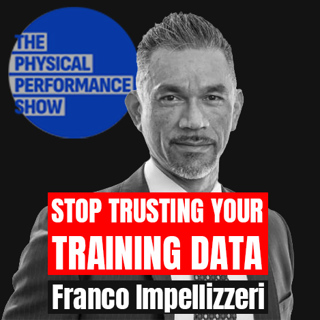

Ep 383: Prof  Franco Impellizzeri on Load Management, Data & the Truth About ACWR

Ep 383: Prof Franco Impellizzeri on Load Management, Data & the Truth About ACWR

Physical Performance Show – Episode 383 Show Notes

In episode 383 of The Physical Performance Show, host Brad Beer sits down with Professor Franco Impellizzeri, one of the most influential and outspoken voices in athlete load management research, for a wide-ranging conversation on why "load management" is an old concept dressed up in new data, why the acute to chronic workload ratio (ACWR) never held up to scrutiny, and why context — not more metrics — is what separates good decision-making from noise.

Show Sponsor:

Pillar Performance continues to lead the way in sports nutrition through micro-nutrition innovation, now expanding into the Performance Health range. One of their newest releases, Collagen Repair, was developed with Gelita Laboratories (Germany) using a clinically trialled collagen peptide (Tendofort) to support tendon and ligament health in conditions like hamstring tendinopathy, Achilles tendonitis, shin splints, and patellofemoral pain.

Head to pillarperformance.shop (or thefeed.com for North American listeners) and use code PHYSICALPERFORMANCE for 15% off your first purchase.

Pogo Physio also offers online Telehealth Consultations for endurance athletes managing bone, tendon, or joint issues — book online at pogophysio.com.au.

Professor Franco Impellizzeri's work can be explored here:

https://profiles.uts.edu.au/Franco.Impellizzeri

And...

https://scholar.google.com/citations?user=z35F1WAAAAAJ&hl=en

Listen in as we delve into the following:

What "load management" actually means, and why it's a relabelling of concepts coaches have wrestled with since the 1930s–40s

The double-edged sword of the data revolution: from heart rate monitors to today's GPS, wearables, and AI-driven analytics

Commercial and career incentives behind pushing metrics — both from tech companies and researchers

Confirmation bias and why interpreting data without a theoretical framework is "like reading tarot"

The case against the acute to chronic workload ratio (ACWR): its lack of scientific support despite IOC endorsement

A landmark runners' study showing the opposite relationship between ACWR and injury risk — and what that reveals about the field

Why meta-analyses and systematic reviews in load research can be manipulated to "find whatever you like"

The difference between using a metric personally versus promoting it as scientifically validated

Why the most skilled clinicians tend to hold their conclusions with the least certainty

A real-world case study: a soccer training drill "failure" that was actually a video-monitoring blind spot, not a bad drill

The expanding role of data scientists in sport, and why interpretation — not collection — is the real skill gap

Whether AI and machine learning can (or should) replace the sports scientist's judgement

Individualised and personalised training approaches — and why even these are still built on group-level generalisations

Distinguishing signal from noise, and why one "failed" intervention doesn't mean an athlete won't respond next time

Practical advice for coaches and practitioners: accept uncertainty, treat training like a "trial of therapy," and reassess

If he could track only one metric: heart rate (or perceived effort) over power

The push for more honest scientific debate — including a proposed on-air "intellectual sparring" series with dissenting researchers

Quotes:

"Understanding the quantity of training for athletes has been a hot topic since training methodology started... managing load is not new." — Professor Franco Impellizzeri

"When you don't have a theoretical framework and an a priori idea strong and supported, it's like reading tarot, to be honest." — Professor Franco Impellizzeri

"There's zero evidence that this metric can either help or can actually reflect some sort of mechanism." — Professor Franco Impellizzeri, on the acute to chronic workload ratio

"Don't take yourself too seriously." — Professor Franco Impellizzeri

Timeline:

00:00 – Introduction: host's specialist physio training and the load management "viva" question

01:04 – What is load management? An old concept, relabelled

02:31 – From heart rate monitors to GPS: the rise of training data

06:14 – Commercial interests and the risk of becoming "slaves of data"

08:05 – Why load management matters: the drug-dosing analogy

09:24 – Load management as a decades-old coaching concern

10:23 – Confirmation bias and interpreting data "like reading tarot"

13:17 – Championing methodological rigor in sports science

16:33 – Meta-research, honesty, and acknowledging uncertainty

18:22 – Why the most skilled clinicians express the least certainty

19:18 – Origins of the critique of the acute to chronic workload ratio (ACWR)

20:09 – Takeaways for contemporary practitioners on load management models

21:34 – Why the ACWR lacked scientific and conceptual support

23:02 – Training load, time-at-risk, and reframing injury risk

24:24 – The contradictory runners' study and what it implies

26:43 – Cherry-picking and overfitting in load-injury meta-analyses

28:34 – Taking a stronger public stance on social media

30:34 – Science as a self-correcting process

31:31 – The discipline required to properly read and critique research

33:58 – Why data alone can't tell you what to do

34:24 – Case study: the soccer drill that "failed" — until the video told the real story

36:49 – The role (and limits) of data scientists in sport

38:46 – Could AI replace the sports scientist's job?

40:42 – Advice for coaches and practitioners: accept uncertainty

42:09 – Individualised approaches are still a form of generalisation

44:31 – Separating signal from noise — and why not to give up early

46:56 – If only one metric: heart rate over power

48:21 – One piece of advice: "don't take yourself too seriously"

48:51 – This week's physical challenge: swimming without pain

50:16 – What's next: meta-research projects and replication studies

51:43 – A proposal for public scientific debate, and Ian Shrier's work on consensus

56:32 – Why genuine debate is hard to find in science communication today

57:59 – Episode close

THE TEAM:

Join The Physical Performance Show LEARNINGS membership through weekly podcasts here: https://www.patreon.com/TPPShow

Our goal is to get you back to your Physical Best. Find out more about Telehealth Consultations and book online at pogophysio.com.au.

Your Host:
🏃 Brad Beer - Instagram & X @Bradbeer and YouTube @PogophysioAu

The Physical Performance Show can be found at:
Facebook: facebook.com/thephysicalperformanceshowpodcast
X: @tppshow1
Instagram: @physicalperformanceshow

Det här avsnittet är hämtat från ett öppet RSS-flöde och publiceras inte av Podme. Det kan innehålla reklam.

Avsnitt(386)

Ep 385: Lateral Ankle Sprains Masterclass

Ep 385: Lateral Ankle Sprains Masterclass

In episode 385 of The Physical Performance Show, host Brad Beer sits down with fellow physiotherapist Lewis Craig for a lateral ankle sprain masterclass. Drawing on material the pair recently presente...

14 Aug 41min
Ep 384: Tibial Bone Injury Q&A - All Your Questions Answered

Ep 384: Tibial Bone Injury Q&A - All Your Questions Answered

In episode 384 of The Physical Performance Show, Brad Beer and fellow physiotherapist Tim Studley tackle a wide-ranging Q&A on tibial bone stress injuries. Following the recent bone stress injury mini...

7 Aug 34min
Ep 382: Tibial Bone Stress Masterclass Part 2 (Fixing Shin Pain & Tibia Injuries)

Ep 382: Tibial Bone Stress Masterclass Part 2 (Fixing Shin Pain & Tibia Injuries)

Physical Performance Show – Episode 382 Show Notes In this episode of The Physical Performance Show, host Brad Beer sits down with Pogo Physio's Tim Studley for Part 2 of their two-part mini-series o...

24 Juli 33min
Ep 381: Tibial Bone Stress Masterclass Part 1 (Shin Pain, Shin Splints or Stress Fracture?)

Ep 381: Tibial Bone Stress Masterclass Part 1 (Shin Pain, Shin Splints or Stress Fracture?)

In episode 381 of The Physical Performance Show, host Brad Beer — sports and exercise physiotherapist — sits down with Pogo physiotherapist Tim Studley for the first instalment of a two-part mini-seri...

17 Juli 36min
Ep 380: Bone Stress Injuries: Recovery, Rehabilitation & Return to Running (Part 3)

Ep 380: Bone Stress Injuries: Recovery, Rehabilitation & Return to Running (Part 3)

In episode 380 of The Physical Performance Show, host Brad Beer and Pogo Physio physiotherapist Tim Studley conclude their three-part expert series on bone stress injuries by focusing on what happens ...

10 Juli 29min
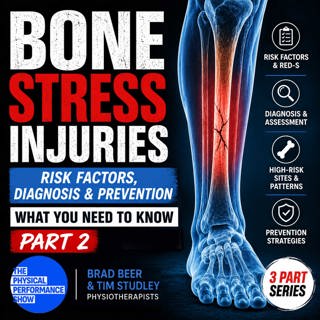
Ep 379: Bone Stress Injuries: Risk Factors, Diagnosis & Prevention (Part 2)

Ep 379: Bone Stress Injuries: Risk Factors, Diagnosis & Prevention (Part 2)

In episode 379 of The Physical Performance Show, host Brad Beer and Pogo Physio physiotherapist Tim Studley continue their three-part expert series on bone stress injuries by shifting the focus from t...

3 Juli 28min
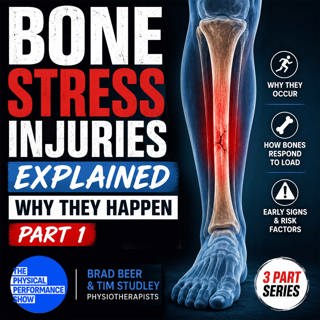
Ep 378: Bone Stress Injuries: Causes, Symptoms & Early Warning Signs (Part 1)

Ep 378: Bone Stress Injuries: Causes, Symptoms & Early Warning Signs (Part 1)

*]:pointer-events-auto R6Vx5W_threadScrollVars scroll-mb-[calc(var(--scroll-root-safe-area-inset-bottom,0px)+var(--thread-response-height))] scroll-mt-[calc(var(--header-height)+min(200px,max(70px,20s...

25 Juni 29min

Populärt inom Hälsa

somna-med-henrik
rss-jossan-nina
rss-bara-en-till-om-beroende-medberoende
inga-beiga-morsor
rss-vuxna-pa-latsas
rss-viktmedicinpodden
johannes-hansen-podcast
sexnoveller-deluxe
brottarbroder
bullfika
angestpodden
not-fanny-anymore
rss-hos-psykologen
sova-med-dan-horning
rss-basta-livet
rss-traningsklubben
halsoveckan-by-tyngre
tyngre-traningssnack
rss-angra-inget-3
sa-in-i-sjalen