The North American Model of Conservation: A Political Quagmire of Language and Ethics

The North American Model of Conservation: A Political Quagmire of Language and Ethics

The North American Model of Wildlife Conservation (NAM) is a set of seven principles that proponents claim when collectively applied has led to the successes of wildlife conservation and management in the United States and Canada. Originally described as a historical account in the 1990’s by Valerius Geist, it soon thereafter gained wide acceptance as a prescriptive methodology for wildlife managers and government agencies responsible for sustaining game and furbearing populations. Over the last fifty years, as threats to wildlife and ecosystems increased, critics of NAM have grown, arguing that it conceptually limits wildlife agencies’ conservation approaches and largely neglects non-game species. Traditional hunters and trappers, however, have resisted vigorously any changes to NAM. Consequently, policymakers are paralyzed, caught in a “political quagmire.” Fred Koontz, a former WA state Wildlife Commissioner, will discuss how addressing differences in purpose, expressed through language and wildlife values, is a key to improving NAM and wildlife management.

HOSTS & GUESTS

Fred Koontz, PhD is Fellow Emeritus at PAN Works. https://panworks.io/team/name/fred-koontz/

William S. Lynn, PhD (Bill) is President and founder of PAN Works and host of the PAN Thinks podcast. https://panworks.io/team/name/william-lynn/

Production is by Gary Sheer. https://garysheerphotography.com/

Recorded on 24 January 2024.

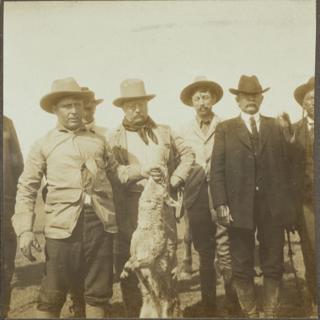
Episode art by Lambert, Alexander, 1861-1939., [1905, September 12]. Abernethy holding wolf by jaw. Library of Congress Prints and Photographs. Theodore Roosevelt Digital Library. Dickinson State University. https://www.theodorerooseveltcenter.org/digital-library/o275213

RESOURCES

Eichler, L., & Baumeister, D. (2018). Hunting for Justice: An Indigenous Critique of the North American Model of Wildlife Conservation. Environment and Society: Advances in Research, 9, 75–90. https://doi.org/10.3167/ares.2018.090106

Geist, V. (2006). The North American Model of Wildlife Conservation: A Means of Creating Wealth and Protecting Public Health While Generating Biodiversity. In D. Lavigne (Ed.), Gaining Ground: In Pursuit of Ecological Sustainability (pp. 285-294). University of Limerick Press.

Nelson, M. P., Vucetich, J. A., Paquet, P. C., & Bump, J. K. (2011). An Inadequate Construct: North American model: what’s flawed, what’s missing, what’s needed. The Wildlife Professional, 5(Summer), 58–60.

🎧 Apple Podcasts: https://podcasts.apple.com/us/podcast/pan-thinks/id1870689174

▶️ YouTube: https://www.youtube.com/@panworksio

📌 Flipboard: https://flipboard.com/@panworks

🌐 Learn More: https://panworks.io/

🐾 Support: https://www.zeffy.com/en-US/donation-form/donate-for-animal-wellbeing

Det här avsnittet är hämtat från ett öppet RSS-flöde och publiceras inte av Podme. Det kan innehålla reklam.

Avsnitt(13)

Impacts of Human Population Pressures on Animals

Impacts of Human Population Pressures on Animals

Human expansionism — both through the growth in our consumption and population — is the leading driver of cascading ecological and social crises. Animal exploitation, in the form of accelerating rates...

18 Juli 1h 43min

One Health Ethics: Part 4— The Tree Kangaroo Conservation Project

One Health Ethics: Part 4— The Tree Kangaroo Conservation Project

The Tree Kangaroo Conservation Program was founded at the Woodland Park Zoo (Seattle, WA, USA) in 1996. It began as the first wild study of the endangered Matschie’s tree kangaroo in Papua New Guinea ...

1 Juli 1h 30min

One Health Ethics: Part 3—Mountain Gorilla Conservation

One Health Ethics: Part 3—Mountain Gorilla Conservation

Through her work in conservation and One Health, Dr. Gladys Kalema-Zikusoka has seen how protecting endangered mountain gorillas around Bwindi Impenetrable National Park goes hand in hand with improvi...

26 Juni 51min

One Health Ethics and Conservation: Part 2— Historical and Practical Considerations

One Health Ethics and Conservation: Part 2— Historical and Practical Considerations

Over the last two decades One Health has gained prominence as a program paradigm among wildlife conservation practitioners. There is more than one definition of One Health but they share the starting ...

20 Juni 1h 8min

One Health Ethics and Conservation: Part 1—One Health 101

One Health Ethics and Conservation: Part 1—One Health 101

The term “One Health” explicitly recognizes that the health and wellbeing of people, other animals, and nature are interdependent. While the goal of One Health is optimal health for all, in practice i...

13 Juni 1h 10min

What It Means to Know an Animal

What It Means to Know an Animal

An elephant pauses at a crossroads. Her trunk rises, testing the air. She weighs memory, social awareness, the quality of the wind — then commits to a path. What does she know? And what follows, for s...

6 Juni 1h 31min

Wellbeing and Animal Lives: Part 2

Wellbeing and Animal Lives: Part 2

How does the concept of wellbeing inform animal lives? Wellbeing incorporates and yet extends previous ideas of animal welfare. It envisions in both a scientific and ethical sense how people should th...

23 Maj 1h 28min
Populärt inom Samhälle & Kultur

podme-dokumentar
aftonbladet-krim
gynning-berg
p3-dokumentar
en-mork-historia
aftonbladet-daily
creepypodden-med-jack-werner
hor-har
rss-schyffert-sundin-ar-det-har-nat
killradet
flashback-forever
kod-katastrof
mardromsgasten
svenska-fall
rss-nemo-moter-en-van
rss-mer-an-bara-morsa
p3-historia
vad-blir-det-for-mord
rss-expressen-dok
p1-dokumentar