292-Building Mobile Surgical Capability in Denied Environments

292-Building Mobile Surgical Capability in Denied Environments

In this episode of the Prolonged Field Care Podcast, Dennis sits down with Mitch (U.S. family practice/ER physician) and Augustine (frontline surgeon with five years of experience) to unpack what it actually takes to build and sustain mobile surgical capability in a high-threat Asian conflict zone.

They share the hard-won realities of operating close enough to hear the fighting—often within a mile—while remaining mobile enough to survive repeated bombings. You’ll hear how a pre-war physician assistant training program created a ready pool of skilled local providers, how an engineering student turned a broken village diesel generator into life-saving power, and how two family tents duct-taped together became an operating theater.

Key topics include life-saving procedures that can actually be done under those constraints (chest tubes, hemorrhage control, laparotomy, emergency C-sections), the critical role of a pre-arranged walking blood bank, the art of improvisation (urine catheter as chest tube), the security reasons civilians and fighters refuse local government hospitals, and why underground facilities are often impossible. Most importantly, they discuss the non-negotiable principles: local invitation and ownership, language and cultural integration, knowing why you are there, and the constant tension between capability and mobility.

This is practical, unfiltered prolonged field care for anyone preparing to operate—or train others to operate—when the next facility is days away and the sky is full of drones.


Key Takeaways

  • Pre-war training programs (5-year PA model focused on the 80% of common regional problems + trauma) create the only sustainable talent pipeline.
  • Mobility is survival: plan the next location before you need it; a full move still costs roughly one day to tear down and one day to stand up.
  • Improvisation is a core clinical skill—urine catheters become chest tubes when the real ones run out.
  • Walking blood banks beat stored products in this environment if you pre-type the team and cultivate local donors before the first patient arrives.
  • Community ownership and language fluency are force multipliers and personal survival tools; operating without local invitation is a fast way to get people killed.
  • Generators, headlights, and ambulance patterns create detectable signatures; concealment and rapid patient throughput matter more than concrete.


Chapters

00:40 – Why Mobile Surgical Teams Are Essential in Modern Conflict

01:55 – Pre-War Training Program & Building a Ready Talent Pool

03:00 – First Lessons from the Golden Week Reality

04:30 – Improvising the Facility: Generators, Tents, and Operating Tables

07:00 – The Mobility Dilemma: What You Carry vs. What You Leave

09:30 – Life-Saving Procedures Actually Performed on the Front Line

13:00 – Critical Thinking & Improvisation in Action (Urine Catheter Chest Tube)

14:20 – Walking Blood Bank Strategy & Community Engagement

17:00 – Language, Trust, and Why Local Integration Keeps You Alive

19:00 – Why Patients Bypass Nearby Hospitals

21:00 – Access, Invitation, and Working Under Local Leadership

23:00 – How Close Is Too Close? Drones, Signatures & Site Selection

26:00 – Triage, Patient Flow & Pre-Arranged Evacuation Pathways

28:00 – Sourcing Supplies Without Becoming a Target

32:00 – Faith, Motivation & Enduring Under Fire

32:40 – Underground Facilities vs. Pure Mobility (Ukraine Comparison)

36:00 – How Long Do You Stay? Reading the Threat & Knowing When to Move

38:00 – Final Reflections: People Over Adrenaline


For more content, go to ⁠⁠⁠⁠⁠⁠⁠⁠⁠⁠⁠⁠⁠⁠⁠⁠⁠⁠⁠⁠⁠⁠⁠⁠⁠⁠⁠⁠⁠⁠⁠⁠⁠⁠⁠⁠⁠⁠⁠⁠⁠⁠⁠⁠⁠⁠⁠⁠⁠⁠⁠⁠⁠⁠⁠⁠⁠⁠⁠⁠⁠⁠⁠⁠⁠⁠⁠⁠⁠⁠⁠⁠⁠⁠⁠⁠⁠⁠⁠⁠⁠⁠www.prolongedfieldcare.org⁠⁠⁠⁠⁠⁠⁠⁠⁠⁠⁠⁠⁠⁠⁠⁠⁠⁠⁠⁠⁠⁠⁠⁠⁠⁠⁠⁠⁠⁠⁠⁠⁠⁠⁠⁠⁠⁠⁠⁠⁠⁠⁠⁠⁠⁠⁠⁠⁠⁠⁠⁠⁠⁠⁠⁠⁠⁠⁠⁠⁠⁠⁠⁠⁠⁠⁠⁠⁠⁠⁠⁠⁠⁠⁠⁠⁠⁠⁠⁠⁠⁠

Det här avsnittet är hämtat från ett öppet RSS-flöde och publiceras inte av Podme. Det kan innehålla reklam.

Avsnitt(624)

294 - Do Antibiotics Really Reduce Mortality in Trauma? Wound Care First in Prolonged Field Care

294 - Do Antibiotics Really Reduce Mortality in Trauma? Wound Care First in Prolonged Field Care

Antibiotics are not magic. In this episode of the PFC Podcast, Dennis sits down with Ryan to cut through the common myth that “I’ve given antibiotics, so the wound is protected.” They unpack why vigor...

31 Aug 36min
SOMA 26' - Fresh Whole Blood is Not The Answer: It's Still a Question

SOMA 26' - Fresh Whole Blood is Not The Answer: It's Still a Question

Whole Blood Is Not a Solution (Until Conventional Forces Can Deliver It)Recorded live at SOMA 26Dr. Vanessa Hanick (emergency physician, former active-duty Army, now National Guard) and 1SG Cy Clayton...

27 Aug 28min
293 - Dead Tissue Kills in Prolonged Field Care: 4 C’s, Early Debridement & Delayed Primary Closure Lessons from the Field

293 - Dead Tissue Kills in Prolonged Field Care: 4 C’s, Early Debridement & Delayed Primary Closure Lessons from the Field

In this episode of the PFC Podcast, Dennis sits down with missionary surgeon Jason to cut through the noise on real-world wound care in austere and unconventional warfare environments. From the bridge...

24 Aug 49min
SOMA 26' - European Medical Preparations for Major Engagements and Large-Scale Combat Operations

SOMA 26' - European Medical Preparations for Major Engagements and Large-Scale Combat Operations

Recorded live at SOMA 26Pierre Pasquier (France) and his German counterpart deliver a clear-eyed assessment of how European military medical systems are preparing for large-scale combat operations and...

20 Aug 31min
SOMA 26 - Optimizing the Efficacy of Commonly Used Tactical Medical Gear and Medications In The Arctic Extreme Cold Operational Environment

SOMA 26 - Optimizing the Efficacy of Commonly Used Tactical Medical Gear and Medications In The Arctic Extreme Cold Operational Environment

Recorded live at SOMA 26Dr. Emily Johnston (Cascadia Mountain Institute) and SFC Ezequiel Mendoza (Arctic Dustoff, Fairbanks) deliver a hard-hitting, field-validated look at how standard tactical medi...

13 Aug 29min
291 - Pediatric Burns In Prolonged Field Care Assessment, Resuscitation & Airway Management

291 - Pediatric Burns In Prolonged Field Care Assessment, Resuscitation & Airway Management

In this essential episode of the Prolonged Field Care Podcast, Dennis sits down with pediatric intensivist Dr. Sara Bibbens to tackle one of the most challenging and anxiety-inducing scenarios in aust...

10 Aug 30min
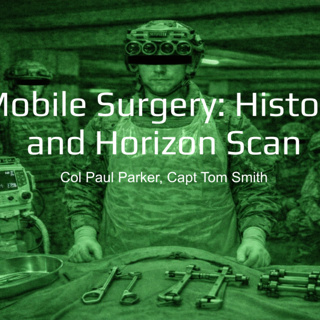
SOMA 26 - A History of Mobile Surgical Teams Role 1-3 and Horizon Scan

SOMA 26 - A History of Mobile Surgical Teams Role 1-3 and Horizon Scan

In this presentation, we take a deep dive into the 300-year history of mobile surgery supporting land campaigns — from Dominique Larrey’s ambulance volantes through the Letterman system, Arnhem, the F...

6 Aug 28min

Populärt inom Utbildning

historiepodden-se
det-skaver
rss-bara-en-till-om-beroende-medberoende
harrisons-dramatiska-historia
nu-blir-det-historia
roda-vita-rosen
rss-viktmedicinpodden
rikatillsammans-om-privatekonomi-rikedom-i-livet
johannes-hansen-podcast
allt-du-velat-veta
i-vantan-pa-katastrofen
not-fanny-anymore
rss-max-tant-med-max-villman
sa-in-i-sjalen
rss-ar-det-rimligt
rss-foraldramotet-bring-lagercrantz
rss-basta-livet
sektledare
rss-traningsklubben
rss-autismandan