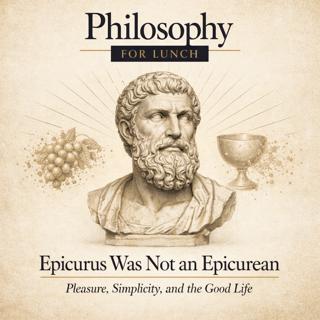
Episode #019 - Epicurus Was Not an Epicurean

Episode #019 - Epicurus Was Not an Epicurean

If someone described a philosophy whose central teachings were: live simply, eat bread and water, cultivate close friendships, manage your desires so they never exceed what is easily available, and spend time thinking about death so you stop being afraid of it — you probably would not call that philosophy Epicurean.

And yet that is exactly what Epicurus taught. The man whose name became synonymous with luxury and sensual indulgence was a philosopher who lived in a garden outside Athens, ate simple food, drank water rather than wine, and argued that most human suffering comes not from the absence of pleasure but from the disordered pursuit of pleasures we do not need.

In this episode, Shawn and Claire correct a misreading that has been running for roughly two thousand years. They cover the distinction Epicurus draws between kinetic pleasures — excitement, acquisition, sensation — and katastematic pleasures — the stable absence of pain in the body and disturbance in the mind. His central claim, consistently misread, is that tranquility is higher than stimulation. The good life is not organized around the pursuit of more. It is organized around the achievement of sufficiency.

The episode also takes seriously Epicurus's philosophy of death — his argument that death is nothing to us, the symmetry between pre-natal and post-mortem non-existence, and what Thomas Nagel's deprivation account says in response. And it covers the role of friendship in Epicurean life: not casual social connection, but the deep, lasting philosophical friendship that Epicurus called the greatest good wisdom procures.

The contemporary research on hedonic adaptation — how quickly we return to baseline happiness after acquiring more — suggests Epicurus was onto something real. The person whose happiness depends on bread and water and good conversation is almost always able to be happy. The person whose happiness depends on fame and wealth is perpetually at risk.

The question Epicurus leaves you with is simple and genuinely difficult: what do you actually need? And do you already have it?

Shawn and Claire together. No prior philosophy required.

SHOW NOTES

Primary Sources

  • Epicurus. (1994). The Epicurus Reader: Selected Writings and Testimonia (B. Inwood & L. P. Gerson, Trans. & Eds.). Hackett Publishing.
  • Diogenes Laertius. (2018). Lives of the Eminent Philosophers (P. Mensch, Trans.). Oxford University Press. (Original work written c. third century CE)
  • Lucretius. (2007). The Nature of Things (A. E. Stallings, Trans.). Penguin Classics. (Original work written c. first century BCE)

Works Referenced in This Episode

  • Nagel, T. (1979). Death. In Mortal Questions (pp. 1–10). Cambridge University Press.
  • Waldinger, R., & Schulz, M. (2023). The Good Life: Lessons from the World's Longest Scientific Study of Happiness. Simon & Schuster.
  • Solomon, S., Greenberg, J., & Pyszczynski, T. (2015). The Worm at the Core: On the Role of Death in Life. Random House.

Accessible Starting Points

  • Greenblatt, S. (2011). The Swerve: How the World Became Modern. Norton.
  • Wilson, C. (2019). How to Be an Epicurean: The Ancient Art of Living Well. Basic Books.
  • de Botton, A. (2000). The Consolations of Philosophy. Pantheon.

New episodes every Monday. Philosophy for Lunch · Big ideas. Human conversations.

Det här avsnittet är hämtat från ett öppet RSS-flöde och publiceras inte av Podme. Det kan innehålla reklam.

Avsnitt(20)

Episode #020 - Was Mathematics Invented or Discovered?

Episode #020 - Was Mathematics Invented or Discovered?

Here is a question that sounds like it should have an obvious answer. Was mathematics invented or discovered? Did humans create the number two the way we created the word for it? Or did the number two...

24 Aug 40min
Episode #018 - Probability and Judgment: Why We Get Risk Wrong

Episode #018 - Probability and Judgment: Why We Get Risk Wrong

Here is a medical test scenario. A disease affects one in a thousand people. There is a test that is ninety-nine percent accurate. You take the test. It comes back positive. What is the probability th...

10 Aug 31min

Episode #017 - The Paradox of Tolerance: Can a Free Society Tolerate Intolerance?

Episode #017 - The Paradox of Tolerance: Can a Free Society Tolerate Intolerance?

Karl Popper wrote one of the most widely shared philosophical texts on the internet. It is also one of the most consistently misread.The argument is simple on its surface: a society that tolerates int...

3 Aug 31min

Episode #016 - Nietzsche: God Is Dead — Now What?

Episode #016 - Nietzsche: God Is Dead — Now What?

Nietzsche is probably the most misread philosopher in the Western tradition. He has been claimed by Nazis, nihilists, self-help gurus, and people who have read a sentence or two and decided they under...

27 Juli 31min

Episode #015 - William James and the Will to Believe

Episode #015 - William James and the Will to Believe

Imagine you are standing at the edge of a chasm. You need to get to the other side. The leap is possible — just barely — but you cannot know in advance whether you will make it. Does believing you can...

20 Juli 29min

Episode #014 - Viktor Frankl and the Meaning Made from Suffering

Episode #014 - Viktor Frankl and the Meaning Made from Suffering

There is a question that arrives most forcefully when circumstances are at their worst. Not why is this happening in the causal sense, but the question underneath that one: what does this mean? Is the...

13 Juli 30min

Episode #013 - What Does It Mean to Live Philosophically?

Episode #013 - What Does It Mean to Live Philosophically?

Socrates said the unexamined life is not worth living. That sentence is probably the most quoted in the history of philosophy. But the popular interpretation — that you should think more and be more s...

6 Juli 30min

Populärt inom Samhälle & Kultur

podme-dokumentar
gynning-berg
aftonbladet-krim
en-mork-historia
p3-dokumentar
aftonbladet-daily
hor-har
creepypodden-med-jack-werner
killradet
rss-schyffert-sundin-ar-det-har-nat
flashback-forever
kod-katastrof
rss-nemo-moter-en-van
svenska-fall
vad-blir-det-for-mord
mardromsgasten
rss-vill-du-veta-en-hemlis-2
rss-mer-an-bara-morsa
p3-historia
rss-vad-fan-hande