
The Oklahoma City Bombing

The Oklahoma City Bombing

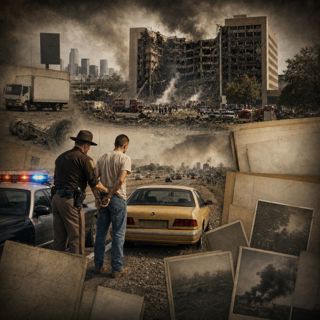
78 minutes after the front of the Alfred P. Murrah Federal Building came off, an Oklahoma Highway Patrol trooper named Charles Hanger pulled over a yellow Mercury on Interstate 35 because there was no license plate on the back bumper.

He wasn't looking for a bomber. He was running hard toward a wreck scene he'd worked in the dark the Sunday before, and he'd already been ordered to Oklahoma City and then told to turn around. Ten minutes later he had Timothy McVeigh handcuffed in the front seat of his patrol car on a tag violation and a concealed weapon charge, and neither man on that shoulder had any reason to connect it to what had happened 80 miles south.

Almost everybody knows the outline of this case, and almost all of it is true, which is what makes it unusual. The wrong man didn't go to prison. The evidence against Timothy McVeigh is about as complete as any case Brian has ever read — a partial VIN stamped on a truck axle found 575 feet from the crater, a fingerprint on a fertilizer receipt, six months of calls consolidated onto one prepaid card under a false name, a motel register signed in his own handwriting. But the summary most people carry around makes a movement look like a man, and it leaves out most of what's actually in the file.

The two years between Ruby Ridge in August 1992 and Waco in April 1993 that built an American militia movement almost from nothing. A journalism student from Southern Methodist who interviewed McVeigh outside the Branch Davidian siege in March 1993, got his real name, and kept the clipping until it became evidence. 4,000 pounds of ammonium nitrate bought for cash under an alias in McPherson, Kansas, on September 30 and October 18, 1994. A racing fuel salesman who heard a stranger at a Kansas drag strip ask for the two chemicals that make a bomb and had nowhere to take it.

A gun dealer's robbery in Royal, Arkansas, on November 5, 1994, that funded the plot and produced two witnesses the defense took apart on the stand. And the Fortiers in Kingman, Arizona, who watched McVeigh lay soup cans out on their living room floor in a triangle to show them how the barrels would sit in the truck, then went about their lives for five months.

Then the parts that never closed. Tom Kessinger conceded he'd described the wrong man as John Doe No. 2 and never conceded there wasn't one, and Eldon Elliott and Vicki Beemer kept believing two men walked into that shop on April 17. Somebody used a calling card registered in a false name to call a white separatist compound in eastern Oklahoma on April 5, 1995, and ask for its German chief of security, while an ATF informant living inside that compound was reporting talk of bombing federal buildings around the April 19 anniversary of Waco.

A paramilitary group in the Arkansas Ozarks had put the same building on a target list in October 1983, and one of the men behind that plan was executed by the state of Arkansas roughly 12 hours after it came down. A cooperating bank robber tied to that compound was found hanged in a Kentucky cell on July 12, 1996, nine days after pleading guilty.


Brian also takes the technical objections head-on, because they come up in every conversation about this case and most people have never heard the answers — what the seismographs actually recorded and how the May 23, 1995 demolition of the building settled it, what the FEMA engineers found when they traced the collapse column by column, and why a transfer girder is the reason 168 people died instead of a dozen.

The government's own failures get the same treatment, including the April 1997 Justice Department Inspector General finding that the FBI Laboratory's explosives report reached conclusions incriminating the defendants without a scientific basis, and more than 3,100 pages of case file the Bureau couldn't locate until six days before it executed a man on June 11, 2001.

None of that makes Timothy McVeigh innocent. All of it makes the story bigger than him.


Email Brian

Join Our FREE Newsletter

Get Brian's Books

Leave Us A Voicemail

Visit Our Website


Have a forgotten historical mystery, disturbing event, unsolved crime, or hidden conspiracy you think deserves investigation?

Send your suggestions to brian@paranormalworldproductions.com.

Disturbing History is a dark history podcast exploring unsolved mysteries, secret societies, historical conspiracies, lost civilizations, and the shadowy stories buried beneath the surface of the past.

Follow the show and enable automatic downloads so you never miss a deep dive into history’s most unsettling secrets.

Because sometimes the truth is darker than fiction.

Det här avsnittet är hämtat från ett öppet RSS-flöde och publiceras inte av Podme. Det kan innehålla reklam.

Avsnitt(154)

The 1990's

The 1990's

On July 16, 1990, Time magazine put a group of young adults on its cover beneath the word “twentysomething” and asked whether they were laid back, late blooming, or simply lost. The story said they st...

30 Sep 1h 12min
The Siege At Ruby Ridge

The Siege At Ruby Ridge

Listener discretion is advised. This episode contains descriptions of real-life violence and death, including the shooting deaths of a fourteen-year-old boy, his mother, and a federal law enforcement ...

27 Sep 1h 18min
The 1980's

The 1980's

The 1980s began with 52 Americans still being held hostage in Tehran and ended with crowds tearing open the Berlin Wall. Between those two moments came one of the most turbulent, contradictory decades...

25 Sep 1h 9min
Halley's Comet

Halley's Comet

On the night of May 18, 1910, people across the world waited for Halley’s Comet to kill them.Hotels in New York opened their rooftops. Miners in Pennsylvania refused to go underground. A religious sec...

23 Sep 1h 1min
The Freeway Killer

The Freeway Killer

This episode discusses sexual violence against children and teenagers, torture, and murder and is not suitable for younger audiences. Listener discretion is strongly advised. On the night of June 11, ...

21 Sep 1h 19min
The 1970's

The 1970's

The 1970s opened in conflict.On April 30, 1970, President Richard Nixon announced the expansion of U.S. military operations into Cambodia.Days later, four students were killed by the Ohio National Gua...

18 Sep 1h 2min
The Bystander Effect

The Bystander Effect

On March 27, 1964, The New York Times published a story that would become one of the most famous examples of human indifference ever told. According to the report, 38 people in Queens watched as 28-ye...

16 Sep 1h
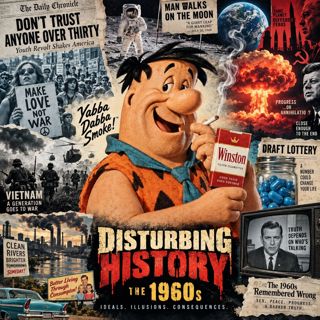
The 1960's

The 1960's

Everybody knows the line: “Don’t trust anyone over thirty.” It became shorthand for an entire generation, even though the man who said it was a 24-year-old Berkeley graduate student who would turn thi...

13 Sep 1h 2min

Populärt inom Samhälle & Kultur

podme-dokumentar
en-mork-historia
gynning-berg
svenska-fall
p3-dokumentar
aftonbladet-krim
rss-creepypodden
hor-har
flashback-forever
rss-schyffert-sundin-ar-det-har-nat
aftonbladet-daily
rss-hemlispodden
kod-katastrof
killradet
spar
rss-expressen-dok
p1-dokumentar
rss-mer-an-bara-morsa
rss-nemo-moter-en-van
vad-blir-det-for-mord