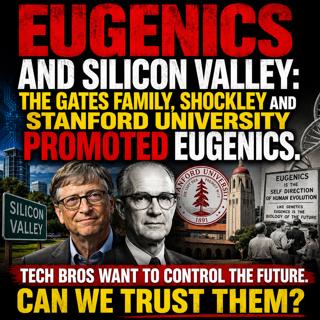
Eugenics and Silicon Valley: The Gates Family, Stanford University and William Shockley, Father of Silicon Valley, PROMOTED Eugenics.

Eugenics and Silicon Valley: The Gates Family, Stanford University and William Shockley, Father of Silicon Valley, PROMOTED Eugenics.

"Before you trust someone with the future, look at what they did with the power they already had." - Dianne Emerson

Eugenics and Silicon Valley: The Gates Family, Stanford University and William Shockley, Father of Silicon Valley, PROMOTED Eugenics.

Silicon Valley wants us to trust its most powerful technology leaders with artificial intelligence, personal data, communications, surveillance, defense, jobs and technologies capable of reshaping human society. But before asking where the Tech Bros want to take humanity, perhaps we should ask a more basic question: Who are these people, how did they acquire so much power, and why should we trust them?

This episode investigates the history behind the Silicon Valley mythology, beginning with Stanford University and its disturbing connections to the American eugenics movement. From Stanford's founding president David Starr Jordan and psychologist Lewis Terman to Frederick Terman and the creation of the Stanford-centered technology ecosystem, the story follows an extraordinary intersection of eugenics, intelligence testing, military research, government funding, universities and private industry.

The semiconductor family tree raises another remarkable connection. Nobel Prize-winning transistor pioneer William Shockley founded Shockley Semiconductor Laboratory and later became one of America's most notorious public advocates of eugenics. Eight Shockley employees left to establish Fairchild Semiconductor, and Fairchild's Gordon Moore and Robert Noyce later founded Intel. The history of Silicon Valley is far more interconnected than the familiar stories of independent geniuses starting companies from nothing.

The investigation also follows Bill Gates, Microsoft and the IBM deal; Mary Gates's connection to IBM chairman John Opel; Bill Gates Sr.'s involvement with Planned Parenthood; Microsoft's landmark antitrust case; government support behind Elon Musk's Tesla and SpaceX; taxpayer-funded research that became the foundation for enormous private fortunes; and the continuing influence of Stanford, SRI, Fairchild, Intel and other institutions on the technologies that now dominate our lives.

Google, Palantir, Tesla, SpaceX, Theranos, WeWork, Uber, Airbnb and other celebrated technology companies raise the same fundamental question: How much of the Silicon Valley success story actually belongs to the billionaire standing onstage, and how much was created behind the curtain by taxpayers, government agencies, military programs, universities, scientists and engineers whose names most people will never know?

Drawing on my own experience working at Intel and later suing the company after years spent developing a project involving Intel technology, I also return to the 1994 Pentium processor crisis and something I witnessed firsthand: a technology problem becomes something much larger when the public stops trusting the people responsible for the technology.

Today the stakes are vastly greater than a defective computer chip. Elon Musk, Peter Thiel, Alex Karp, Sam Altman, Mark Zuckerberg, Bill Gates and other technology billionaires and executives increasingly operate at the intersection of artificial intelligence, defense, surveillance, biotechnology, global health, communications, information and political power.

Everybody publishes lists of the richest people in technology.

Maybe we have been keeping the wrong list.

This is a story about Silicon Valley, Stanford University, eugenics, Bill Gates, Microsoft, Elon Musk, Peter Thiel, Palantir, artificial intelligence, Intel, Fairchild Semiconductor, William Shockley, government funding, military research, monopoly, Big Tech, surveillance, population policy, billionaire power and trust.

Who actually built the technological world we live in? Who paid for it? Who controls it now?

And if a remarkably small group of extraordinarily wealthy and powerful people intends to influence humanity's future, perhaps the most important question is also the simplest: Tech Bros Want to Control the Future. Can We Trust them?

Clip: Peter Thiel Doesn't Want You to See This Clip

Music: The Lovin' Spoonful - Do You Believe in Magic (Official Audio)

Bill Gates' Father Ran Planned Parenthood, His Mother Created Microsoft, Together They Trained Their Son To Spread The Gospel Of Eugenics • Now The End Begins

Bill Gates, His Father and Eugenics :: By Geri Ungurean - Rapture Ready

Birth control leader Margaret Sanger: Darwinist, racist and eugenicist · Creation.com

Eugenics in America: The Legacy of Sanger and Gates – Catholic Stand

Bill Gates, Eugenics, Vaccines, and Planned Parenthood — Dean W. Arnold

Bill-Gates-Philanthropist-Eugenicist.pdf

William Shockley - Wikipedia

William Shockley

William Shockley: The Flawed Visionary Behind Silicon Valley - News

'BlacKkKlansman' and William Shockley's Eugenic Agenda - AAIHS

Stanford Eugenics History Project

How hormones work to flip sexes: Hormones

Do you have a psychopath in your life? The best way to find out is read my book. BOOK *FREE* Download – Psychopath In Your Life4

Support is Appreciated: Support the Show – Psychopath In Your Life

Download Pods here: TOP PODS – Psychopath In Your Life

My old discussion forum with last 10 years of victim stories, is back online. Psychopath Victim Support Community | Forums powered by UBB.threads™

Google Maps My HOME Address: 309 E. Klug Avenue, Norfolk, NE 68701 SMART Meters & Timelines – Psychopath In Your Life

Reasons You Might Not Want to Trust the Tech Bros

Everybody publishes lists of the ten richest people in tech.

Maybe we have been keeping the wrong list.

Microsoft, Bill Gates and the IBM Deal
Microsoft's breakthrough deal with IBM helped turn the company into a technology powerhouse. But the familiar garage-genius story leaves out an interesting connection: Bill Gates's mother, Mary Gates, served on the national United Way board alongside IBM chairman John Opel. The relationship doesn't prove she arranged Microsoft's deal, but it is a part of the story worth knowing.

Taxpayer-Funded Research, Privately Owned Fortunes
Many technologies underlying today's enormous private fortunes grew out of decades of government-funded research, military programs and university laboratories. The public often financed the early risk; private companies eventually captured enormous commercial rewards.

Stanford, Frederick Terman and the Birth of Silicon Valley
Silicon Valley didn't simply spring from a collection of brilliant kids working in garages. Stanford's Frederick Terman deliberately cultivated relationships among the university, military research, government funding and private technology companies—helping create the ecosystem that became Silicon Valley.

  • David Starr JordanStanford University's founding president, serving from 1891 to 1913, and then chancellor until 1916. Jordan was one of the prominent American advocates of eugenics in the early 20th century. He served on the Eugenics Committee of the American Breeders Association, an important early organization in the American eugenics movement, and became associated with the Human Betterment Foundation, the California organization that promoted compulsory sterilization. Jordan wrote and lectured extensively about heredity, human breeding, race, and what he considered the deterioration of the population. His eugenic interests therefore weren't peripheral to Stanford's early history: the university's founding president was himself an active participant in the American eugenics movement.
  • Lewis Terman — probably the most important after Jordan. Stanford psychologist, Stanford-Binet IQ test, advocate of hereditarian ideas and eugenics, and member of the Human Betterment Foundation. He later became head of Stanford's psychology department.
  • Ellwood P. CubberleyJordan personally recruited him to Stanford in 1898. He became professor of education and ultimately the first dean of Stanford's School of Education. Cubberley then hired Lewis Terman in 1910, giving you a direct personnel connection between these figures.
  • Leonas Lancelot Burlingame — joined Stanford biology in 1909 and actually taught a course dealing with heredity, social welfare and eugenics for years. A 1922 biology textbook he coauthored explicitly promoted eugenic ideas, including sterilization. He later published Heredity and Social Problems in 1940. Stanford archival research also connects him with the Human Betterment Foundation, from which he obtained pro-sterilization material for his Stanford course.

William Shockley: Semiconductors and Eugenics
Nobel Prize-winning physicist William Shockley was one of the central figures in the development of the transistor and founded Shockley Semiconductor Laboratory—the company from which the famous "traitorous eight" departed to create Fairchild Semiconductor. Shockley later became one of America's most notorious public advocates of eugenic ideas, including proposals involving voluntary sterilization and IQ.

Shockley → Fairchild → Intel: The Silicon Valley Family Tree
The semiconductor industry wasn't created by hundreds of unrelated entrepreneurs appearing independently. Shockley Semiconductor produced the group that founded Fairchild. Fairchild produced Gordon Moore and Robert Noyce, who founded Intel. Follow the family tree and Silicon Valley suddenly becomes much smaller.

Bill Gates Sr., Planned Parenthood and Population Control
Bill Gates Sr. served on the board of Planned Parenthood in Seattle. His son later became one of the world's most influential private actors in global health, vaccination and family planning. Gates Sr. himself said population issues had interested Bill since childhood. That doesn't establish a secret eugenics program—but the family history belongs in any serious examination of Gates's later population and health work.

Microsoft and the Antitrust Case
Distrust of Microsoft wasn't simply conspiracy theory or resentment of a successful businessman. The United States government brought a landmark antitrust case against Microsoft, and a federal judge found that Microsoft possessed monopoly power and engaged in anticompetitive conduct. The litigation ultimately ended in a settlement after the breakup order was overturned on appeal.

Elon Musk and the Government Money Behind the Empire
The mythology presents the tech billionaire as the ultimate private entrepreneur. The reality is more complicated. Tesla, SpaceX and other Musk ventures have benefited from government contracts, loans, tax incentives, subsidies and other public support. The question isn't whether the companies accomplished extraordinary things. It is why taxpayers so often disappear from the origin story.

The Strange Deaths and Power Struggles Around Technology Fortunes
Technology history also contains deaths, lawsuits, corporate battles and succession fights that deserve careful examination. These cases need to be separated into what is documented, what remains disputed and what is merely speculation—but they shouldn't automatically be ignored simply because enormous fortunes and powerful people are involved.

The Next Generation: Phoebe Gates and Phia
The story doesn't necessarily end with the founders. Phoebe Gates, Bill Gates's daughter, co-founded shopping startup Phia. In 2026 the company faced controversy over affiliate attribution practices, including allegations of "cookie stuffing." Phia disputed aspects of the accusations, removed the features at issue and said it was working to reverse improperly attributed transactions and strengthen compliance.

Eugenics on the Farm David Starr Jordan, a notable eugenicist, was the first president of Stanford University. (Wikimedia Commons)

David Starr Jordan, the first president of Stanford University, was one of the most prominent eugenicists of the early 20th century. In the name of eugenic progress, Jordan promoted the sterilization of unwanted populations, led and founded eugenic advocacy groups, and fought against the immigration of "inferior" populations to the United States. With his popular influence and widespread networks, Jordan was a kingpin of the American eugenics movement, bringing eugenicists together and securing funding for their research. It is therefore no coincidence that Stanford has an extensive history entangled with eugenics and race science.

Since its foundation, Stanford has been home to many key eugenic researchers, including David Starr Jordan, Lewis Terman, Ellwood Cubberley and many others. Even as recently as the 1970s, eugenicists have taught at Stanford — for example, William Shockley, notable physicist and professor, obsessively attempted to prove the intellectual superiority of the white race. Many of our campus buildings still bear the name of notable eugenicists. Over the course of this year, I will use this column to explore this history, examining the ways eugenic and scientifically racist thought manifested themselves at Stanford, the myriad of Stanford affiliates who have endorsed this line of thought, and the painful legacies of eugenics in the United States and abroad.

As students at an elite university, the history of eugenics is deeply relevant to us. Stanford and the Graduate School of Education (notably named after Cubberley, a eugenicist) played a fundamental role in the application of eugenic theory to the university, affecting many aspects of how we understand higher education — who is gifted, who deserves access to the university and who is excluded through systems of educational standardization. Even today, the National Association for Gifted Children uncritically cites Lewis Terman and Francis Galton ("the father of eugenics") as key figures of their movement. If we want to end the structural inequality of education, exploring this genealogy is the first step.

Before getting into Stanford's history, let's first cover what eugenics is. Eugenics is the science of improving the human race through selective breeding, often seeking to control who can and who cannot reproduce. After the term was coined in 1883 by English scientist Francis Galton, eugenics quickly gained traction in the United States. Proponents of eugenics sought to a) promote the "fit" members of society (white able-bodied people) to reproduce at higher rates, and b) discourage or forcibly limit the reproduction of "unfit" members of society (people of color and disabled people). These approaches are known as positive eugenics and negative eugenics, respectively.

The history of eugenics in the United States is one of harm and oppression, of state-endorsed violence against the most vulnerable members of society. Between 1907 and 1937, 32 U.S. states passed sterilization laws in the name of eugenic progress. These laws forcibly sterilized unwanted populations: prisoners, disabled people, "feeble-minded" people, and other eugenically unfit populations, with people of color being disproportionately impacted. State governments performed upwards of 60,000 eugenic sterilization procedures on their unwanted populations between 1907 and 1963.

The State of California alone performed 20,000 (one-third) of those procedures. Into the 1970s, public clinics and hospitals targeted poor Black, Latinx and Indigenous women for coercive sterilization, often threatening to revoke their welfare benefits if they did not comply. By the 1970s, The Indian Health Service had sterilized at least 25% of all Indigenous women in the United States. Even as recently as between 2006 and 2010, the State of California performed almost 150 sterilization procedures on imprisoned women without informed consent.

The eugenics movement also had a transnational impact — eugenicists from across the globe exchanged ideas with each other in their mission to perfect the human race. Many countries, such as Canada and Sweden, had their own eugenic laws, limiting the reproduction of unwanted groups. Inspired in no small part by American eugenic research and sterilization laws, Nazi Germany sought to eliminate its unwanted populations, leading to the genocide of 11 million Jewish people, Slavic people, disabled people, queer people and other groups during the Holocaust. It is impossible to know how many human lives were harmed by eugenic logic and a belief in racial progress.

This column will examine in detail the role Stanford played in the history of eugenics. Each article in this year-long series will explore one prominent eugenicist or eugenic theme at Stanford and discuss their larger influence. To do so, I will be drawing from many excellent historians of eugenics — Alexandra Stern, Daniel Kevles, Nathaniel Comfort, Paul A. Lombardo, Wendy Kline, Stefan Kühl, among others — as well as my own research into the histories of eugenics and of Stanford University.

I will intentionally be referring to eugenics as a science, as opposed to a pseudoscience. This is not to imply that any of the axioms or theories of eugenics are factually accurate. Rather, it is to anchor eugenic thought historically in the sciences, to show its connection with claims of objectivity and rationality. Eugenics, for all practical purposes, was a science: scientists studied eugenics, scientific journals published eugenics, and students of science learned eugenics. Given the context of Stanford University, and given the context of Silicon Valley, it remains especially vital to remember the violence enacted in the name of science and narratives of progress.

I do not recount this history to assign guilt. Though Stanford today is the same institution as Stanford 100 years ago, the people I will be discussing have been dead for decades, along with the administrators who empowered them. Nevertheless, their ideas have outlived them. This legacy runs deeper than the names of eugenicists that appear on buildings: it is structural, shaping and constraining how we understand ability and education. That is the legacy I aim to uncover.

Stanford may not be unique in this matter (many other universities are currently grappling with their own histories with eugenics). However, Stanford students can gain much from understanding the role their university, their home, played in one of the most harmful ideologies in human history. To end, I'll quote a few words from Leilani Muir, a survivor of eugenic sterilization by the Canadian government in the 1950s, on the importance of remembering the legacies of eugenics:

"I think it is great that this story is being kept alive, through other people, through young people. Because they can stop this from happening again if they stay involved." Source: Eugenics on the Farm

Science's Distortion of William Shockley

In the Science editorial, Thorp attempted to picture Shockley as a loner, not mainstream, even claiming that he, "carried out his non-physics work through op-eds and conservative think tanks, not through the accepted mechanism of peer review that he used in doing physics."[8] But, in fact, Shockley published in leading mainline peer-reviewed literature, openly pushing what we now regard as his racist ideas. Some of the many examples include:

  1. Shockley. 1965. "Is Quality of U.S. Population Declining." U.S. News & World Report, November 22, pp. 68–71.
  2. Shockley. 1966. "Population Control or Eugenics." In J.D. Roslansky (ed.), Genetics and the Future of Man (New York, NY: Appleton-Century-Crofts).
  3. Shockley. 1968. "Proposed Research to Reduce Racial Aspects of the Environment-Heredity Uncertainty". Proposal read by Shockley before the National Academy of Sciences (NAS) on April 24, 1968.
  4. Shockley. 1968. "Ten Point Position Statement on Human Quality Problems", revised by Shockley from a talk which he presented on "Human Quality Problems and Research Taboos."
  5. Shockley. 1969. "An Analysis Leading to a Recommendation Concerning Inquiry into Eugenic Legislation". Press release by Shockley, at Stanford University, on April 28, 1969.
  6. Shockley. 1970. "A 'Try Simplest Cases' Approach to the Heredity-Poverty-Crime Problem." In V.L. Allen (ed.), Psychological Factors in Poverty (Stamford, CT.: Markham Publishing).
  7. Shockley. 1970, "New Methodology to Reduce the Environment-Heredity Uncertainty About Dysgenics." National Academy of Sciences Autumn Meeting (Houston, TX), October 19-21.
  8. Shockley. 1970. "Proposed NAS Resolution, drafted October 17, 1970." Proposed by Shockley before the National Academy of Sciences.
  9. Shockley. 1971. "Hardy-Weinberg Law Generalized to Estimate Hybrid Variance for Negro Populations and Reduce Racial Aspects of the Environment-Heredity Uncertainty." Annual Meeting NAS, Washington, D.C., May 13.
  10. Shockley. 1971. "Negro IQ Deficit: Failure of a 'Malicious Coincidence' Model Warrants New Research Proposals." Review of Educational Research 41(3):227-248, June.
  11. Shockley. 1971a. "Dysgenics – A Social Problem Evaded by the Illusion of Infinite Plasticity of Human Intelligence?" Manuscript for reading at the American Psychological Association Symposium titled: "Social Problems: Illusion, Delusion or Reality."
  12. Shockley. 1971b. "Models, Mathematics, and the Moral Obligation to Diagnose the Origin of Negro IQ Deficits." Review of Educational Research 41(4):397-377, October.
  13. Shockley. 1972a. "Dysgenics, Geneticity, Raceology: A Challenge to the Intellectual Responsibility of Educators." Phi Delta Kappan 53(5):297-307, January.
  14. Shockley. 1972b. "A Debate Challenge: Geneticity Is 80% for White Identical Twins' I.Q.'s." Phi Delta Kappan 53(7):415-419, March.
  15. Shockley. 1972. "Proposed Resolution Regarding the 80% Geneticity Estimate for Caucasian IQ." Paper presented by Shockley at the Genetics Conference.
  16. Shockley. 1973. "Deviations from Hardy-Weinberg Frequencies Caused by Assortative Mating in Hybrid Populations." Proceedings of the National Academy of Sciences 70(3):732-736, March.
  17. Shockley. 1974. "Eugenic, or Anti-Dysgenic, Thinking Exercises." Published as a press release dated May 3, 1974.
  18. Shockley. 1974. "Society Has a Moral Obligation to Diagnose Tragic Racial IQ Deficits." In Pearson, R. (editor) Shockley on Eugenics and Race: The Application of Science to the Solution of Human Problems. Scott-Townsend, Washington, D.C., January 1. Prepared statement by Shockley to be read during his February debate with Roy Innis.
  19. Shockley. 1978. "Has Intellectual Humanitarianism Gone Berserk?" Introductory statement read by Shockley prior to a lecture given by him at UT Dallas.
  20. Shockley. 1980. "Sperm Banks and Dark-Ages Dogmatism." Position paper presented by Shockley in a lecture to the Rotary Club of Chico, California, on April 16, 1980.
  21. Shockley. 1981. "Intelligence in Trouble." Article by Shockley published in Leaders Magazine, dated June 15, 1981.
  22. Shockley, William, and Roger Pearson (editor). 1992. Shockley on Eugenics and Race: The Application of Science to the Solution of Human Problems. Scott-Townsend, Washington, D.C., January 1.

Darwin's connection to eugenics documented.

This sample list shows that Dr Shockley, a professor at Stanford University when most of this work appeared, was publishing widely in leading academic peer-reviewed journals and books. To picture him as a loner and radical racist is worse than inaccurate. The fact is that, "science" in general was supportive of racism and eugenics for much of the last part of the 19th and most of the 20th century. The Civil Rights Movement changed all of this. Thorp admits:

The failure of Science to condemn Shockley began in 1968, [this is when eugenics was only beginning to be opposed] when it published a letter lamenting the fact that he was prohibited from speaking at the Polytechnic Institute of Brooklyn [one of the few places that would not allow him to speak]. The letter repeated the familiar trope that Shockley was simply asking questions about the role of race in intelligence. But Shockley had no scientific basis for doing so, he was not submitting peer-reviewed papers on the topic, [clearly not true as documented in the list above of some of his publications], and most importantly, he was using his ideas as the basis for promoting eugenics.[9]

William Shockley, Stanford professor and winner of the 1956 Nobel Prize in physics for his co-invention of the transistor, was arguably the single person most responsible for ushering in the computer age. He was also an ardent eugenicist whose theories of black racial inferiority eventually made him an academic pariah.

Despite having no training whatsoever in genetics, biology or psychology, Shockley devoted the last decades of his life to a quixotic struggle to prove that black Americans were suffering from "dysgenesis," or "retrogressive evolution," and advocated replacing the welfare system with a "Voluntary Sterilization Bonus Plan," which, as its name suggests, would pay low-IQ women to undergo sterilization. Although his theories were universally condemned by biologists as racist pseudoscience, Shockley partly succeeded in rehabilitating eugenics as an ideology by providing the foundations for a new, more politically savvy generation of academic racists, including Arthur Jensen, Richard Lynn and Charles Murray.

In his own words

"Babies too often get an unfair shake from a badly-loaded parental genetic dice cup. At the acme of unfairness are features of racial differences that my own research inescapably leads me to conclude exist: Nature has color-coded groups of individuals so that statistically reliable predictions of their adaptability to intellectually rewarding and effective lives can easily be made and profitably be used by the pragmatic man-in-the-street." — "Models, Mathematics, and the Moral Obligation to Diagnose the Origin of Negro IQ Deficits," Review of Educational Research, 1971.

"Preliminary research suggested that an increase of 1% in Caucasian ancestry raises Negro IQ an average of one point for low IQ populations. It should be kept in mind, however, that no conclusive evidence has been presented. In responding to a recent questionnaire, the majority of 23 presidents of predominantly Negro colleges indicated that black students at their schools are academically advantaged by attitudes towards racial differences; consequently, comparing racial mix differences with achievement differences might refine or reject the preliminary estimate that a one point increase in average "genetic" IQ occurs for each 1% of Caucasian ancestry, with diminishing returns approaching 100 IQ. To fail to use this method of diagnosis for fear of being called a racist is irresponsible. It may also be a great injustice to black Americans. If those Negroes with the fewest Caucasian genes are in fact the most prolific and also the least intelligent, then genetic enslavement will be the destiny of their next generation. The consequences may be extremes of racism and agony for both blacks and whites. … If what I fear is true, our society is being profoundly irresponsible. Our nobly intended welfare programs may be encouraging dysgenics—retrogressive evolution through disproportionate reproduction of the genetically disadvantaged." — "Negro IQ Deficit: Failure of a 'Malicious Coincidence' Model Warrants New Research Proposals," Review of Educational Research, 1971

"The view that the US negro is inherently less intelligent than the US white came from my concern for the welfare of humanity. My initial concern was not with the racial aspects, as these dysgenic effects occur for whites as well as blacks. If this is going on, it will harm both. I would like to stress that the failure of the intellectual community to deal with these matters is one of the cruelest irresponsibilities to a minority group that has ever occurred. If, in the US, our nobly-intended welfare programs are indeed encouraging the least effective elements of the blacks to have the most children, then a destiny of genetic enslavement for the next generation of blacks may well ensue. It is my considered opinion and evaluation that, at the present time, I am less likely to do damage by exacerbating a situation, and am currently the intellectual in America most likely to reduce Negro agony in the next generation." — Interview with New Scientist, 1973

"Prejudice that is not supported by strong facts is both illogical and not in accordance with truth. The general principle that truth is a good thing applies here. Some things that are called prejudice, which are based on sound statistics, really shouldn't be called prejudice. … It might be easier to think in terms of breeds of dogs. There are some breeds that are temperamental, unreliable, and so on. One might then regard such a breed in a somewhat less favorable light than other dogs. Now some of the business prejudices against blacks, the pragmatic man-in-the-street prejudices, are not incorrect. The man in the street has had experience and knows what to expect from blacks in business. If one were to randomly pick ten blacks and ten whites and try to employ them in the same kinds of things, the whites would consistently perform better than the blacks." — Interview with Playboy, 1980

Background

William Shockley's importance in the development of modern electronics cannot be overstated. While working at Bell Labs during the 1940s and 50s, Shockley led the team that invented the transistor, for which he and his collaborators won numerous prizes and awards. In 1965, however, Shockley's career took an abrupt turn from internationally famous physicist to racist crank when he gave an address at a Nobel conference on "Genetics and the Future of Man." In his lecture, Shockley warned of the threat of "genetic deterioration" and "evolution in reverse," problems exacerbated, he claimed, by the Great Society welfare programs that allowed the less genetically fit to reproduce at will, free from the constraints of natural selection.

By his own account, his obsession with the genetic inferiority of the black population was sparked by an article published two years previously in the Los Angeles Times detailing an acid attack on a delicatessen owner by a black teenager with a reported IQ of 65. According to the Times article, the attacker was the son of a woman with an IQ of 55 who had 17 children, only nine of whose names she could remember. In response to this story, Shockley said: "I asked myself what people I knew who had families that large. I could think of none. Apparently, these large families were those of people who were not making it in our society, so that those with the least intelligence were having the most children. The more I talked to people about this, the more alarmed I became. No one was willing to look at this subject objectively, dispassionately. This is what drew me into the whole question of dysgenics, or retrogressive evolution."

For Shockley, this anecdote about a black, low-IQ acid-thrower and his dysfunctional family provided proof that "the major cause of the US negro's intellectual and social deficits are hereditary and racially genetic in origin and thus not remediable to a major degree by any practical improvements in environment." Inspired by this revelation, he began a tireless campaign to raise awareness of the dysgenic threat. His efforts brought him to the attention of Harry Weyher, then president of the notorious Pioneer Fund. Between 1969 and 1976, the Pioneer Fund provided Shockley with almost $1.5 million (in inflation-adjusted 2002 dollars), both through grants to Stanford University to fund "research into the factors which affect genetic potential" and directly to Shockley's nonprofit Foundation for Research and Education on Eugenics and Dysgenics (FREED).

In addition to providing Shockley with funds, Weyher put him in contact with a cadre of white supremacist and segregationist scientists and public intellectuals. This group, which included psychologists Henry Garrett and Travis Osborne, biologist Robert E. Kuttner, and businessman Carleton Putnam, welcomed Shockley—and the legitimacy and prestige that came with the Nobel Prize winner—into their ranks. Putnam in particular embraced Shockley as an ally although his segregationist rhetoric was so extreme—in his book Race and Reality, he referred to integration as a Jewish "equalitarian conspiracy" and said of universal suffrage that "to apply it to states or communities with high percentages of a retarded race is suicidal"—that other segregationists, including Kuttner, who was himself a neo-Nazi, warned Shockley against associating with Putnam too publicly for fear of harming his reputation.

Despite these warnings, Shockley became a vocal supporter of Putnam, even providing an endorsement of Race and Reality, a jacket blurb stating that "Putnam penetratingly analyzes how liberal dogmatism has paralyzed the ability to doubt popular views even in academic cloisters with resultant prevention of publication of research on racial questions. My personal investigations verify some specifics and the general tenor of Putnam's extensive reporting of such effective suppression. … I urge thoughtful citizens to read Putnam's analyses and, in keeping with constitutional principles of freedom of speech and press, to provoke public debate between the unpopular ideas he presents and those currently popular. I urge this action in the interest of replacing prejudice, prejudgment and bias with scientific method and objectivity even though I by no means accept all of his conclusions. I have also learned by both spoken and written communication that several members of the National Academy of Sciences share Putnam's conclusion that there do exist significant genetic differences in distribution of potential intelligence between races."

This comment exposed the other half of Shockley's obsession with race and genetics: a supposed conspiracy of "liberal dogmatism" standing in the way of research on "racial questions." Despite Shockley's total lack of training or expertise in biology, or his resounding condemnation by biologists nationwide, he was convinced that he was being persecuted because "the mere fact that I had mentioned both Negroes and I.Q. in one and the same paragraph led my critics to label me a racist." When he first aired his concerns about race an IQ in 1965, his Stanford colleagues in the genetics department condemned him in a letter to the editor. Shockley took great delight in mocking that letter to his friends and the media for years after the fact.

In retaliation against his critics' accusations of racism and sympathy for Nazi ideology, Shockley tried to turn the tables, claiming that those opposing his agenda were the real Nazi analogues, and arguing that "eugenics is a shunned word because it was a feature of Hitlerism. But the lesson of Nazi Germany is not that eugenics is intolerable… . The real lesson of Nazi history was anticipated 140 years before Hitler when the Bill of Rights incorporated into our Constitution the First Amendment guaranteeing freedom of speech and the freedom of the press. Only the most anti-Teutonic racist can believe the German people to be such an evil breed that they would have tolerated the concentration camps and gas chambers if a working First Amendment had permitted exposure and discussion of Hitler's final solution… . I suggest that there is a significant parallel between the attitude of German intellectuals in Hitler's day and our intellectuals' unwillingness to face the dysgenic threat."

Not only did Shockley consider his opponents to be modern-day Nazis, he was also adamant that his own work was actually intended to benefit all of humanity, regardless of race. In his now-infamous Playboy interview, Shockley defended his work, claiming, "I would say that the responsibility to [research ideas about black genetic inferiority] rests primarily with those who are most intellectually capable of it. In terms of race, a disproportionate fraction of the white population can do this compared with the black population. So the white population is most responsible… . The smack of racism attributed to 'my rhetoric' lies in the ears of the listeners. It is not present in my written or spoken words. The word racism carries with it a connotation of belief in the superiority of one's own race, plus fear and hatred of other races, and lacks any hint of humanitarianism. What I am intending to do is to promote raceology, the study of racial problems and trends from a scientific point of view, and this approach is quite different from racism."

Despite Shockley's claims of suppression and persecution, he made very little in the way of actual efforts to prove his theories scientifically. As psychologist and historian William Tucker has pointed out, Shockley "conducted little to no research" with the money he obtained from the Pioneer Fund; rather, he used the funds to make FREED into "a publicist for Shockley, producing a newsletter with descriptions of his public appearances, his press releases, and copies of articles written by and about him."

Tucker has documented that Shockley did offer some suggestions for potential research projects, which included "hiring Pinkerton agents to carry out surreptitious investigations of the backgrounds of both randomly selected students and students who had been active in campus demonstrations to learn whether any had been adopted," blood testing on "prominent black intellectuals to investigate whether the most capable 'Negroes obtain their intelligence from white ancestors,'" blood testing on "teenage negro mothers, whose children are illegitimate and who are on welfare" to determine if they had any Caucasian ancestry, and "research on the intelligence of black children adopted into white families, and the use of physiological measures to assess reasoning ability." However, none of these studies were actually performed.

Although Shockley failed to provide any evidence for his theories, and despite near-universal acknowledgement that his work was that of a racist crank, he successfully used his high profile and love of controversy to resurrect eugenics as a topic of discussion, and paved the way for subsequent eugenicists, segregationists, and scientific racists to move their agendas forward. Through FREED, Shockley popularized his idea for a "Voluntary Sterilization Bonus Plan" which would pay poor women to undergo sterilization, a idea that has subsequently been taken up in various forms by Garrett Hardin, Richard Lynn and Charles Murray, among others. He also succeeded in popularizing the work of racist educational psychologist Arthur Jensen who, until his death in 2012, was the leading opponent of educational interventions to help underachieving black students because of their supposedly genetic limitations.

Shockley's successes in this vein have led to his being revered within the white nationalist community. A search for his name at white supremacist websites will turn up articles like The Occidental Quarterly's "Shockley Vindicated," numerous stories at VDARE.com, and authors and commenters at Stormfront.org, a white nationalist Web forum run by a former Alabama Klan leader, referring to Shockley as "one of the smartest men who ever lived" and calling for a "William Shockley Day" to coincide with Martin Luther King Jr. Day. Source: William Shockley

Silicon Valley investors, including Peter Thiel's Founders Fund, helped accelerate the run on Silicon Valley Bank. Founders Fund was among the venture-capital firms that reportedly advised its portfolio companies to withdraw their money from SVB as concerns about the bank spread.

The withdrawals quickly became a stampede. Customers attempted to pull about $42 billion in a single day, and regulators closed Silicon Valley Bank on March 10, 2023.

Then came the extraordinary part.

Ordinary FDIC insurance protected deposits only up to $250,000 per depositor, per insured bank, per ownership category. Many SVB customers were companies and investors holding millions of dollars—sometimes vastly more—above that insured limit.

After the bank collapsed, the federal government invoked a systemic-risk exception and guaranteed all SVB deposits, including the uninsured deposits above the normal FDIC limit.

Silicon Valley investors helped accelerate the run on Silicon Valley Bank.

The bank collapsed. Then the government stepped in and protected the remaining Silicon Valley depositors from losses on money that ordinary FDIC insurance had never guaranteed.

Silicon Valley Bank when it collapsed in March 2023 included:

  • Circle Internet Financial — about $3.3 billion
  • Sequoia Capital — about $1 billion
  • Kanzhun Ltd. — about $903 million
  • BILL (Bill.com) — about $670 million disclosed initially; FDIC records later listed about $761 million, including customer funds
  • Altos Labs — about $680 million
  • Roku — $487 million disclosed by Roku; an FDIC depositor document reportedly listed about $420 million
  • BlockFi — $227 million
  • Roblox — about $150 million
  • Ginkgo Bioworks — about $74 million
  • Sunlight Financial — about $64 million
  • AcuityAds — about $55 million
  • iRhythm Technologies — about $54.5 million
  • Rocket Lab — about $38 million
  • Sangamo Therapeutics — about $34 million
  • LendingClub — about $21 million
  • Payoneer — about $20 million
  • Protagonist Therapeutics — about $13 million
  • Cohu — about $12.3 million
  • Oncorus — about $10 million
  • Eiger BioPharmaceuticals — about $8.3 million

The amounts come from a combination of company disclosures and subsequently reported FDIC depositor records, so some figures differ depending on the reporting date and whether customer funds were included.

The names at the very top make the scale especially striking: Circle had roughly $3.3 billion sitting at SVB and Sequoia Capital roughly $1 billion, despite the ordinary FDIC insurance limit being $250,000 per depositor, per insured bank, per ownership category.

VENTURE CAPITAL

Sequoia Capital — approximately $1 billion

TECH/CRYPTO/BIOTECH AND OTHER COMPANIES

Circle — approximately $3.3 billion

Kanzhun — approximately $903 million

BILL — approximately $761 million

Altos Labs — approximately $680 million

Roku — approximately $420–487 million

BlockFi — approximately $227 million

Roblox — approximately $150 million

Silicon Valley's venture-capital establishment built its reputation on being exceptionally sophisticated about money and risk. Yet billions of dollars were sitting uninsured at SVB. When the bank failed, the federal government ultimately protected those uninsured deposits anyway.

And Sand Hill Road adds something numbers alone don't convey: these were among the people Silicon Valley itself regarded as the experts at deciding who deserved capital and which risks were worth taking.

1884 — Leland Stanford Jr. dies

Leland and Jane Stanford's only child, Leland Stanford Jr., dies of typhoid fever at age 15. His parents decide to establish a university in his memory.

1885 — Stanford University is founded

Leland and Jane Stanford establish Leland Stanford Junior University, using their fortune and their Palo Alto stock farm. The university is intended to combine liberal arts with science and engineering.

1891 — Stanford opens; David Starr Jordan becomes the first president

The university opens on October 1, 1891. Leland and Jane Stanford personally select David Starr Jordan as Stanford's first president. Jordan begins recruiting the faculty and building the academic structure of the new university.

1893 — Leland Stanford dies

Leland Stanford dies only two years after the university opens. His death creates a serious financial crisis for the young university. Jane Stanford keeps it operating while Jordan continues running its academic affairs.

1891–1913 — David Starr Jordan presidency

Jordan remains Stanford's president for 22 years, giving him enormous influence over the university's formative period.

Eugenics becomes an important part of Jordan's activities. While Stanford president, he becomes the inaugural chairman of the Eugenics Committee of the American Breeders Association, often identified as the first American eugenics organization. Stanford now says Jordan used his position as president to advance eugenics through his teaching and advocacy.

Jordan later becomes a trustee of the Human Betterment Foundation, which promoted compulsory sterilization.

Stanford itself now describes its early Sociology Department as having "eugenicist origins."

1913–1915 — John Casper Branner

Geologist John Casper Branner succeeds Jordan. He serves only about two years. I would not characterize Branner himself as an important eugenics advocate without stronger evidence.

Importantly, Jordan doesn't disappear. After leaving the presidency, he remains at Stanford as chancellor and later chancellor emeritus until his death in 1931.

1916–1943 — Ray Lyman Wilbur

Ray Lyman Wilbur, a physician and former dean of Stanford Medical School, becomes Stanford's third president.

During this period, eugenics remains part of Stanford's intellectual environment. One of the most important figures is psychologist Lewis Terman, who takes over Stanford's Psychology Department in 1922. Terman is famous for the Stanford-Binet intelligence test and is also one of the major Stanford figures associated with American eugenics.

There is an important connection to what comes later: Lewis Terman's son is Frederick Terman, who will become one of the central architects of Stanford's relationship with government-funded engineering and Silicon Valley.

1943–1948 — Donald Tresidder

Donald B. Tresidder becomes Stanford's fourth president. His presidency overlaps with World War II and the enormous expansion of government-supported science and technology.

During this period Frederick Terman becomes increasingly important. During World War II, Terman had headed Harvard's top-secret Radio Research Laboratory, which worked on electronic warfare and radar countermeasures.

After returning to Stanford, Terman aggressively pursues government-sponsored research. By 1946 he was reporting Stanford projects supported by the Navy, Army Air Forces, Signal Corps and other federal agencies.

Tresidder dies unexpectedly in 1948.

1949–1968 — J. E. Wallace Sterling

J. E. Wallace Sterling becomes Stanford's fifth president.

By the time Sterling takes over in 1949, classical American eugenics has been badly discredited, particularly following Nazi Germany and World War II. The word itself becomes so closely associated with Nazi racial policies that eugenics organizations begin changing their names and repositioning themselves.

Stanford's emphasis is also shifting dramatically.

Under Sterling, working closely with Frederick Terman, Stanford expands engineering and scientific research, aggressively recruits leading researchers, builds major research facilities and capitalizes on the enormous postwar expansion of federal funding for university research.

Sterling makes Terman Stanford's provost in 1955.

Together they undertake an aggressive faculty recruitment program sometimes called "The Big Raid." Stanford expands its research facilities, establishes its industrial research park and secures the federally funded Stanford Linear Accelerator Center.

Stanford's own historical account describes the postwar Sterling-Terman period as one in which they recognized the new opportunities for university research and helped push Stanford to a new level while contributing substantially to the growth of Silicon Valley.

1885 — Leland and Jane Stanford create the university.

1891 — David Starr Jordan is placed in charge.

1893 — Leland Stanford dies.

1891–1930s — Jordan, Lewis Terman and others make Stanford an important center of American eugenic thinking.

1940s — World War II dramatically expands the relationship between universities, science and the federal government.

1949 onward — Sterling and Frederick Terman build Stanford into a major federally supported scientific and engineering research institution.

1950s–1960sThat university-government-industry relationship becomes one of the foundations of Silicon Valley.

The especially interesting historical connection is Lewis Terman → Frederick Terman.

The father, Lewis Terman, was the Stanford psychologist associated with intelligence testing and eugenics.

The son, Frederick Terman, became Stanford's engineering dean and then provost and is frequently called one of the "fathers of Silicon Valley."

Those are two different fields and two different historical periods, so they shouldn't be presented as though Silicon Valley was simply an extension of eugenics. But the father-son succession provides a very concrete link between Stanford's early-20th-century intellectual history and the institution that became central to the postwar technology industry.

Steve Jobs and Bill Gates were arguably the two technology figures the general public knew best before the current generation of Musk, Zuckerberg, etc. They weren't merely CEOs. They became media personalities and symbols of the computer revolution.

Jobs was repeatedly photographed for major magazines and became inseparable from the Apple brand. His black turtleneck, product launches and "rebel/visionary" image eventually became part of popular culture. Even people who knew very little about technology knew Steve Jobs.

Gates had an interestingly different trajectory. In the 1980s and early 1990s, the press frequently presented him as the young computer genius or "whiz kid" billionaire. But Microsoft's dominance eventually changed that image. The U.S. government's landmark antitrust case against Microsoft began in 1998, and Gates's videotaped deposition became notorious because prosecutors portrayed him as evasive and combative. A federal court ultimately found Microsoft had maintained its operating-system monopoly through anticompetitive means.

So by the late 1990s, Gates wasn't simply the lovable computer whiz anymore. Microsoft had become the giant that people worried was becoming too powerful.

Then comes the fascinating image transition.

The Bill & Melinda Gates Foundation was established in its current form in 2000, and Gates increasingly moved his public identity away from Microsoft and toward global health, vaccines, education, poverty and philanthropy. He stepped away from Microsoft's day-to-day leadership and eventually became known to a younger generation at least as much for philanthropy as for Microsoft.

Specifically to recognizable tech figures/companies and distinguish university/publicly funded origins from later government contracts, loans, credits and subsidies:

  1. Google — Larry Page & Sergey Brin — Stanford research environment plus federal support. Google's precursor, BackRub, grew out of their Stanford work; NSF funding supported the broader Stanford Digital Library project, and Brin held an NSF graduate fellowship. Stanford owned the PageRank patent and licensed it to Google. National Science Foundation — Google's origins
  2. Netscape — Marc Andreessen — Andreessen helped create the Mosaic browser at the National Center for Supercomputing Applications at the University of Illinois, a federally supported supercomputing center. He then joined Jim Clark to create Netscape.
  3. Silicon Graphics — Jim Clark — Clark's graphics work originated at Stanford, where he and students developed the Geometry Engine. He subsequently founded SGI to commercialize the technology.
  4. Sun Microsystems — Stanford — Sun's origins are practically contained in its name: SUN originally stood for Stanford University Network. Andy Bechtolsheim developed the workstation while a Stanford graduate student before cofounding Sun Microsystems.
  5. Tesla — Elon Musk — Different mechanism. Tesla wasn't created inside a university, and Musk wasn't its original founder. But Tesla benefited enormously from government policy, including a $465 million Department of Energy loan, which Tesla repaid early, as well as federal and state EV incentives that helped create demand for electric vehicles. U.S. Department of Energy — Tesla loan repayment
  6. SpaceX — Elon Musk — Again, Musk supplied substantial private startup capital, so it would be inaccurate to portray SpaceX as simply taxpayer-created. But its subsequent growth has been deeply intertwined with NASA and U.S. government contracts worth billions, including NASA's Commercial Orbital Transportation Services and Commercial Crew programs. NASA deliberately used public money to stimulate private commercial space capabilities.
  7. Palantir — Peter Thiel, Alex Karp and others — A particularly interesting one for this argument. Early Palantir received investment from In-Q-Tel, the CIA-linked venture-capital organization, and government/intelligence agencies became important customers. This wasn't simply a company appearing independently and later discovering Washington.
  8. Apple / Steve Jobs — government-created technological foundations — Apple itself was privately founded, so it doesn't belong in precisely the same category as Google. But many technologies underlying the modern smartphone economy—GPS, networking/internet technologies, touchscreen research, semiconductor research and voice-recognition research—have important roots in government-funded R&D. The iPhone brilliantly integrated and commercialized technologies whose underlying research history extends far beyond Apple.
THE INTERNET — U.S. TAXPAYERS.

DARPA funded ARPANET. Government agencies and universities funded crucial networking research. NSFNET expanded academic networking and became a major backbone in the development of the modern Internet before commercial restrictions were removed.

So the point for trust isn't that these entrepreneurs contributed nothing. Obviously they did. Commercialization, manufacturing, scaling and turning laboratory technology into something hundreds of millions of people can use are enormous accomplishments.

It's that the popular story frequently starts too late.

The story begins:

"Two brilliant guys founded a company…"

But the fuller history may begin years or even decades earlier.

It may begin with taxpayer money and government research. That research moves into university laboratories, where scientists and graduate students develop new technologies. Then come the patents and prototypes. Then technology transfer and licensing. Then venture capital. Then the private company.

And finally, the story we all recognize: the billionaire founder.

Musk gives us another version of the same story. In that case, you can begin with the private entrepreneur, followed by government loans, contracts and incentives, and ultimately an enormous private enterprise.

That's directly relevant to the question of trust because the mythology matters.

If someone is asking society to entrust him with transportation, communications, artificial intelligence, space infrastructure or enormous amounts of personal data, partly because he's portrayed as the singular genius who created it all, then it's reasonable to ask:

Who actually built the foundation? Who paid for it? Who took the early risk? And who ultimately got the prize?

  • Elizabeth Holmes / Theranos — Stanford student who dropped out to create Theranos. Holmes developed her early blood-testing ideas while at Stanford. Stanford professor Channing Robertson became closely involved with Theranos, and Stanford/Hoover figure George Shultz became a major supporter and board member. Holmes eventually was convicted of defrauding investors. Stanford connections helped give a very young Holmes credibility.
  • Sam Bankman-Fried / FTX — Both parents, Joseph Bankman and Barbara Fried, were Stanford Law professors. Bankman-Fried grew up in the Stanford environment, and his parents' Stanford property became his residence while he was awaiting trial. He was eventually convicted in the massive FTX fraud.
  • Caroline Ellison / Alameda Research — Stanford graduate who became CEO of Alameda Research, the trading firm at the center of the FTX collapse. She pleaded guilty and testified against Bankman-Fried.
  • Andrew Huberman — Stanford School of Medicine neuroscientist who turned his Stanford credentials into an enormous podcast/wellness platform. Promotes discussions of supplements, hormones, dopamine, cold exposure and biological optimization. Subsequently became the subject of extensive reporting about his conduct toward women and simultaneous romantic relationships.
  • Peter Thiel — Stanford undergraduate and Stanford Law graduate. Founded the Stanford Review. Went on to PayPal and Palantir. His interests include radical longevity, parabiosis/"young blood," seasteading, René Girard's theories, Christianity, apocalypse and lengthy lectures concerning the Antichrist.
  • René Girard — Stanford professor and major intellectual influence on Thiel. Developed theories involving mimetic desire, rivalry, scapegoating, sacrifice, religion, violence and ultimately apocalyptic catastrophe.
  • Alex Karp / Palantir — Stanford Law graduate who met Thiel at Stanford. Palantir subsequently became deeply embedded in government, intelligence, defense, military, immigration and data-analysis systems.
  • Joe Lonsdale / Palantir — Stanford graduate, Stanford Review figure and Palantir cofounder. Went on to become a major Silicon Valley venture capitalist.
  • Stephen Cohen / Palantir — Stanford computer-science graduate, Stanford Review connection and Palantir cofounder.
  • Stanford Review Network — Worth treating as an entity itself. Thiel's student newspaper became an extraordinary networking point connecting numerous people who subsequently entered technology, venture capital, Palantir and politics.
  • David Sacks — Stanford graduate and Stanford Review alumnus. PayPal executive, technology entrepreneur, investor and later political figure.
  • Keith Rabois — Stanford graduate and Stanford Review alumnus. PayPal and subsequently a powerful Silicon Valley venture capitalist.
  • Reid Hoffman — Stanford graduate. PayPal executive, LinkedIn founder, major technology investor and political donor.
  • Sam Altman / OpenAI — Stanford student/dropout. OpenAI/AGI; acknowledged psychedelic experiences; investments involving longevity and nuclear fusion; associated with World/Worldcoin and biometric iris-based proof-of-personhood technology.
  • Larry Page & Sergey Brin / Google — Google emerged directly from their Stanford graduate research. The PageRank technology was Stanford intellectual property, creating a direct university-to-Google commercial relationship.
  • Google / Stanford / Data — What began as university search-engine research became one of history's largest information, advertising and data enterprises. Stanford itself lists PageRank among technologies invented at Stanford.
  • Alphabet / Calico — Google's lineage subsequently extends into biotechnology and radical investigation of aging and longevity. Not originally a Stanford project, but relevant through the Google-Stanford corporate lineage.
  • James Monsees & Adam Bowen / Juul — Met through Stanford's product-design program. Their work on alternatives to cigarettes developed into Juul, which later became the center of an enormous controversy concerning youth vaping and marketing.
  • Marc Tessier-Lavigne — Stanford president and neuroscientist who resigned the presidency in 2023 following an investigation into scientific papers associated with laboratories he led. Importantly, Stanford's investigation did not find that Tessier-Lavigne himself committed research misconduct, but found that in several cases he failed to take sufficient steps to correct the scientific record.
  • Stanley N. Cohen / Biotechnology — Stanford professor and one of the pioneers of recombinant-DNA technology, which helped create the modern biotechnology industry. Later became involved in contentious litigation surrounding biotech company Nuredis.
  • Do Kwon / Terraform Labs — Stanford graduate and founder of Terraform Labs. Terra/Luna collapsed spectacularly, destroying billions in cryptocurrency value and leading to criminal prosecution and conviction.
  • Jerry Yang & David Filo / Yahoo — Stanford graduate students when they created Yahoo. Another direct Stanford-to-Internet-company pipeline.
  • Frederick Terman — One of the most important people on the entire list. Stanford engineering professor, dean and provost who deliberately encouraged Stanford engineers to establish companies and cultivated relationships between Stanford, corporations and government.Stanford calls him the "academic architect" of Silicon Valley.
  • William Hewlett & David Packard / HP — Stanford students encouraged by Terman to commercialize their technology. HP became one of the foundational Silicon Valley corporations.
  • Stanford Research Park — Established in 1951 on Stanford land. Stanford calls it the world's first university research park and an "engine for Silicon Valley." It deliberately put university research next to private technology corporations.
  • Stanford Research Park + Defense Industry — Historical tenants included Varian, Hewlett-Packard, Lockheed's Space and Missile Division and Xerox PARC. This makes the park important not merely to consumer technology but to the Stanford-defense-industry relationship.
  • Varian Brothers / Varian Associates — Russell and Sigurd Varian had deep Stanford connections. Their klystron microwave technology had applications in radar, navigation, communications and particle accelerators.
  • William Shockley / Shockley Semiconductor — Terman encouraged Shockley to establish his semiconductor operation near Stanford. Eight employees famously left Shockley to form Fairchild Semiconductor. Stanford's own history of its research park notes that by 1980 more than 50 Silicon Valley semiconductor companies could be directly linked to Shockley's original company.
  • Fairchild Semiconductor — Emerged from Shockley's operation and became one of the critical ancestors of the semiconductor industry, ultimately producing the networks from which companies including Intel emerged.
  • Cisco Systems — Stanford employees Leonard Bosack and Sandy Lerner founded Cisco in the environment created by Stanford's networking work. The history includes disputes concerning who actually developed important Stanford router technology and ownership/use of Stanford technology. Stanford's own historical account emphasizes that important router work preceded Bosack and Lerner.
  • Sun Microsystems — Closely connected to Stanford computer research. Stanford associate professor Andy Bechtolsheim's workstation work contributed to Sun's creation. Stanford itself identifies Sun among companies arising from work that began at Stanford.
  • Stanford Research Institute / SRI — Created in 1946 in association with Stanford as an applied research organization. It later separated from Stanford. This becomes an important bridge among academia, Silicon Valley, corporations, the federal government and military research.
  • SRI + Department of Defense — SRI's own history of its Artificial Intelligence Center says the group was supported largely by the Defense Department.
  • SRI + ARPA/DARPA — SRI became deeply involved in federally funded advanced computer and defense research.
  • SRI + ARPANET — SRI operated one of the first ARPANET nodes. On October 29, 1969, UCLA attempted to transmit "LOGIN" to SRI; the system crashed after transmitting LO. The UCLA-SRI connection was firmly established the following month.
  • Douglas Engelbart / SRI — Developed pioneering interactive-computing technology involving the mouse, hypertext, graphical interaction and collaborative computing. His work is part of the direct ancestry of modern personal computing.
  • SRI + Artificial Intelligence — SRI developed one of the world's important early AI research centers. Its research involved reasoning, planning, machine vision, natural-language communication and systems capable of advising humans.
  • Shakey the Robot / SRI — One of the earliest important autonomous AI robots. It attempted to combine environmental perception, reasoning, planning and physical action.
  • SRI + CIA Remote Viewing — SRI researchers Harold "Hal" Puthoff and Russell Targ conducted government-funded investigations into purported psychic phenomena and remote viewing.
  • Ingo Swann / SRI — Claimed psychic who became one of the important experimental subjects in SRI's remote-viewing research.
  • Uri Geller / SRI — Tested by Puthoff and Targ concerning his claimed paranormal abilities. The research and conclusions became highly controversial.
  • SRI → Government Remote-Viewing Programs — The SRI experiments became part of the history leading into the U.S. government's longer-running investigation of purported psychic spying, eventually associated with the Stargate program.
  • John McCarthy / Stanford Artificial Intelligence Laboratory — McCarthy, one of AI's founding figures, established Stanford as an early center of artificial-intelligence research.
  • Stanford AI + Government Funding — Early Stanford computing and AI developed within a much larger Cold War system in which federal and defense money financed advanced university technology research.
  • Stanford Prison Experiment / Philip Zimbardo — Not a technology company, but relevant to Stanford's history of controversial human behavioral research. The famous 1971 experiment has subsequently faced substantial methodological and historical criticism.
  • Stanford + Psychedelic Research — Worth investigating further, particularly the intersection among Stanford medicine/psychiatry, Palo Alto, Menlo Park and the larger Bay Area psychedelic movement. This one needs to remain person-by-person and program-by-program so Stanford isn't credited with things actually done elsewhere.
  • Stanford + Hoover Institution + Technology — Hoover sits at Stanford and creates another intersection among academia, national security, government and Silicon Valley. George Shultz's involvement with Theranos makes this especially worth examining.
  • Stanford + Military/Defense Technology — This isn't incidental to the university's Silicon Valley history. Stanford's own account identifies technologies including microwave technology for military radar, Internet protocols, AI and numerous companies arising from federally funded Stanford research.
  • Stanford + Commercialization Model — Stanford deliberately institutionalized the process of taking university research, licensing it, forming companies around it, encouraging faculty consulting and connecting researchers with corporations. This wasn't simply a few students accidentally becoming entrepreneurs.
  • The Larger Stanford → Silicon Valley Pipeline — Stanford itself says its alumni and faculty have created more than 39,900 companies since the 1930s, and specifically names Cisco, Google, Hewlett-Packard, LinkedIn and many others.

Adam Neumann — WeWork — approx. $47 billion valuation
Turned an office-leasing business into a supposed technology phenomenon valued privately at about $47 billion. The attempted IPO exposed governance problems, conflicts involving Neumann and questions about the business model. Neumann stepped down as CEO in 2019.

  1. Travis Kalanick — Uber — approx. $70 billion valuation
    Uber became a Silicon Valley powerhouse valued privately at roughly $68–70 billion before its IPO, while accumulating controversies involving corporate culture, sexual-harassment allegations, privacy practices and Greyball, software used to evade regulators. Kalanick resigned as CEO in 2017.
  2. Brian Chesky — Airbnb — approx. $100 billion market value at its 2020 debut
    Airbnb took an old idea—renting rooms, homes and vacation properties—and transformed it into a massive technology platform. Its market value exceeded $100 billion shortly after its 2020 stock-market debut. Unlike several companies on this list, Airbnb's underlying business was not exposed as fraudulent, but it became embroiled in major controversies over housing availability, rising rents, neighborhood disruption, safety, discrimination and cities attempting to regulate short-term rentals.
  3. Trevor Milton — Nikola — approx. $30 billion market value
    Nikola's stock-market value briefly approached $30 billion in 2020, despite having generated very little automotive revenue. Milton promoted it as a breakthrough electric/hydrogen-truck company while making false and misleading statements about its technology and products. He was later convicted of securities and wire fraud.
  4. Carlos Watson — Ozy Media — approx. $160 million valuation / tens of millions raised
    Ozy was considerably smaller than the others but was reportedly valued at roughly $159 million during one financing round and raised tens of millions of dollars from investors. The deception included an executive impersonating a YouTube executive using voice-altering software during a call with Goldman Sachs. Watson was convicted of fraud and aggravated identity theft.

1921 — Margaret Sanger creates the American Birth Control League.
Sanger served as president until 1928. Her clinical organization later reunited with the ABCL in 1939 to form the Birth Control Federation of America.

1942 — It becomes Planned Parenthood Federation of America.
So this isn't a completely unrelated organization that appeared after Sanger. It's the organizational descendant of the movement she built.

Sanger and eugenics — unquestionably an actual historical connection.
Interestingly, Planned Parenthood itself now explicitly acknowledges this. Its official history states that Sanger believed in eugenics, repeatedly expressed that alignment in her writings, and endorsed the Buck v. Bell compulsory-sterilization decision. PPFA today repudiates those beliefs.

1940s–1950s — population becomes increasingly important.
The Rockefeller Brothers Fund began supporting Planned Parenthood in 1942. Its own historical archive describes funding PPFA programs involving reproduction and population issues, with Rockefeller family involvement continuing for decades.

1952–1959 — Sanger heads the international organization.
Sanger became president of the International Planned Parenthood Federation, taking the birth-control/population movement internationally.

1962 — Dr. Alan Guttmacher becomes president of PPFA.

Guttmacher ran Planned Parenthood from 1962 until his death in 1974. Harvard's archive of his papers says that during his presidency PPFA expanded its work on poverty, government family-planning programs and international programs addressing global population growth.

1966 — Margaret Sanger dies.

By 1972 — Bill Gates Sr. is on Planned Parenthood Federation of America's national board.

Therefore, Gates Sr.'s documented board service falls during Alan Guttmacher's presidency.

1962 — Alan Guttmacher becomes president of Planned Parenthood.

At that moment, he was simultaneously vice president of the American Eugenics Society.

1963 — Guttmacher's last documented year as AES vice president.

By 1972 — Bill Gates Sr. is documented as a member of Planned Parenthood Federation of America's national board.

1974 — Guttmacher dies while still president of Planned Parenthood.

Therefore:

Bill Gates Sr. served on Planned Parenthood's national board while Alan Guttmacher was president of Planned Parenthood.

That's not speculation about two people inhabiting the organization decades apart. Their PPFA leadership tenures actually overlapped.

And Guttmacher wasn't merely someone who had encountered eugenics as a young man before World War II. His AES leadership occurred in the 1950s and 1960s, immediately preceding—and initially overlapping—his Planned Parenthood presidency.

So the historically defensible chain is:

Margaret Sanger — eugenics advocate and founder of the movement that became PPFA

Alan Guttmacher — American Eugenics Society vice president → president of PPFA

Bill Gates Sr. — national PPFA board member under Guttmacher

Bill Gates — later major global funder of family planning and reproductive health

Phoebe Gates — reproductive-rights donor/activist and publicly "For Planned Parenthood"

1962 — Alan Guttmacher becomes president of Planned Parenthood. At that moment, he was simultaneously vice president of the American Eugenics Society.

1963 — Guttmacher's last documented year as AES vice president.

By 1972 — Bill Gates Sr. is documented as a member of Planned Parenthood Federation of America's national board.

1974 — Guttmacher dies while still president of Planned Parenthood.

Therefore:

Bill Gates Sr. served on Planned Parenthood's national board while Alan Guttmacher was president of Planned Parenthood.

That's not speculation about two people inhabiting the organization decades apart. Their PPFA leadership tenures actually overlapped.

And Guttmacher wasn't merely someone who had encountered eugenics as a young man before World War II. His AES leadership occurred in the 1950s and 1960s, immediately preceding—and initially overlapping—his Planned Parenthood presidency.

So the historically defensible chain is:

Margaret Sanger — eugenics advocate and founder of the movement that became PPFA

Alan Guttmacher — American Eugenics Society vice president → president of PPFA

Bill Gates Sr. — national PPFA board member under Guttmacher

Bill Gates — later major global funder of family planning and reproductive health

Phoebe Gates — reproductive-rights donor/activist and publicly "For Planned Parenthood"

1956–1963 — Alan Guttmacher is vice president of the American Eugenics Society.

1962 — Alan Guttmacher becomes president of Planned Parenthood Federation of America.

1962–1963 — He therefore holds leadership positions in BOTH organizations simultaneously.

1962–1974 — Guttmacher remains president of Planned Parenthood.

By 1972 — Bill Gates Sr. is documented on Planned Parenthood's national board, while Guttmacher is still president.

The Gates Family: The Part of the Bill Gates Story Most People Don't Know

The public story of Bill Gates usually begins with a brilliant young computer programmer who dropped out of Harvard, started Microsoft with Paul Allen and became one of the richest men in the world.

But the Gates family history adds important context that is often missing from that story.

Bill Gates's mother, Mary Maxwell Gates, was a prominent Seattle civic and business figure. She served on numerous corporate and nonprofit boards and became the first woman to chair the national United Way's executive committee. While serving with the United Way, she knew John Opel, the chairman and CEO of IBM. According to accounts of Microsoft's history, Mary Gates spoke with Opel about her son's company. Microsoft subsequently received the opportunity to provide an operating system for IBM's new personal computer, a deal that became pivotal to Microsoft's extraordinary growth.

That does not mean Mary Gates simply handed Microsoft the IBM contract. Microsoft still had to produce what IBM needed, and the famous operating-system story involved additional negotiations and acquisitions. But it does challenge the simplified mythology that Bill Gates's rise occurred entirely outside established networks of wealth, business and influence.

Bill Gates's father, William H. Gates Sr., was a prominent Seattle attorney and civic leader. He also served on the board of Planned Parenthood in Seattle. That becomes particularly interesting historically because the American birth-control movement had significant documented overlap with the eugenics movement during the first half of the twentieth century.

Gates Sr. also discussed his son's longstanding interest in population issues. In a 1998 Salon interview, he said population had interested Bill "since he was a kid" and described the subject as fitting both Bill's interests and his own.

Bill Gates eventually moved far beyond computers. Through the Bill & Melinda Gates Foundation, he became one of the world's most influential private figures in global health, vaccination, contraception, family planning and population-related programs.

Then there is the next generation.

Bill Gates's daughter, Phoebe Gates, co-founded the shopping technology company Phia with Sophia Kianni. In 2026, Phia became embroiled in controversy over affiliate attribution practices, including allegations of "cookie stuffing," in which affiliate tracking can improperly claim credit for transactions. Phia disputed aspects of the allegations, removed the features at issue and said it was taking steps to reverse improperly attributed transactions and strengthen compliance.

None of these facts proves that three generations of the Gates family have participated in some single coordinated scheme. That would go beyond the evidence.

But taken together, they reveal something much more interesting than the familiar story of a computer genius who became a billionaire philanthropist.

Mary Gates had extraordinary access to America's corporate establishment.

William Gates Sr. was a powerful attorney involved with Planned Parenthood and interested in population issues.

Bill Gates became one of the most powerful technology entrepreneurs in history and subsequently one of the world's most influential private forces in global health and family planning. And now another generation of the Gates family has entered the technology business.

That family history doesn't tell us what to think about Bill Gates.

But it gives us considerably more information with which to decide for ourselves.

References

California Academy of Sciences. "David Starr Jordan: The Eugenics Movement and Stanford University." California Academy of Sciences. Accessed August 18, 2026.

Gallup. "Americans' Trust in Businesses to Use Artificial Intelligence Responsibly." Gallup, 2026.

Google. "Our History." Google. Accessed August 18, 2026.

Intel Corporation. "Intel Corporation History." Intel. Accessed August 18, 2026.

National Science Foundation. "A Brief History of NSF and the Internet." National Science Foundation. Accessed August 18, 2026.

NASA. "Commercial Crew Program." National Aeronautics and Space Administration. Accessed August 18, 2026.

SRI International. "Our History." SRI International. Accessed August 18, 2026.

Stanford University. "David Starr Jordan and Eugenics." Stanford University. Accessed August 18, 2026.

Stanford University Department of Sociology. "History of Sociology at Stanford." Stanford University. Accessed August 18, 2026.

Stanford University Engineering. "Frederick Emmons Terman." Stanford University. Accessed August 18, 2026.

Stanford University Libraries. "Stanford University and Silicon Valley." Stanford University. Accessed August 18, 2026.

Stanford Research Park. "History of Stanford Research Park." Stanford University. Accessed August 18, 2026.

Stanford University Office of Technology Licensing. "History of Technology Licensing at Stanford." Stanford University. Accessed August 18, 2026.

Stanford University Office of Technology Licensing. "Google PageRank Technology." Stanford University. Accessed August 18, 2026.

U.S. Department of Energy. "Tesla Motors Loan Programs Office Project." Loan Programs Office, U.S. Department of Energy. Accessed August 18, 2026.

U.S. Department of Justice. "United States v. Microsoft Corporation." Antitrust Division, U.S. Department of Justice. Accessed August 18, 2026.

Federal Trade Commission. "Cambridge Analytica." Federal Trade Commission. Accessed August 18, 2026.

Federal Bureau of Investigation. "Elizabeth Holmes Sentenced for Defrauding Theranos Investors." U.S. Department of Justice/Federal Bureau of Investigation.

In-Q-Tel. "Portfolio and History." In-Q-Tel. Accessed August 18, 2026.

SRI International. "Artificial Intelligence Center." SRI International. Accessed August 18, 2026.

Defense Advanced Research Projects Agency. "ARPANET and the Origins of the Internet." DARPA. Accessed August 18, 2026.

National Science Foundation. "NSFNET: The Partnership That Changed the World." National Science Foundation. Accessed August 18, 2026.

Stanford University. "Stanford Research Park: An Engine for Silicon Valley." Stanford University. Accessed August 18, 2026.

Stanford University. "Stanford's Role in the Development of Silicon Valley." Stanford University. Accessed August 18, 2026.

Encyclopaedia Britannica. "Francis Galton." Encyclopaedia Britannica. Accessed August 18, 2026.

Encyclopaedia Britannica. "Eugenics." Encyclopaedia Britannica. Accessed August 18, 2026.

Encyclopaedia Britannica. "David Starr Jordan." Encyclopaedia Britannica. Accessed August 18, 2026.

Encyclopaedia Britannica. "Lewis Terman." Encyclopaedia Britannica. Accessed August 18, 2026.

Encyclopaedia Britannica. "Silicon Valley." Encyclopaedia Britannica. Accessed August 18, 2026.

Halliburton, Murphy. Research and writing on David Starr Jordan, Lewis Terman, Stanford University, and the history of American eugenics.

Nicely, Thomas R. "Pentium FDIV Flaw." Lynchburg College, 1994.

IBM. "IBM Statement on the Intel Pentium Processor." December 1994.

U.S. Securities and Exchange Commission. Enforcement materials concerning Theranos, Elizabeth Holmes, Nikola Corporation, Trevor Milton, Terraform Labs, and other technology-company fraud cases.

U.S. Department of Justice. Criminal case materials concerning Elizabeth Holmes, Samuel Bankman-Fried, Trevor Milton, Carlos Watson, and Do Kwon.

CNBC and Generation Lab. 2026 survey reporting attitudes among Americans ages 18–34 toward artificial intelligence executives and AI data-center development.

Stanford University. Historical materials concerning Stanford University's founding, Leland and Jane Stanford, David Starr Jordan, Lewis Terman, Frederick Terman, Stanford Research Park, Stanford Research Institute, federally sponsored research, technology licensing, and the development of Silicon Valley.

Det här avsnittet är hämtat från ett öppet RSS-flöde och publiceras inte av Podme. Det kan innehålla reklam.

Avsnitt(575)

Walter Rodney Exposed How America and Europe Looted Africa. Then He Was Murdered by a Car Bomb.

Walter Rodney Exposed How America and Europe Looted Africa. Then He Was Murdered by a Car Bomb.

"The question as to who and what is responsible for African underdevelopment can be answered at two levels. First, the operation of the imperialist system bears major responsibility for African econom...

13 Aug 35min

Is Ivermectin a BioWeapon from Unit 731? Hundreds of Millions of People. 38 Years in Africa. Over 5 billion Treatments. Merck USA's Largest Drug Donation Program.

Is Ivermectin a BioWeapon from Unit 731? Hundreds of Millions of People. 38 Years in Africa. Over 5 billion Treatments. Merck USA's Largest Drug Donation Program.

"Are we allowing the entire world to become a kill box—where governments can identify, track, and strike people anywhere with little public oversight?"  Ivermectin: 38 Years in Africa. Over 5 Billion ...

7 Aug 4h 2min

Human Feces Spread on Crops Worldwide. But not in Switzerland or Netherlands. Biosolids Means Human Feces in Fertilizer. Was Cyclospora CREATED in a lab?

Human Feces Spread on Crops Worldwide. But not in Switzerland or Netherlands. Biosolids Means Human Feces in Fertilizer. Was Cyclospora CREATED in a lab?

Why Is Everyone Getting Explosive Diarrhea?  The Answer Isn't What Most People Think. The Story Begins Decades Before Cyclospora—with The United States, Nazi Germany, Sanitation, And the Long History...

2 Aug 4h 52min
A Curious Detail About My LinkedIn Account Hacking

A Curious Detail About My LinkedIn Account Hacking

"Most people follow the story. I look for what the story left behind." Do you have a psychopath in your life? The best way to find out is read my book.  BOOK *FREE* Download – Psychopath In Your Life4...

23 Juli 6min
My LinkedIn Account Has Been Hacked by a Gang from Germany Belgium Amsterdam and Montreal WTH

My LinkedIn Account Has Been Hacked by a Gang from Germany Belgium Amsterdam and Montreal WTH

"The further a society drifts from the truth, the more it will hate those who speak it." I don't say this because I want this to happen to anyone else. I hope it doesn't. But at some point, all of us ...

18 Juli 19min
The LIES of The Nuremberg Trial. Many escaped Justice. Why Was Josef Mengele's Mentor Otmar von Verschuer Never Charged.

The LIES of The Nuremberg Trial. Many escaped Justice. Why Was Josef Mengele's Mentor Otmar von Verschuer Never Charged.

"After all, the victor will not be asked whether he told the truth or not." — Adolf Hitler, remarks to German military commanders on August 22, 1939, as quoted from the Nuremberg documentary record by...

11 Juli 3h 56min
Was George H.W. Bush Really George Scherff Jr., a Nazi Agent? Was Nikola Tesla Murdered by Hitler's Commando, Otto Skorzeny?

Was George H.W. Bush Really George Scherff Jr., a Nazi Agent? Was Nikola Tesla Murdered by Hitler's Commando, Otto Skorzeny?

"The German people lost the war. Did the people who financed it, profit from it, and survived it lose anything at all?" What happens to powerful people, powerful institutions, and powerful ideas when...

5 Juli 6h 29min

Populärt inom Utbildning

det-skaver
historiepodden-se
rss-bara-en-till-om-beroende-medberoende
nu-blir-det-historia
not-fanny-anymore
rss-viktmedicinpodden
harrisons-dramatiska-historia
allt-du-velat-veta
johannes-hansen-podcast
roda-vita-rosen
i-vantan-pa-katastrofen
rikatillsammans-om-privatekonomi-rikedom-i-livet
rss-max-tant-med-max-villman
sektledare
rss-basta-livet
rss-traningsklubben
sa-in-i-sjalen
kan-jag-sa-kan-du-podden
sex-pa-riktigt-med-marika-smith
rss-okrystat